PART 1
My sister told our relatives I had refused to donate a kidney to her.
The strange thing is, I nearly ignored it because that is what I usually do when family gets messy. For thirty years, my older sister, Connie, has treated every family gathering like a stage where she is either the grand hostess or the tragic victim.
Whenever she stirred up trouble, whether it was complaining that our mother favored me or whispering that my teaching salary made me arrogant, I kept trying to stay calm. I let things roll off my back so our Sunday dinners wouldn’t turn into shouting matches.
This time, the silence cost me.
Connie was diagnosed with stage-four renal disease in November. When our cousins and aunts started calling me, their voices were cold, hurried, and sharp. My aunt June called from Ohio on a Tuesday evening, barely asking about my school day before snapping, “You could have tried harder, Brenda. A sister doesn’t leave her own flesh and blood to languish on a state waiting list.”
No one had bothered to ask whether I had even been tested.
They simply believed her. Connie had told the entire family that when she asked me to step forward as a living donor, I told her I couldn’t risk my health or take time away from my classroom.
I am not proud of how long I waited to defend myself. I stayed quiet for six weeks because I was scared the answer would hurt more than the wondering. I was terrified of what would happen if I called Connie out directly and made her illness harder to carry.
Then, on a Friday afternoon in late January, I noticed something in my mail that I couldn’t explain away.
It was an official certified envelope from the regional university transplant center downtown. Inside was a formal clinical evaluation summary dated December 12th, addressed to me.
The letter stated plainly that after three rounds of cross-matching and tissue typing, I was not a compatible donor for Connie due to high-titer donor-specific antibodies and a complete mismatch on two critical HLA antigen markers. The transplant board had formally ruled me out as a candidate to prevent immediate, catastrophic hyperacute organ rejection.
I read the date twice: December 12th.
Connie had received her copy of those exact results six weeks ago.
She had known since before Christmas that the medical board had barred me from giving her an organ. Yet she had spent the entire month of January letting our cousins and aunts believe I had turned my back on her out of pure selfishness.
I told myself I only wanted one clear answer. I didn’t want a bloodbath, but I wasn’t going to spend the rest of my life wearing a stain I didn’t earn.
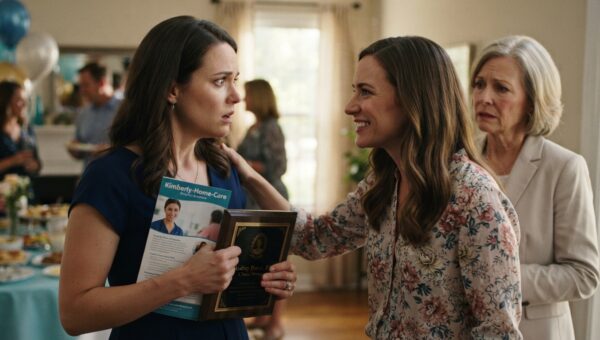
The following Sunday was our aunt June’s seventy-second birthday lunch at the cedar private dining room of Miller’s Tavern on 4th Street. Ten of our relatives were seated around the long pine table, passing bowls of warm rolls and salad.
I kept the transplant center letter folded inside my purse. I thought I finally had my answer, and I was waiting for the right moment between the salad plates and the entrees to set it on the table and clear my name.
Before I could speak, Connie’s husband, Ray, set his fork down with a loud clatter and asked why his own test results were missing from the conversation.
PART 2
Ray sat two chairs down from Connie at the corner of the table. He was fifty-four, a quiet, broad-shouldered man who had worked thirty years as an estimator for a commercial glass company. For fourteen years of marriage, Ray had barely said ten sentences at any family gathering. He usually sat with his hands folded in his lap, letting Connie run the conversations, order his food, and answer for him whenever anyone asked about their home.
When Ray spoke, the table went dead still.
Aunt June stopped with her butter knife poised over a hot roll. Cousin Greg paused mid-sentence.
Connie’s hand jerked against the tablecloth, knocking over an empty water glass. “Ray, honey, don’t start,” she said quickly, her voice high and tight. “This lunch is for Aunt June. We don’t need to discuss our private medical business over dinner.”
“No, Connie,” Ray said. His voice was not loud, but it was steady, scraping across the quiet room like coarse sandpaper. “Brenda has sat here for forty minutes while your cousins look at her like she’s a stranger. It is time we talked about tests.”
I reached into my handbag, pulled out the white university transplant envelope, and laid it flat on the wood between my bread plate and Aunt June’s water glass.
“I was tested on November 28th, Aunt June,” I said, looking across the table at my aunt. “The transplant board sent the final panel on December 12th. My antibodies would destroy Connie’s graft within twenty minutes of perfusion. The surgical team disqualified me by law.”
Aunt June took her reading glasses from her pocket, unfolded the paper, and read the clinic stamp. Her mouth pressed into a thin line, and her eyes flicked toward Connie.
“You told me Brenda refused to go to the clinic, Connie,” Aunt June said.
Connie’s neck flushed dark red. She pulled her cardigan tight around her chest, looking around the table for an ally.
“It’s technical jargon, Aunt June!” Connie said, her voice rising into that defensive scold she used whenever she was cornered. “The doctor said there are paired exchange programs where an incompatible donor gives a kidney to a stranger so their loved one moves up the list! Brenda didn’t offer to enter the donor swap pool! She just walked away!”
“The paired exchange requires a healthy kidney from an eligible donor, Connie,” Ray said, turning in his chair to face his wife. “Brenda has a history of childhood nephritis. Her glomerular filtration rate is sixty-eight. The hospital told you in December that they would never harvest an organ from her because it would put her in renal failure within ten years. You knew that.”
Connie’s mouth snapped shut. She stared at Ray with pure disbelief.
“How do you know her filtration rate, Ray?” Connie whispered.
“Because I went down to the hospital records department on Thursday,” Ray said. He pulled a folded manila file from the breast pocket of his dark blazer. “I went down there to ask why my name had been marked as an absolute refusal on your recipient intake file.”
Ray laid the manila file on the table right beside my letter.
“I told you back in November that I wanted to be tested first, Connie,” Ray said, his eyes locking onto his wife. “I am your husband. I am an O-positive blood type. I don’t have high blood pressure, and I don’t have diabetes. But every time I brought it up, you told me the coordinator said spouses rarely match. You told me the doctor said family blood was the only safe bet.”
Ray tapped the hospital intake form with a thick, calloused finger.
“The hospital coordinator never said that,” Ray said. “The coordinator noted on November 15th that the patient, Connie Vance, stated her spouse had severe preexisting cardiovascular contraindications and could not be evaluated. You lied to the hospital to keep me from ever stepping into that lab.”
PART 3
The dining room stayed completely silent. One of the servers came through the swinging kitchen doors with a tray of roasted chicken, saw the tension in the room, and stepped backward into the hallway without setting a plate down.
“Why, Connie?” Ray asked.
He didn’t yell. The absence of shouting made the question heavier than any insult.
Connie looked down at her lap, her fingers twisting her cloth napkin into tight knots. The polished, tragic composure she had worn into the tavern was entirely stripped away.
“You’re fifty-four, Ray,” she whispered, her voice cracking. “You have six years until your full union pension vests. If you go through major abdominal surgery and have a complication, you could lose your field rating. You could be put on disability.”
“That’s not why, Connie,” Ray said.
Connie didn’t answer.
“Tell them,” Ray said. “Or I will read the second note from the social worker’s file.”
“Ray, please,” she begged, looking up with tears spilling over her mascara. “Not here. Not in front of everyone.”
“You dragged Brenda’s name through the mud in front of everyone,” Ray told her. “You told sixty people in this town that your sister was heartless, just so nobody would ask why your husband was still walking around with two good kidneys.”
Ray opened the manila folder and read the handwritten social work assessment from the transplant registry:
*Patient expresses extreme resistance to living donor evaluation for spouse. Patient states spouse carries primary life insurance and disability income essential to household mortgage maintenance. Patient prefers deceased donor list or sibling living donor to avoid any reduction in household primary earning capacity.*
I sat in my chair with my hands resting flat on the table, feeling the cold weight of what my sister had done.
Connie hadn’t been worried about Ray’s health. She had been calculating our utility.
Ray was the paycheck that kept her split-level house on the golf course running. If Ray underwent major surgery and suffered an extended recovery or a complication, their household cash flow would take a hit. But I was an unmarried fifth-grade teacher with no children and a paid-off bungalow. In Connie’s mind, my body, my career, and my safety were expendable commodities she could draft to protect her household assets.
And when my medical tests showed that my own kidneys weren’t strong enough to be harvested, she couldn’t admit it to the family. To admit that I was disqualified would force our relatives to look at Ray and ask why he hadn’t stepped up to the plate.
So she invented the lie. She turned her sister into a villain to keep her husband’s earning power safe and her social standing spotless.
Aunt June pushed her plate away. She didn’t look at Connie. She reached across the tablecloth, picked up my medical letter, and slipped it back into my handbag with a hand that was trembling with shame.
“I am sorry, Brenda,” Aunt June said softly. “I should have known better than to listen to gossip without asking you first.”
Cousin Greg cleared his throat, his face dark with embarrassment. He stood up from the table, threw a twenty-dollar bill down for the lunch bill, and walked out of the room without looking at Connie once.
Connie buried her face in her hands, weeping loudly into her napkin. But nobody at that table moved to comfort her. The performance had played out, and the curtain had come crashing down on the bare boards.
Ray stood up from his chair. He didn’t pick up his coat from the back of the seat. He looked at Connie, then over at me.
“I’m going to the clinic tomorrow morning, Brenda,” Ray said quietly. “I’m having my cross-match panel drawn at eight o’clock. Whatever happens with her treatment, I am going to see it through like an honest man.”
He gave me a brief, respectful nod, turned on his heel, and walked out into the tavern lobby.
ENDING
Ray went to the university medical center the next morning.
Two weeks later, the lab results confirmed that Ray was a five-out-of-six antigen match for his wife. The living donor committee approved him for direct donation, and the transplant surgery was scheduled for mid-April.
Ray gave his left kidney to Connie on a rainy Tuesday morning.
The surgery went smoothly. Connie’s body accepted the graft, her creatinine levels dropped to normal within forty-eight hours, and she was discharged home six days later to recover in her split-level house. Ray spent four weeks resting at home before returning to his estimating desk at the glass company on light duty, his pension and his health intact.
I didn’t go to the hospital during their recovery.
I sent a potted green peace lily to their house with a card wishing them both a swift healing, signed simply with my name.
A week after she came home, Connie tried to call me. She left a three-minute voicemail, crying, saying that she had been under terrible stress, that the fear of dying on dialysis had made her lose her mind, and that sisters are supposed to forgive everything.
I listened to the message once while standing at my kitchen sink. Then I deleted it.
There are some apologies that are real confessions, and there are some that are just the sound of someone who is miserable because they got caught. Connie didn’t regret what she had done to my reputation; she regretted that Ray had opened that folder in front of Aunt June.
Our family changed after that Sunday at Miller’s Tavern.
Aunt June called me every Sunday morning for six months, checking in on my school projects and inviting me down to Ohio for the summer holidays. The quiet, dismissive glances from my cousins stopped completely. When we gathered for Thanksgiving at my house last fall, Connie wasn’t there. Ray attended for forty-five minutes, bringing a pecan pie from a local bakery, staying long enough to drink a cup of black coffee with me on the back porch while the kids played touch football in the yard.
He didn’t complain about his marriage, and I didn’t pry. Ray had done his duty as a husband, and he carried himself with the quiet dignity of a man whose conscience was entirely clean.
Yesterday afternoon, I was cleaning out my desk drawers in the den, sorting through old lesson plans and medical receipts for my annual tax filing.
Tucked into the bottom of the folder was that certified white letter from the university transplant center, dated December 12th.
I picked it up, looking at the faded ink and the official state embossed seal along the bottom edge. For a long time, I had kept it close because I felt like I needed a shield to prove to the world that I wasn’t the selfish sister Connie had painted.
I stood there in the quiet afternoon light, looking at the words *incompatible donor*.
I didn’t need the shield anymore. The truth was out in the open, the people who mattered knew who I was, and I didn’t owe anyone an explanation for surviving.
I folded the paper in half, dropped it into the small metal wastebasket beside my desk, and walked into the kitchen to start dinner.