The frost on the windshield was thick enough that morning to use the scraper instead of just the warm defroster. Raymond was already out there on the gravel drive with his old blue scraper before the coffee pot had even finished gurgling its last drop into the glass carafe. I watched him from the kitchen window, his shoulders rounded beneath his heavy wool coat, his hands moving with that slow, steady rhythm he had kept up for thirty-eight years.
He did it every Saturday without being asked, winter after winter, like a man tending to an altar.
When he came back inside, stamping his boots on the rubber mat by the back door, I handed him a mug without looking up. I had lived with him long enough to know the exact weight of his footsteps on the linoleum, the way he set his keys on the little oak shelf by the pantry, the quiet hum he made when the house was too still. We had built a life out of those small, predictable pieces. There were no grand surprises left between us, or so I kept telling myself while the morning news murmured softly from the little radio on the counter.
It was when I was looking for the spare packet of heavy-duty needles for the mending basket that I found the calendar. Raymond kept his socks in the bottom drawer of the oak bureau in our back bedroom, neatly rolled into tight balls the way his mother had taught him half a century ago.
Tucked beneath three pairs of gray wool socks that hadn’t seen a winter boot in years was a feed-store calendar from three counties over. It was strange right off the bat because we lived right in town and never owned so much as a stray hen, let alone livestock that needed grain from a place forty miles away.
I pulled it out, half expecting to find old seed receipts or maybe some rebate slips for fertilizer we never bought. Instead, a series of folded slips came loose from behind the month of July. Veterinary invoices. Each one was made out on crisp, pale green paper with a faded logo for a rural animal hospital out past the county line. The total came to $3,960 spread out over three years of monthly installments, all paid out in cash or cashier’s checks signed in Raymond’s neat, unhurried hand.
My hands felt cold holding that paper. Thirty-eight years of knowing a man, or thinking I did, and here was an entire life tucked behind the wool socks that had nothing to do with me, our mortgage, or the quiet retirement we had planned down to the last penny.
I didn’t yell or storm into the hallway. I just put the calendar back where I found it, slid the most recent invoice beneath his supper plate on the oilcloth table, and waited for six o’clock to roll around.
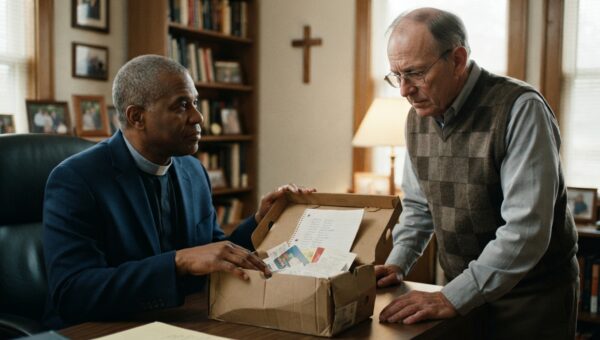
The stew was hot and thick, smelling of carrots and rosemary, but neither of us touched our plates right away. Raymond sat down, took off his glasses to wipe them on his napkin, and then he saw the green paper sitting right there beneath his fork. He didn’t jump. He didn’t ask what it was doing out of the drawer. He just looked at it for a long, quiet minute while the grandfather clock in the hall ticked off the seconds like small drops of water hitting stone.
“Please don’t make this ugly,” he said.
Those five words did something to me that thirty-eight years of quiet marriage never prepared me for.
My jaw tightened until my teeth ached, the muscles in my neck locking up like wire pulled through a winch. I didn’t raise my voice because my throat had gone too dry for shouting, but the silence between us felt heavy enough to crack the timber in the floorboards. I asked him if Marla was a woman, and the way he looked at me then told me everything I was afraid to hear.
He nodded once, slow and miserable, and the last illusion I had about the man across the table simply dissolved. He didn’t try to lie or make up some story about a stray dog or a neighbor’s farm. He just reached into his back pocket with fingers that looked suddenly clumsy and pulled out a worn leather wallet, the edges soft and frayed from decades of being rubbed against denim. From the secret inner fold, he drew out a small piece of lined notebook paper, folded into a tiny square so many times the creases were practically worn through.
“She’s not what you think,” he said, his voice dropping down to that gravelly whisper he used when he was talking about something he couldn’t fix. “She never was.”
He laid the note down beside the stew bowl, smoothing it out with his thumb. The ink had faded to a pale purple over what looked like a very long time, the handwriting slanted and jagged like someone writing while the vehicle was moving. I didn’t want to touch it, but my fingers moved on their own, sliding the paper across the oilcloth toward my side of the table.
The top line caught my eye immediately, the words stark and unsettling under the yellow light of the hanging lamp. Raymond, if your wife ever finds out, tell her I was the woman who lived with the ghost you left behind on the old River Road.
I had to read it twice because the letters didn’t seem to belong to any language I knew, even though every word was plain English. My brain stalled out on the sentence, refusing to stitch the pieces together into something that made sense of our kitchen, our Saturday mornings, and the man sitting across from me who still scraped the ice off my windshield. Raymond didn’t look at me while I read; he kept his eyes fixed on his empty water glass, his thumbs hooked together in his lap.
Forty years ago, long before we ever met at the county fair or shared a cup of coffee at the diner, Raymond was a boy with a loud truck and a head full of nothing much. It was late November, the first real freeze of the year, when the gravel on River Road turned to grease under a skim of sleet. He had taken a curve too fast, the headlights catching a young woman on a bay mare just as the horse bolted from the ditch. There was a sound of splintering wood and a scream that got cut off by the wind, and then Raymond had panicked. He didn’t stop to check the girl or the animal. He hit the gas, drove straight home to his father’s barn, and spent the next three days pretending nothing had happened while the local paper ran a short, two-paragraph item about a hit-and-run on the county line that left a nineteen-year-old girl with a shattered hip and a crippled horse.
The girl was Marla. She never found him back then because the snow had covered the tire tracks before the sheriff could get out with a plaster kit. She spent her twenties in braces and her thirties learning how to run a broken-down rescue on five acres of clay soil, taking in every limping, unwanted animal she could find because she knew what it felt like to be left in the ditch. Three years ago, she found him through an old insurance ledger her father had kept in a trunk, and she didn’t call the police or come looking for blood. She simply sent a letter to his hardware store with a picture of the old barn where it happened and a single line asking if he remembered the price of running away.
Raymond hadn’t slept right since the day that letter arrived in the mail. He didn’t tell me because he was terrified that the good, quiet life we had built would turn to ash if I knew what kind of coward he had been before he ever learned to love me. The $3,960 wasn’t hush money; it was every spare dollar he could skim from his truck repair jobs and his small pension, sent through the feed store so my name wouldn’t ever touch the ledger, paying for the winter hay and the vet bills for animals that had no business surviving the cold.
“I couldn’t undo it,” he whispered, staring down at the grain of the wooden table. “Every time I scraped your windshield, I kept thinking about her out there in the dark with that horse. I had to send something. I had to pay on the debt.”
The kitchen stayed quiet for a long time, the hum of the refrigerator filling the space where our marriage used to sit. I looked at the note again, at the way Marla’s handwriting ended with a simple sentence telling him that the ledger was balanced and he could finally stop hiding in his own house. She wasn’t asking for more, and she wasn’t looking for a fight. She was just tired, the same way Raymond was tired, both of them carrying the weight of a Tuesday night in November that happened before we were even old enough to vote.
I didn’t pack a bag. I didn’t scream or throw his coffee mug against the wall, though part of me wanted to find something heavy enough to break the stillness. Instead, I stood up, cleared his untouched bowl from the table, and walked over to the calendar hanging by the pantry. I took it down from the little brass nail where he had hidden it behind the spare dish towels.
“Get your coat,” I said.
The drive out to Marla’s place took forty-five minutes on roads that got narrower and darker the further we got from town. Raymond didn’t talk the whole way, his hands resting flat on his knees like he was sitting in a waiting room, waiting for a doctor to give him bad news. The rescue wasn’t much to look at from the road, just a sagging pole barn with a corrugated tin roof that rattled in the wind and a few rusted stock tanks turned into water troughs for three old horses and a dozen goats with bad legs.
Marla met us by the gate with a lantern in her hand, her hair cropped short and silver, walking with that uneven hitch in her left hip that told the whole story without needing a single word from the police reports. She looked at Raymond, then at me standing beside him in the gravel, and she didn’t look surprised to see us at all.
“You brought her,” Marla said, her voice dry as corn husks in January.
“I did,” I said, stepping past Raymond into the circle of yellow light. “And we brought the truck.”
We stayed for two hours, helping her haul fresh straw into the stalls and filling the water buckets that had started to skim over with ice in the wind. Raymond didn’t try to hide who he was anymore; he took off his good jacket, rolled up his sleeves, and went to work on the latch of the feed gate that had been dragging in the mud for years. I watched him from the doorway of the barn, working beside the woman he had wronged forty years ago, both of them moving with that slow, deliberate care of people who had finally put down a heavy load.
We didn’t talk much on the way home either, but the silence felt different this time. It wasn’t the silence of a secret kept in a sock drawer; it was just the quiet of two people who had nothing left to hide from each other in the dark.
The next morning, Saturday came around just like it always did, with the gray light creeping over the rooftops and the temperature dropping down below freezing while we slept. I woke up before the alarm, listening for the familiar scrape of metal against glass out on the drive. When I got out of bed and walked into the kitchen, the feed-store calendar wasn’t hidden away anymore. I had taken a small brass tack and hung it right beside the pantry door where we kept the grocery lists and the vet appointments for our own old dog, with our shared dates written openly in the margins right next to the upcoming bills for the winter hay.