PART 1
Two days before my wedding, my mother called my cell phone to say she would not come because she could not sit beside my stepfather’s new wife.
I was sitting on the carpet of our rented apartment with twenty-four place cards spread out over the coffee table, trying to make room for eighty-five guests. The chapel ceremony was on Saturday at two o’clock.
My fiance, Mark, was out picking up the rented folding chairs for the hall.
“Claire, I cannot do it,” my mother, Evelyn, said through the phone. Her voice had that brittle, clipped pitch she always used when she was getting ready to dig her heels into the dirt. “You have Marcus and that woman listed on the second pew. I gave sixteen years of my life to that man before he walked away to buy a motorboat and marry his dental hygienist. If I have to walk past Brenda smelling her lavender lotion, my stomach will turn over in front of the whole town.”
Marcus was my stepfather. He had married my mother when I was seven, paid my dental bills, taught me how to parallel park our station wagon, and walked me through my high school geometry homework. When they split up four years ago, it was messy and loud, but Marcus had never stopped calling to check on me, and he had paid $1,800 for the wedding photographer without asking for a dime back.
I was thirty-one years old. My mother and I had spent the last four years having careful, stiff lunches at the diner near the county courthouse, trying to rebuild a bridge that had rotted down to the pilings. Every time we got close to normal conversation, Marcus’s name would come up like a wall of wet mud.
“Mom,” I said, rubbing the space between my eyebrows with my thumb. “You don’t have to sit on the same side. Brenda and Marcus can sit on the groom’s side in the third row. You can have the entire first pew on the bride’s side all to yourself.”
“People will count the empty feet, Claire,” she snapped. “They will whisper that Marcus was invited as family while his new bride sits in the family section, and they will look at me like the leftover piece. I won’t put myself on display for their pity.”
I was hurt, but I didn’t want a seating chart to end the relationship we had been trying to repair for four long years.
“I’ll save you a chair near the back, Mom,” I told her, keeping my voice as quiet as I could. “Right beside the double doors in row eight. You can slip in after the mothers are seated, see me walk down the aisle, and leave before the receiving line starts. Nobody has to whisper. Just be there.”
She didn’t promise. She let out a long, dry breath, said her arthritis was acting up from the damp weather, and clicked off.
Saturday morning arrived gray and cold, with a sharp November wind blowing dead leaves across the chapel steps.
At one-forty-five, I stood in the small bridal parlor behind the altar in my ivory lace dress. My best friend and maid of honor, Sarah, was pinning my grandmother’s veil into my hair with two bobby pins.
Through the crack in the door, I watched the guests trickle into the sanctuary. Marcus and Brenda took their seats on the third row, Marcus in his dark charcoal suit, Brenda quiet with her hands in her lap.
I kept my eyes on the eighth row by the back double doors.
The wooden folding chair stayed completely empty. Two minutes before two o’clock, the ushers pulled the outer oak doors shut. The chair was still bare.
My throat burned. I swallowed the lump, took a slow breath of the dusty chapel air, and took my bouquet of white roses from the table. I told myself it was fine. I told myself my mother was seventy-one, stubborn, and that some wounds never close up enough to let light through.
The church organ began the slow chords of the processional.
Sarah straightened my train, smoothed down her green satin dress, and turned to take her place in the aisle.
Just as the chapel double doors began to swing wide for my entrance, the venue coordinator, an older woman named Mrs. Gable, rushed up the side hallway holding a small, flat cardboard jewelry box wrapped in brown butcher paper.
Mrs. Gable caught Sarah’s elbow and pushed the box into her hands.
“Your mother left this at the front registration desk forty minutes ago,” Mrs. Gable whispered, her eyes wide behind her glasses. “She said she couldn’t stay for the music. She said it had to be in Claire’s hands before she took her first step.”
Sarah turned and handed the parcel to me.
The butcher paper was taped with yellowed cellophane tape. On the front, my name was written in my mother’s small, tight pencil script: *For Claire, at the altar.*
I pulled the tape away.
Inside the small cardboard box, nestled on a square of yellowed cotton batting, was something from my childhood I thought had burned in our house fire twenty-two years ago.
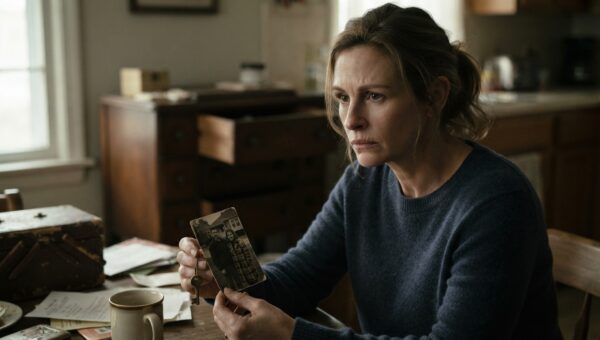
It was a small, tarnished silver charm shaped like an open book, with the initials *C.E.* engraved on the cover. Tucked beneath the cotton was a folded piece of lined stationery from my mother’s kitchen drawer.
The note had three short sentences, ending with words I had never heard her say in my entire life.
PART 2
The handwriting on the yellow stationery was shaky, pressed so hard into the paper that the pencil lead had left ridges on the back.
*I bought this for you in 1999 so you would remember that a daughter never owes her parents an explanation for growing up. Marcus did not buy the photographer; I sent him the cash through his sister so your pride wouldn’t get bruised. I am sorry for every room I made too small for you.*
I stood behind the closed side door of the chapel, staring at the little silver charm resting on the yellow cotton.
In 1999, when I was eight years old, our wood-frame house on Route 4 had burned down to the stone foundation on a freezing night in January. We lost everything: our winter coats, my school scrapbooks, and the cedar chest my grandfather had built. For twenty-two years, my mother had told me that every keepsake from my early childhood had gone up in smoke that night.
Whenever I asked about the little silver charm bracelet my grandmother had given me, my mother would look out the window and say the fire had cleared the slate clean, and that looking for ashes only brought bad luck.
Now, holding the tarnished silver book in my palm, I remembered the afternoon Marcus had walked into my apartment in August to hand me the photographer’s receipt.
He had handed me a white business envelope containing a paid slip for $1,800 from a commercial studio downtown. He had leaned against my refrigerator, clapped his hands together, and told me he wanted to make sure my big day was captured right, like any good father would. He had let me hug him, let me cry against his wool vest, and let me thank him for carrying the cost while my mother was refusing to return my calls.
My mother hadn’t refused to help.
She had given her ex-husband eighteen hundred dollars through his sister, allowing Marcus to play the generous patriarch while she stayed home in her four-room house counting her social security check.
“Claire,” Sarah whispered, touching my shoulder. “The organist is on the second verse. The guests are standing.”
Through the frosted glass panel of the double doors, I could see the heads of eighty-five people turned toward the aisle. Mark was standing at the altar in his black tuxedo, looking down the red carpet toward the doors with his hands clasped in front of him.
And on the third row, on the groom’s side, Marcus sat with his arm resting on the back of the pew, smiling like a man who owned the room.
My legs felt heavy under the layers of tulle, but the fog in my head was completely gone.
“Give me thirty seconds, Sarah,” I said.
I didn’t hand the box back to Mrs. Gable. I closed the cardboard lid, held the small box tight against the stems of my white roses, and nodded to the coordinator.
“Open the doors,” I said.
The heavy oak doors swung back.
The chapel was warm and smelled of beeswax candles and lilies. When I took my first step onto the red carpet runner, the eighty-five people in the pews rose to their feet.
I didn’t look at the flowers on the altar rail. I didn’t look at the stained-glass window over the pulpit.
As I walked down the center aisle, my eyes moved to the third pew on the right.
Marcus caught my eye. His chest swelled, his head tilted back with that familiar, easy warmth he used whenever he wanted people to notice him, and he gave me a slow, proud nod, expecting me to smile back at the man who had paid for the pictures.
I didn’t smile.
I stopped walking right at the end of the third pew.
The organ music faltered for half a beat. The minister at the front looked up from his black leather book, his eyebrows drawing together. Mark took a step forward from the altar, his eyes darting between me and the pews.
The chapel went completely silent, the kind of quiet where you can hear the radiator clanking against the baseboard in the back corner.
PART 3
Marcus looked confused. The easy smile stayed on his face, but his eyes narrowed slightly as I turned my body toward his pew.
“Claire?” Marcus whispered, leaning forward over the wooden rail. “Honey, you’re supposed to keep going to the rail.”
I didn’t answer him with a speech.
I reached down into my bouquet, took the small brown paper box from between the rose stems, and laid it flat on the wooden hymnal rack right in front of his chest.
Tucked under the yellow twine was the folded note from my mother’s kitchen stationery.
“Give that to your sister, Marcus,” I said. My voice wasn’t loud, but in that small, plaster-walled chapel, every single person in the first six rows heard every syllable. “Tell her my mother’s eighteen hundred dollars is paid in full.”
Brenda’s head snapped up. Her mouth parted, her eyes darting from the brown box to her husband’s neck.
Marcus’s face went from pale to a dull, mottled brick red. His hand reached out instinctively toward the box, but his fingers froze three inches from the cardboard, trembling against the dark wood of the pew.
“Claire, this isn’t the time,” he stammered, his voice dropping into a tight, desperate hiss. “People are watching. Let’s talk about this at the reception.”
“There won’t be a conversation at the reception, Marcus,” I said.
I looked at Brenda, who had pulled her handbag tight against her ribs, her face completely drained of color.
“My mother stayed in her house today because you told her you would cause a scene if she sat in the front row,” I told him, looking straight into his eyes. “You took her money, took the credit in my kitchen, and let me think she didn’t care enough to buy a card.”
Marcus opened his mouth, but nothing came out. The polished charm that had carried him through two marriages and twenty years of sales calls simply dissolved. He looked around at the faces in the pews across the aisle, where my cousins and aunts were staring at him with cold, hard eyes.
I didn’t wait for him to find another lie.
I turned back to the center aisle, gathered my lace train in my left hand, and walked the remaining twenty feet to the altar steps.
Mark didn’t ask a single question.
When I reached the bottom step, he stepped down onto the carpet, took both of my cold hands in his warm ones, and looked down into my face with steady, quiet understanding.
“You okay?” he whispered.
“I am now,” I told him.
The minister cleared his throat, raised his hands over the pulpit, and began the opening prayer.
We said our vows before our friends and neighbors under the soft yellow light of the altar candles. We exchanged our simple gold bands, signed the parish registry on the vestry table, and turned to face the congregation as husband and wife.
When we walked back down the center aisle, the third pew on the right was completely empty. Marcus and Brenda had slipped out through the side fire exit before the rings had even been blessed, their folding programs left crumpled on the red carpet.
We didn’t go straight to the reception hall for the roast beef dinner.
I stood in the chapel vestibule, unpinned the heavy lace veil from my hair, and handed it to Sarah.
“Take the wedding party over to the hall,” I told Mark. “Tell the caterer to start the appetizers. I have to make a stop.”
Mark looked at my white dress, then at the gray drizzle beginning to tap against the glass doors.
“I’m driving you,” Mark said, taking his keys from his trouser pocket.
ENDING
We drove four miles down the county road to the small gray shingle house where my mother had lived alone since the divorce.
The silver Buick was parked in the narrow gravel drive. The front porch light was off, and the yellow floral curtains in the front room were drawn tight against the afternoon gloom.
I climbed out of the car, lifting my ivory hem out of the damp gravel with both hands, and walked up the three wooden steps. Mark stayed by the car, leaning against the fender with his hands in his pockets, giving me the space I needed.
I didn’t knock politely. I opened the aluminum storm door and knocked hard three times on the wood.
The door opened two inches on the safety chain.
My mother looked out through the gap. She was wearing her old gray housecoat over her clothes, her hair uncombed, her eyes swollen and red from hours of crying in the dark.
When she saw me standing on her porch in my full wedding dress with rain mist clinging to my lace sleeves, she gasped, her hand flying to her throat.
“Claire?” she whispered, her voice cracking. “What happened? Did something go wrong with Mark?”
“Unlatch the door, Mom,” I said softly.
The chain rattled against the jamb. The door swung open.
The house smelled of peppermint tea and old newspapers. I walked into her small front hallway, the satin of my dress rustling against her low boot bench.
She stood back against the wall, clutching the collar of her robe, looking down at my muddy shoes with an expression of pure, terrified shame.
“I ruined it, didn’t I?” she wept, the tears spilling over the deep lines on her cheeks. “I should have just sat in the back chair. I couldn’t bear to see him look at me like that, Claire. I’m just an old, bitter woman who couldn’t keep her pride in her pocket.”
I reached into my small satin evening purse, pulled out the little tarnished silver book charm, and held it out in the palm of my hand.
“How did you save it from the fire, Mom?” I asked.
She looked at the little silver book. Her shoulders hitched, her breath coming in ragged, uneven sobs.
“I had it in my coat pocket,” she whispered. “The night the furnace blew up in the basement, I grabbed your coat from the hook by the kitchen door. The charm was in the little zip pocket where you used to hide your hair ribbons. I carried it in my purse for twenty-two years. I wanted to give it to you when you graduated college, but Marcus told me it would just remind you of being poor.”
She covered her face with both hands, her thin body shaking under the velour robe.
“He took eighteen hundred dollars from you,” I said, stepping closer.
“I didn’t want you to have to borrow from the bank,” she choked out into her fingers. “I knew your credit was tight after Mark’s truck broke down in the spring. Marcus told me that if I gave him the money, he would pretend it came from his contractor bonus so you wouldn’t feel bad about taking it from my pension.”
I didn’t lecture her about the four years of silence. I didn’t scold her for the cold phone calls or the pride that had kept her from sitting in that empty chair by the double doors.
I reached out, pulled her hands away from her face, and wrapped my arms around her narrow shoulders.
The wet lace of my sleeve pressed against her wool robe. She stiffened for a second, startled by the touch, and then she collapsed against my chest, burying her face into my shoulder just like she used to do when the wind was too cold on our walk home from the bus stop.
“Go get your navy blue suit from the closet, Mom,” I told her, resting my chin against her gray hair.
She pulled back, blinking through her tears. “Claire, the reception… everybody will know I skipped the church.”
“Nobody cares about the church, Mom,” I said, wiping a tear from her cheek with the edge of my thumb. “Marcus is gone. Brenda is gone. The head table has eight chairs, and the one right next to me is empty.”
She stood there for five seconds, looking at my white dress, then looked down at the little silver charm in my hand.
“Give me ten minutes,” she whispered, her voice finally steadying. “Let me find my good shoes.”
Twenty minutes later, we pulled into the gravel lot of the reception hall.
When Mark opened the passenger door and helped my mother out into the light of the entryway lanterns, my aunts and uncles were standing by the coat rack with their punch cups.
Nobody asked a single question about where she had been. Aunt Evelyn walked over, took my mother’s wool coat, and handed her a glass of ginger ale with a small, knowing smile.
We danced our first dance under the string lights in the center of the wooden floorboards.
When the dinner was served, my mother sat on my left side, eating her roast beef off the white china plate, her posture straight and her shoulders back. Every time someone came up to the head table to offer a toast, she held her head high and smiled like a woman who had finally stepped out of a cold room into the sun.
Yesterday was Sunday.
Mark and I were packing our suitcases for our three-day trip up to the mountain cabin.
I stood by our bedroom dresser, looking down at my jewelry tray. Resting in the center of the velvet dish was that little silver charm, polished clean with a dab of toothpaste until the engraving shone like new.
I picked it up, looped it onto my gold neck chain, and fastened the small clasp behind my neck.
The silver felt cool against my skin.
I looked at my face in the mirror, adjusted the little pendant so it rested right over my collarbone, and walked out to the truck to start our life, carrying thirty-one years of truth right where everyone can see it.