PART 1
My mother came over every Tuesday to help with my twins, even after I told her we had a routine.
My boys, Luke and Ben, were six months old. Anyone who has raised twins knows that keeping them on a strict nursing and nap schedule is the only thing that keeps a house from falling apart. I had charts taped to the kitchen cabinet, labeled bottles lining the refrigerator door, and a three-hour block in the afternoon where the nursery curtains stayed shut.
Mom ignored the charts. She would let herself in through the back mudroom with her spare key, set her canvas tote on the counter, and start warming washcloths or wiping down high chairs that had already been sanitized. She was sixty-seven, a retired county records clerk who had raised three children on an hourly budget, and she carried herself like someone whose practical experience trumped any modern parenting book.
Two weeks ago on a Tuesday, I stepped into the hallway after finishing the laundry. The house was dead quiet.
I walked into the nursery and found Mom in the wooden rocker by the window.
She was holding Ben against her cardigan, rocking him with slow, steady pushes of her slippers against the floorboards. Ben was the twin with severe reflux; he usually screamed with anyone who wasn’t me, arching his back and spitting up his formula within ten minutes. But in Mom’s arms, his cheek was pressed flat against her collarbone, his breathing even and deep.
Mom had her eyes closed. She was humming the soft, low melody she used to sing when I had scarlet fever at seven years old.
I stood in the doorway with my hands gripping the laundry basket. I felt grateful, but beneath the gratitude was that sharp, familiar irritation of feeling like an amateur in my own home.
“Mom,” I said, keeping my voice down. “Why didn’t you call before driving over? We just got them down twenty minutes ago.”
Mom stopped humming. She didn’t open her eyes right away.
“I didn’t want you to think I was asking permission to see my own family, Laura,” she said softly.
That did it. The sleepless nights and the pressure boiled over right there on the rug.
“This isn’t about permission,” I told her. “This is about my life and my house. You can’t just show up and run the clock whenever you feel like it. I have a system.”
Mom didn’t raise her voice. She stood up slowly, laid Ben into his crib on his side, and tucked the yellow muslin blanket around his feet.
She walked past me into the hall without looking at my face, took her purse off the coat peg, and left before four o’clock. She didn’t stay for dinner, and she didn’t take the plastic container of beef stew I had set aside for her.
The next Tuesday arrived, gray and raining.
The clock on the microwave clicked past ten, then eleven, then noon. Her car never turned into the gravel drive.
Around one-thirty, our next-door neighbor, Mrs. Gable, knocked on my side door holding an umbrella and a brown paper grocery sack.
“Laura,” Mrs. Gable said, shaking the water from her raincoat. “Your mother stopped by my driveway about an hour ago. She asked me to bring this over to your porch. She said she didn’t want to disturb the babies’ nap.”
I carried the wet paper bag to the kitchen counter.
Sitting on top were two tiny cardigans knit from cream-colored wool, each with small wooden buttons carved into little acorns. Resting on top of the sweaters was a plain white envelope with my name written in Mom’s careful pencil script.
PART 2
The envelope was unsealed.
I pulled out a single sheet of lined notebook paper. Mom’s handwriting was neat, but the pencil lines were pressed thin and light, as if she had written it while resting the pad on her knee.
“Laura,
I finished the acorns on Ben’s sleeves this morning.
You were right last week. I did not give you enough room to be their mother. When you have watched your own children grow up and walk away into their own lives, you forget that the house belongs to them now, not to you.
I will not come over on Tuesdays anymore. I have some medical appointments scheduled at the university clinic in Columbus over the next couple of months, so my weeks are going to be tied up with travel.
The freezer meals I left in your chest freezer should last through the frost. Keep Ben’s head elevated twenty minutes after he drinks his warm water.
Love, Mom.”
I stood by the kitchen island with the letter in my hand, looking down at the two tiny sweaters.
The wool smelled like her cedar closet and the lavender soap she kept in her linen drawers. The yarn was soft, four-ply baby merino that cost twelve dollars a skein at the specialty craft shop downtown. Mom lived on her county pension of $1,840 a month. She rarely bought herself anything beyond her basic tea and pharmacy copays, yet she had purchased enough high-grade wool to knit matching winter sets.
The sentence about the university clinic stuck in my chest.
Mom lived forty miles east in Dover. If she needed routine blood work or eye checks, she went to Union Hospital five minutes from her brick bungalow. The university clinic in Columbus was two hours west on Interstate 70, where people went for specialized oncology or advanced cardiac evaluations.
I picked up my kitchen phone and dialed her home number.
The telephone rang five times before her answering machine clicked on with her recorded voice, brisk and formal.
I dialed her cell phone. It went straight to voicemail.
I called my older brother, David, who worked as an estimator at a lumber yard in Akron.
“David,” I said as soon as he answered. “Did Mom tell you she was going to Columbus for doctors?”
David was quiet for three seconds on the other end. I could hear the drone of a radial arm saw in the background of his shop.
“Laura,” David said, his voice dropping into that heavy, guarded tone he used when bad news was coming. “Did you read the note she left with Mrs. Gable?”
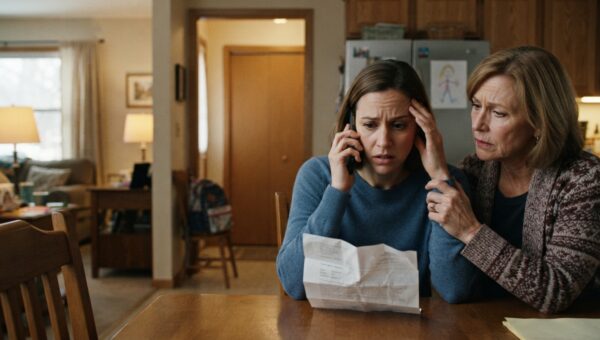
“I have it right here,” I said, my knuckles turning white around the receiver. “She said she was busy with travel.”
“She made me swear not to call you until after her consultation on Thursday,” David muttered. “She didn’t want to stress your milk supply while you were nursing the twins. She had a mass found behind her breastbone during a chest X-ray in August. The local surgeon told her it’s attached to her pericardium, and the clinic in Columbus is doing the needle biopsy tomorrow morning.”
The kitchen floor felt like it had dropped two inches beneath my slippers.
August was two months ago.
For eight weeks, every single Tuesday, she had driven forty miles through the morning fog, walked into my nursery, scrubbed my floors, washed my cloth diapers, and rocked my colicky child, all while carrying an undiagnosed growth against her heart.
And seven days ago, I had stood in the nursery doorway and accused her of invading my space.
PART 3
I didn’t wait for Thursday.
I called my husband, Mark, at the township water department and told him he had to come home to take the boys. He walked through the back door forty minutes later, took one look at the two cream sweaters on the counter, and took the car keys from my hand to put gas in my sedan.
I drove the two hours out to Columbus in a steady autumn downpour, my windshield wipers slapping against the glass.
The James Cancer Hospital was a towering block of brick and reflective glass near the university campus. I walked up to the third-floor outpatient surgical waiting lobby at four o’clock in the afternoon.
The waiting room had blue vinyl chairs, a muted television playing the weather channel, and two families sitting in silence with paper cups of water.
Mom was sitting in the corner by the magazine rack.
She wore her dark navy raincoat over a gray wool skirt, her black handbag held tightly in her lap with both hands. Her hair was pulled back in its usual tortoise clip, but without the distraction of my busy kitchen, she looked smaller than she had a week ago. Her shoulders were curved inward, and the skin beneath her eyes carried a faint, yellow pallor that I had completely missed while I was busy checking my feeding charts.
Beside her chair sat a cardboard take-home tray holding an untouched cup of tea that had long since gone cold.
I walked across the carpet. My boots made no sound on the runner, but as soon as my shadow crossed the floor in front of her, she looked up.
Her fingers tightened around the handle of her purse.
“Laura,” she said. Her voice was cracked, thin, and startled. “What are you doing here? David told you.”
“David told me,” I said.
I didn’t give a speech. I didn’t quote any lines about family.
I dropped my purse on the empty chair beside her, knelt down on the low commercial carpet, and put both of my hands over hers on the leather of her bag.
Her hands were icy cold.
“You should have told me in August, Mom,” I whispered.
Mom looked down at our joined fingers, her chin quivering once before she pulled her lips into that hard, stubborn line she always used when she was trying not to break down in public.
“You had two premature babies who weren’t sleeping three hours together, Laura,” she said, her voice shaking on the consonants. “You were twenty-nine years old, trying to keep your head above water, and Mark was working sixty hours a week on the county mains. What was I supposed to do? Call you up and tell you I had a shadow on a film so you could sit in your rocking chair and cry while you nursed?”
“You were supposed to let me hold you,” I told her, the tears finally running down my cheeks. “Just like you held Ben.”
Mom closed her eyes. Two slow tears slipped from beneath her eyelashes, tracking down the deep lines beside her nose.
“I was so scared, Laura,” she whispered, her fingers opening up and curling around my thumbs. “Every Tuesday when I held that baby against my chest, feeling his heart beating against mine, it was the only two hours all week where I didn’t think about the dark.”
The nurse came through the double doors three minutes later with a metal clipboard, calling Evelyn Miller.
I stood up, helped Mom out of her coat, and walked beside her through the clinic doors into the examination wing.
ENDING
The biopsy was done by six that evening.
The surgical oncologist, Dr. Vance, came out to the consultation room forty minutes later with his glasses in his hand. The mass was a benign thymic cyst that had grown large enough to press against her sternum, causing the shortness of breath she had hidden since mid-summer. It had not invaded her heart tissue, and it did not require radiation or chemotherapy. It needed a simple, scheduled thoracoscopic resection in late November to relieve the pressure, and nothing more.
I drove Mom back to her bungalow in Dover that night through the clearing rain.
We arrived at nine o’clock. I went into her kitchen, made her a pot of decaffeinated black tea, and heated up a bowl of tomato soup from her pantry.
She sat at her small formica kitchen table, wearing her blue housecoat, dipping soda crackers into the broth while the grandfather clock ticked in the hall.
I didn’t go back to my house that night. I slept on the floral hide-a-bed in her den, listening to the quiet settling of the old house where I had grown up.
In the morning, before I left to relieve Mark with the boys, Mom walked me out to my car on the gravel drive.
She held out her hand, offering me her brass key to my house.
“You take this back, Laura,” she said, looking down at the gravel. “You need your routine with the boys. I can call first on the weekends.”
I looked at the brass key resting on her palm.
I reached out, closed her fingers over the metal, and pushed her hand back toward her coat pocket.
“You keep the key, Mom,” I told her, looking straight into her gray eyes. “The boys take their long nap between one and four. But the back door is unlocked from eight in the morning until sundown. If you want to come over and rock Ben, you don’t knock, and you don’t ask.”
Mom looked at me for a long moment, a slow, quiet breath lifting her chest, and gave me one firm nod of her head.
Her surgery took place three weeks before Thanksgiving.
David and I stayed at the hospital until the tube was removed from her side, and by the second week of December, the surgical glue had peeled away and her breathing was deep, easy, and whole.
Yesterday was Tuesday.
The morning was cold and bright, the winter frost white across my front lawn.
At ten o’clock sharp, the gravel in my driveway crunched.
The mudroom door swung open with a familiar squeak. Mom walked into the kitchen wearing her brown winter coat, carrying her canvas tote bag, smelling of cold air and lavender.
She hung her coat on the peg by the door without saying a word, walked into the nursery, and lifted Ben right out of his crib while he was fussing over his teething ring.
She sat down in the wooden rocker by the window, pulled his little blanket over his knees, and began to hum that same old tune.
I stood in the doorway with a stack of folded towels, watching his little eyes grow heavy and quiet against her sweater, knowing that some routines are meant to be broken, and that this house belongs to all of us.