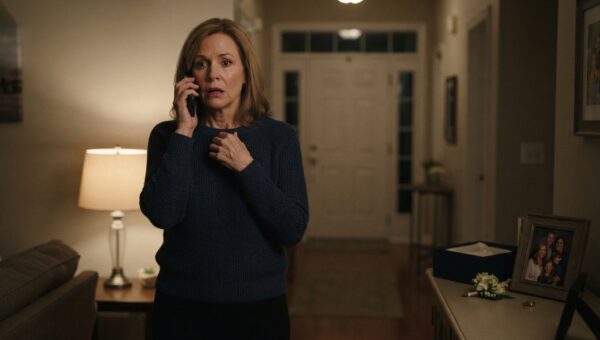
PART 1
Garland passed on the second Tuesday of October, right as the sugar maples in our front yard were turning that deep, bruised red he always loved. We had been married forty-eight years. When you spend almost half a century waking up beside the same quiet man, you think you know the exact weight of his footsteps, the shape of his habits, and every sorrow he ever carried in his chest.
I thought our greatest sorrow was the baby we lost back in November of 1961.
His name was Thomas. I had been twenty years old, exhausted and terrified in a cold county hospital room that smelled of bleach and floor wax. The doctors took him away before they even let me hold him to my breast. The head physician, an older man with gray stubble and ink-stained cuffs, had stood at the foot of my iron bed and spoken in that flat, unyielding tone doctors used back then. He told us the infant had severe brain damage and physical deformities, that he would never walk, never speak, and would not survive to see his fifth birthday. He told Garland it was better not to look, better not to form a bond that would only tear us apart month by month.
I broke completely. I was young, weak from labor, and out of my mind with grief. I remember clutching Garland’s coat, weeping into the wool until my throat tore, begging him to let it be over. I told him I couldn’t bear to watch a baby suffer and die in my arms. I begged him to let me believe our child was simply gone to God so my heart wouldn’t shatter into dust every single morning.
Garland held me while I shook. He kissed the crown of my head, his jaw set tight, and told me he would handle everything. He said he would take care of it so I would never have to carry that pain. Two days later, he came home alone, pale and hollow-eyed, and told me our boy was at peace. We never set up a nursery. We never bought a high chair. For forty-eight years, we were the childless couple on Elm Street. Garland worked thirty-two years at the municipal water department, kept a spotless vegetable patch behind the garage, and walked me to church every Sunday morning.
The funeral was crowded because Garland was a decent, steady man who helped his neighbors without making a fuss. After the graveside service at Oakridge, everyone drifted back to the fellowship hall at Grace Methodist for the repast. The ladies from the auxiliary had set out platters of ham rolls, macaroni salad, and two huge urns of percolator coffee.
I was standing near the sideboard, nodding at condolences I barely heard, my black pumps pinching my heels. My sister Clara was refilling the sugar bowls when an older man I had never seen before shuffled toward me.
He wore a dark blue suit that was clean but hung loose on his narrow shoulders, the trousers hemmed an inch too short over scuffed brown oxfords. He had thick white hair combed straight back with pomade and liver spots across his knuckles. When he reached me, he didn’t offer a polite, two-second squeeze like the other mourners. He took both of my hands into his rough, leathery palms and held on tight.
“Martha,” he said, his voice husky and trembling. “I’m Arthur Vance. I drove down from Blue Ridge. I’m so sorry for your loss. Garland was the finest man I ever met.”
“Thank you, Mr. Vance,” I said gently, trying to be polite while wondering which side of the family he belonged to. “Did you work with Garland at the water board?”
Arthur shook his head. He looked straight into my tired eyes, his own eyes moistening behind thick bifocals.
“No, ma’am,” he said, pressing my cold fingers. “I retired from the state development center up in Watauga County four years ago. I worked the floor in Ward Three. Garland never missed a single month. Rain, sleet, or summer heat, he was there on the first Saturday at nine in the morning. You raised a fine, gentle boy, Martha. You both did.”
The fellowship hall around me seemed to drop into complete, suffocating silence. The clatter of china saucers and the low hum of conversation faded into a dull roar in my ears.
“Excuse me?” I whispered, pulling my hands back an inch. “I think grief has muddled your memory, Mr. Vance. Or you have the wrong family. Garland and I never had children. We lost our only baby sixty-five years ago. We were childless.”
Arthur Vance froze. His jaw dropped slightly, and the warm, sorrowful expression on his weathered face drained away until his skin turned the color of dry paper. He glanced over his shoulder at the room full of mourners, then looked back at me, his eyes wide with sudden, sickening horror.
“Oh, God,” Arthur breathed, his voice dropping to a harsh whisper. “Oh, Lord in heaven. You didn’t know.”
“Know what?” My voice sounded thin, like dry grass snapping under a boot. “What are you talking about?”
Arthur swallowed hard, his Adam’s apple bobbing above his collar. “The state hospital. Garland drove up to Blue Ridge Pine Haven the first Saturday of every single month for over forty years. He came to sit with Tommy. The baby the doctors took in 1961. Martha, he lived. He didn’t pass in five years like they swore. Tommy lived to be forty-seven years old.”
The room tilted violently sideways. My knees gave out beneath my black skirt, my shoulder striking the heavy steel table beside the coffee urn. Coffee sloshed against the chrome rim with a sharp, hollow clang.
Arthur caught me by the elbow with surprising strength, his old hands trembling as he hauled my weight back up and guided me down onto a folding metal chair. Several women turned in alarm, but Arthur shielded me with his body, leaning down close to my ear.
“Breathe, Martha. Just breathe,” he whispered, his own chin shaking. “Garland always brought two paper cups from the diner in town. One for Tommy, and one he set right on the bedside table. Every single month, he’d pull up that vinyl chair, hold that boy’s hand, and tell him, ‘Your mama loves you, Tommy. She’s thinking of you right this minute.'”
PART 2
Clara rushed over with a glass of tap water, but I waved her away with a trembling hand, unable to speak. The breath caught in my windpipe like a dry bone. Forty-seven years. For forty-seven years, my husband had climbed into his pickup truck on the first Saturday of every single month, kissed my cheek at the kitchen door, and told me he was driving out to the county salvage yards to look for tractor parts or going down to the river to fish with his cousin Roy.
Roy had died in 1994, and Garland had kept leaving on those Saturdays. When I asked him why he still went down to the water alone, he had smiled that quiet, tired smile of his and said an old man needed a few hours of quiet woods to keep his head clear.
I looked up at Arthur Vance, whose eyes were wide with deep regret. He stood beside my chair like a man who had dropped a glass pitcher on a church floor and was waiting for the glass to stop skittering.
“I need to talk to you,” I whispered, my voice rattling in my throat. “Not here. Not in front of the church.”
Arthur nodded immediately. Ten minutes later, after Clara made sure I wasn’t having a stroke and agreed to oversee the hall cleanup, Arthur and I walked out the side door of Grace Methodist into the damp October air. We sat together in the front seat of his dusty tan sedan parked beneath the oaks.
“Tell me everything, Arthur,” I said, staring at the scarred dashboard. “Do not spare me a single word.”
Arthur gripped the steering wheel with both hands, staring out at the cemetery fence across the street. He told me that in November of 1961, when the county doctors convinced us our son would not survive infancy, the state still ran closed residential institutions for infants born with profound neurological impairments. The doctors had told Garland that bringing the baby home would destroy our young marriage and drain every cent we would ever earn just to watch him die in an agonizing few months.
Garland had listened to me weeping in that hospital bed, begging to be spared the slow torture of burying an infant. So Garland made the decision alone. He signed the commitment papers for Blue Ridge Pine Haven, a state-run facility two hours north in the foothills. The doctors had filed an administrative death certificate for local hospital records under an old state closure provision, while the child was transferred into ward custody as a ward of the state with private parental support.
Garland never signed away his paternity. He took a second shift at the municipal yard three nights a week during our first ten years of marriage to pay the monthly auxiliary maintenance fee that kept Tommy in private-purchase clothing and soft blankets instead of standard state rough-spun.
“Tommy had severe spastic cerebral palsy and microcephaly,” Arthur said softly, his voice thick with decades of memory. “He couldn’t speak, Martha. His body was twisted, and he spent his life in a high-backed wheelchair or a padded bed. But he wasn’t empty. When Garland walked into Ward Three on those Saturday mornings, Tommy’s face would light up like a kerosene lamp. He knew his daddy’s smell. He knew the sound of Garland’s boots on the linoleum.”
“Why did he keep it from me?” I asked, tears finally breaking hot and heavy down my cheeks. “Why let me live in the dark for almost fifty years? I was his mother.”
“Because of what you told him in that hospital,” Arthur said, turning his head to look at me. “Garland told me about it once, back in the late seventies, while we were sitting out on the facility porch in the sun. Tommy was asleep on his shoulder. Garland said, ‘Arthur, Martha told me her heart would turn to dust if she had to watch this boy suffer. She begged me to let her think he was safe with the Lord. I swore I’d protect her from that pain, even if it meant I had to carry the whole weight on my own back until the day I died.'”
My hand went to my mouth to stifle a scream that tore through my chest. For forty-eight years, I had mourned a ghost, while my husband had driven two hours each way through mountain fog, sitting beside an iron bed, stroking our son’s forehead, carrying the entire crushing burden of that boy’s existence on his solitary shoulders so that I could live in peace.
“Tommy passed in the spring of 2008,” Arthur continued quietly. “He caught pneumonia. It happened fast. Garland was there at the end. He held Tommy’s hand until the heart monitor went flat. Garland bought a plot up there in the facility’s hillside memorial garden. He put a small granite marker down. It just says: Thomas Cole. Beloved Son of Garland and Martha.”
Hearing my own name on that stone broke something deep inside my ribs. I had not been there. I had not held him. I had spent that Saturday in April of 2008 planting petunias along the walkway, wondering why Garland was running late coming home from his drive.
PART 3
When Arthur finished talking, he reached into his breast pocket and pulled out a small, worn brass key attached to a faded green plastic tag. He laid it gently in my palm.
“Before Garland got too sick this past summer,” Arthur said, “he called me. He knew his heart was failing. He asked me if I would come down to the funeral just to see how you were doing. He told me there was a tin trunk on the high shelf above his workbench in the garage. He said, ‘If anything happens to me, Arthur, make sure Martha gets the trunk if she finds out. But if she doesn’t know, let her keep her peace.’ But when I saw you today, Martha, looking so lost, I couldn’t keep my tongue still. It wasn’t right for you to go to your grave thinking you were alone.”
I took the key. My fingers curled around the cold brass until the edges bit into my skin.
I thanked Arthur, got out of his car, and drove myself home to the empty house on Elm Street. The silence in the kitchen was unbearable. Garland’s clean coffee mug was still upside down on the drying mat beside the sink. His work jacket hung on the peg by the back door, smelling of cedar shavings and aftershave.
I walked straight out into the garage. The air smelled of motor oil and fertilizer. In the far corner, above his heavy oak workbench, sat the high shelf where he kept old paint cans and spare spark plugs. Tucked behind a stack of weathered peach crates was a gray metal lockbox, about the size of a breadbox, coated in decades of fine sawdust.
I dragged his step stool over, climbed up with trembling knees, and brought the box down to the workbench. My hands shook so badly that it took three tries to slide the small brass key into the lock.
The lock clicked open.
Inside lay forty-seven years of a hidden life.
There was a stack of small, square spiral notebooks, twenty-two in all, tied neatly with postal twine. Beside them lay a thick manila envelope crammed with carbon receipts from the state hospital dating back to 1962, every single twenty-dollar money order accounted for, clipped to monthly balance sheets.
I untied the first notebook, dated 1961 to 1965. The handwriting was Garland’s, neat and firm, written in blue ballpoint ink.
*November 4, 1961. Took Tommy to Pine Haven. Doctor Evans says his vitals are stable. He has Martha’s chin and her fine hair. Held him for two hours. He cried when I set him down, so I picked him back up until he fell asleep against my chest. Lord, forgive me for lying to my wife. She could not take this. I will take it for her.*
*August 4, 1964. First Saturday. Tommy weighs twenty-four pounds now. He smiled when I rubbed his ear. I bought two coffees at the Texaco on Route 16. Drank mine and let the steam warm his room. Told him Martha made peach cobbler yesterday and that she would have loved the way his eyes catch the light.*
I sat down on Garland’s wooden stool and read through the pages as the afternoon light bled out of the garage windows. Every entry was a record of our son’s life, written directly to me, like letters Garland never had the courage to mail. He recorded every tooth Tommy cut, every bout of winter bronchitis, every small blanket he bought at the dry goods store to tuck around Tommy’s legs.
He recorded the day Tommy turned ten, the day Tommy turned twenty, the day Tommy turned forty. On every single visit, Garland had bought two cups of coffee, setting one on the bedside stand for me, refusing to let my presence fade from that boy’s life even if I never knew it.
In the bottom of the box, tucked beneath the notebooks, lay a small, framed black-and-white photograph. It was taken in the late 1960s on the hospital lawn. Garland sat in a lawn chair, holding a little boy with crooked limbs against his shoulder. The boy’s face was pressed against Garland’s neck, his tiny hand tangled in the collar of Garland’s work shirt. Garland was looking down at the child with an expression of fierce, unyielding devotion that tore the breath from my lungs.
Beside the frame was a small yellow envelope labeled in Garland’s script: *For Martha, if the truth ever comes to light.*
I broke the flap. Inside was a single sheet of lined paper, written in shaky, elderly handwriting dated just three months before he died.
*My darling Martha,*
*If you are reading this, somebody told you, or you found the box after I was gone. I am so sorry. I know you will be angry that I kept Tommy from you. Every time I looked at you over the breakfast table, my conscience screamed at me. But I remembered how you begged me in that hospital room not to make you watch our child die. You were so young, so frail, and you were breaking in my hands. I couldn’t let the world crush you.*
*I thought he would die in a year or two. But Tommy was strong. He had your stubborn heart, Martha. After five years, I realized I had built a lie so big I couldn’t tear it down without destroying your trust in me. So I kept driving. I took your place beside him every month so he would never be an orphan. And I kept the secret so you could have a life without that constant, bleeding wound.*
*He knew your name. Every month, I told him you were the most beautiful, gentle woman on this earth, and that you loved him with all your soul. If there is a sin in what I did, I pray God lays it all on me and lets you walk in peace.*
*Yours always, Garland.*
ENDING
I sat alone in that cold garage until the streetlights flickered on through the dusty window panes. I cried until my eyes were swollen shut and my throat burned from the dry sobs that wracked my chest.
At first, I felt a wave of blind fury so sharp it made my hands shake. He had made me a stranger to my own flesh and blood. He had robbed me of thirty-seven years of holding my son’s hand, of kissing his forehead, of sitting in that vinyl chair and letting Tommy know the sound of his mother’s voice. He had treated me like a child who was too fragile to face the harsh realities of the world.
But as the night wore on, looking down at those twenty-two notebooks filled with forty-seven years of faithful, lonely labor, the anger slowly dissolved into an overwhelming, devastating grief.
Garland had not kept the secret to be cruel. He had kept it out of an agonizing, misguided kind of love. He had spent his entire adult life carrying a double existence, working extra shifts, driving hundreds of miles in the freezing rain, sitting alone in sterile hospital rooms watching our boy slowly decline, all while coming home with a calm face to fix my leaky faucets and share a pot of roast beef on Sunday afternoons. He had absorbed every ounce of the agony so that my life could remain untouched by it. He had sacrificed his own peace to preserve mine.
On Friday morning, three days after the funeral, I woke up before dawn. I put on my warm wool coat, packed a thermos of fresh black coffee, and climbed into Garland’s old pickup truck.
I drove north on Route 16, following the exact highway my husband had traveled every first Saturday for almost half a century. The road wound up into the Blue Ridge foothills, through narrow gaps where the morning fog clung to the yellowing pine trees. It was a long, lonely two-hour drive, and with every mile that passed under the tires, I pictured Garland driving it in the dark, thirty years old, forty years old, sixty years old, gripping the wheel with callused hands, bearing the weight of two parents all by himself.
The state hospital had been closed and privatized years ago, but the grounds remained quiet and sprawling. Following the directions Arthur Vance had written on a napkin, I found the hillside cemetery tucked behind a grove of hemlocks overlooking the valley.
The grass was damp with morning dew. I walked down the gentle slope until I found the small, gray granite stone lying flat against the earth.
*Thomas Cole*
*1961 – 2008*
*Beloved Son of Garland and Martha*
I knelt down in the wet grass. The cold seeped through the knees of my slacks, but I didn’t care. I reached out and traced the carved letters of my son’s name with my fingertips, feeling the rough stone beneath my palm.
“I’m here, Tommy,” I whispered, my voice breaking across the silent hillside. “Mama is here.”
I unscrewed the thermos lid. I poured a small plastic cup full of steaming black coffee and set it gently in the grass beside the stone, right where Garland had always placed it. Then I poured a second cup for myself.
I sat there on the hillside for three hours, drinking coffee with my boy, telling him about the house on Elm Street, about his father’s gentle hands, and about the long, beautiful, heartbreaking life we had all shared in the dark. Garland was gone, and Tommy was gone, but sitting there between the pines, the silence between us finally felt whole.