PART 1
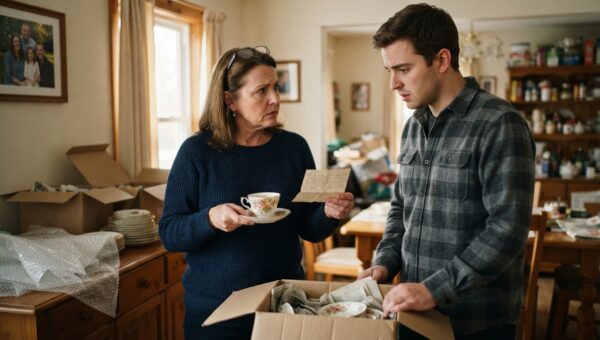
We finished packing up the last of the kitchen boxes when my brother Greg dropped the heavy tape gun on the linoleum. It made a hollow sound in the empty house. Mom had only been gone two weeks, and Greg was already talking about getting the real estate agent over by Tuesday. He wanted the house cleared, painted, and listed before the spring market peaked.
“I am just saying, Martha, we are both in our fifties and we have our own lives,” Greg said, wiping dust off his hands with a paper towel. “Keeping the utilities on another month is throwing money away. Dad has been gone six years, and now Mom is gone too. The house is just wood and drywall.”
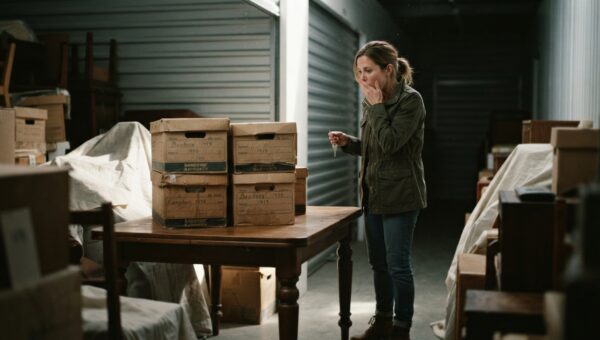
I did not answer him. I was standing in the small hallway office, looking down at the antique oak desk Dad had built back before our knees reached the underside of the table. Mom had kept the center drawer locked since the day Dad died. For six years, whenever any of us asked about the small brass key, she just shook her head and said there was nothing in there worth digging up.
Greg had finally forced the lock open with a flathead screwdriver ten minutes earlier, expecting to find old savings bonds, property deeds, or maybe Dad’s discharge papers from the Navy.
Instead, we found a standard 2004 wall calendar lying flat at the bottom of the drawer.
Every single month of that year had a grocery receipt stapled directly to the grid. Same store. Same neighborhood market three miles down the county road. Same exact total down to the penny. And every single receipt listed one identical item purchased alongside milk and bread.
Baby formula.
There were no babies in our family in 2004. Greg and I were already teenagers, well past the formula stage, and our parents had no grandchildren until years later. Greg had picked up one of the yellowed slips of paper, squinted at it, muttered something about Mom being eccentric in her old age, and shrugged. Then he walked back into the kitchen to finish taping boxes.
I stayed behind in the dim hallway. I pulled the calendar out of the drawer, running my thumb over the brittle, yellowed paper.
The stapled receipts formed a thick stack, crinkling like dry leaves. At the bottom of each receipt, printed in faded thermal ink, was a store loyalty account number.
On an impulse I could not quite name, I pulled out my cell phone and punched in the number for the market. It was an independent family grocery store that had somehow survived the big box chains moving into the county. An older man answered on the third ring, his voice raspy from decades of shouting over deli cases.
“Miller’s Market,” he said.
“Hi,” I said, my voice sounding smaller than I intended in the empty hallway. “I am calling about a loyalty account history. I know it is a strange request, but I am settling my late mother’s estate, and I found some old receipts from 2004.”
I read him the long string of digits printed beneath the store logo.
There was a long pause on the other end of the line. The faint hum of a commercial refrigerator buzzed through the speaker.
“I know that number,” the man said slowly. “That was Eleanor’s account. Eleanor Vance.”
“That was my mother,” I said. “She passed away earlier this month.”
Another pause, heavier this time.
“I am sorry to hear that,” the manager said. “She was a good customer. Came in every week like clockwork.”
“The receipts from 2004 have baby formula on every single one,” I said, my heart ticking harder against my ribs. “We did not have a baby in our family back then. Do you have any idea why she was buying that?”
The manager sighed, a dry rustling sound through the phone.
“She wasn’t buying it for you, honey,” he said gently. “She still shops here. Well, she used to, until a few months ago when she got sick.”
I gripped the edge of the oak desk so hard my knuckles turned white.
“What do you mean, she still shops here?” I asked. “My mother has been dead for two weeks.”
“I know,” the manager said. “I am talking about the girl who uses that loyalty number. She comes in every Thursday afternoon. Same account, same discounts. She is about your age, and she has your father’s eyes.”
PART 2
The dial tone hummed in my ear for three full seconds before I lowered the phone. My hand was shaking so badly I nearly dropped the device onto the hardwood floor.
Greg appeared in the doorway, carrying a stack of flattened cardboard boxes under his arm. He stopped when he saw my face.
“What is wrong with you?” Greg asked, frowning. “Did you find a bug or something?”
“Greg,” I said, my voice dropping to a harsh whisper. “The manager at Miller’s Market just told me something.”
“About what? Mom’s old coupons?” Greg let out a short, dismissive laugh and shifted the boxes. “Look, Martha, I am serious about getting these boxes into the car before dark. If you want to reminisce over every piece of junk in this desk, do it tonight after we lock up.”
“She said someone else is using Mom’s loyalty account,” I said, stepping out of the office and blocking his path to the front door. “Someone about our age. Someone who has Dad’s eyes.”
Greg froze. The boxes slipped an inch down his chest before he caught them. The irritation vanished from his face, replaced by a cold, hard blankness that ran in our family whenever things got too complicated to handle.
“Are you out of your mind?” Greg muttered. “Dad died six years ago. Mom lived in this house for forty years. Some cashier probably made a mistake or gave the wrong phone number at checkout. People reuse loyalty codes all the time.”
“It was not a cashier mistake,” I said, my voice rising. “The manager knew her. He said she came in every Thursday afternoon until Mom got sick.”
“Drop it, Martha,” Greg snapped, his voice cracking slightly. “Dad was a good man. He coached our Little League teams. He worked thirty years at the utility plant. He gave us a college fund. You are digging into a grave that has been sealed for six years just because you are sad and bored.”
He pushed past me and walked out to the driveway. I watched through the screen door as he slammed the trunk of his SUV shut.
I did not follow him outside. Instead, I turned back to the desk. If Mom had kept twenty years of grocery receipts locked in a drawer, there had to be more. People do not lock away ordinary trash.
I pulled out the remaining drawers, checking the backs and bottoms. In the lowest drawer, wedged underneath a false plywood panel that smelled faintly of old cedar, I found a plain manila envelope. It was sealed with brittle tape.
I peeled the tape back with my fingernail. Inside were three things: a hospital birth certificate from 2004, a handwritten letter on lined notepad paper, and a small photograph.
The birth certificate listed a girl named Chloe, born in October 2004 at the county hospital forty miles north. The mother’s name was listed as Sarah Miller. The father’s line was left blank.
I picked up the photograph. It showed a toddler with a shock of dark brown hair and unmistakable hazel eyes sitting on a worn yellow quilt.
Then I read the letter, written in Mom’s neat, sharp cursive.
*If you are reading this, I am gone, and Greg is probably standing right beside you wanting to sell the furniture. Your father made a choice twenty years ago. Sarah came to our door when the baby was six months old. She did not want money; she wanted peace. Your father helped them buy the small house on Elm Street, and I made sure there was food on their table every week until the girl finished high school. I hated him for what he did, but I could not hate a child. I kept the receipts so I would never forget the price of a quiet house.*
PART 3
The paper rustled in my hands as the reality of it settled over me. All those years, while Greg and I complained that Mom was becoming distant and cold in her retirement, she was driving forty miles north every week, paying for formula, groceries, and quiet survival. She had carried the weight of a second family in secret, locking the truth away in a desk drawer so our memories of Dad would not shatter.
I walked out to the driveway where Greg was leaning against his car, smoking a cigarette he had not lit in five years.
“Well?” Greg asked, staring down at the gravel. “Did you find an old checkbook?”
I handed him the photograph and the birth certificate.
He took them slowly, his fingers hesitating before touching the glossy paper. He looked at the toddler in the photograph, then down at the birth certificate, reading the date over and over again.
“She was born… she was born three months after our family vacation to the lake,” Greg whispered, his voice losing all its defensive bluster. “Dad was fixing the boat trailer down there for a whole weekend by himself.”
“He was not at the lake the whole weekend,” I said softly.
Greg dropped his hand to his side, the papers fluttering against his jeans. “Why didn’t she tell us? Why didn’t Mom just divorce him and blow his life apart?”
“Because she wanted to keep her home,” I said. “And maybe because she knew we weren’t strong enough to carry it.”
Greg looked up at the front porch, staring at the scarred wooden door where Dad used to hang his fishing hat. The anger was gone from my brother’s face, replaced by a heavy, hollow exhaustion that matched my own.
“What do we do now?” Greg asked. “Do we pretend we never found this?”
“No,” I said. “Mom kept the receipts for twenty years. We can at least make one phone call.”
ENDING
We left the packing boxes stacked in the hallway and drove north.
It took us an hour to find the small house on Elm Street. The paint was peeling around the front window, and a rusted bicycle lay on the patchy lawn, but the porch light was on.
When a woman in her late thirties opened the door, wiping her hands on a kitchen towel, I did not have to introduce myself. She looked at Greg’s jawline and my eyes, and the question died in her throat.
We stood on the concrete step for a long moment while the evening wind rustled the maples overhead. No one shouted. No one cried.
We just stepped inside out of the cold.