PART 1
For seven years, I told myself that my sister Lisa was just trying to heal. When her divorce was finalized and her house was sold off in the settlement, Mom did what mothers always do. She opened her front door. She told Lisa she could stay in the spare bedroom for a few months until she got back on her feet.
At first, it looked like a temporary arrangement. But temporary arrangements have a way of hardening into permanent laws when nobody is willing to make a scene. Month after month turned into year after year. Every time I drove out to visit Mom in her quiet suburban neighborhood in Columbus, Lisa was occupying more and more physical and emotional space. Her clothes filled the hallway closet. Her boxes stacked up in the basement.
Over the last two years, something shifted. Mom started calling me less often, and when she did, her voice sounded thin and strained. If I suggested going out for lunch just the two of us, Lisa always managed to insert herself into the plans with a tight smile and an excuse about how Mom was tired or needed to stay close to home. If I tried to talk to Mom about family matters on the phone, Lisa would background-whisper or abruptly take over the receiver.
I kept brushing my unease aside, convincing myself that I was just being an overprotective sister who was jealous of how close Lisa and Mom seemed to be.
That illusion shattered on a rainy Tuesday afternoon.
My phone buzzed while I was standing at my kitchen counter chopping vegetables. I glanced at the screen and saw Mom’s number. When I answered, there was no cheerful greeting. Instead, there was only a breathless whisper that cut straight through me.
“Are you alone?” Mom asked, her voice shaking so badly I barely recognized it.
“Yes, Mom. What is wrong?”
“Come without telling Lisa,” she whispered urgently. “Just get here right now. I have one suitcase packed and I want out.”
Before I could ask another question, the line went dead.
I dropped my knife, grabbed my car keys, and drove faster than I ever had in my life. The thirty-minute drive took twenty.
My hands gripped the steering wheel so tightly my knuckles turned white. I didn’t know what I was driving into, but I knew Mom was terrified, and that meant Lisa had finally crossed a line from which there was no return.
When I turned down Mom’s street, I saw Mom standing on the front porch. She was wearing her old beige raincoat, clutching a battered green suitcase with both hands. Her shoulders were hunched against the mist, and she looked smaller than she had at Thanksgiving.
I pulled my car into the driveway and threw it in park. Before I could even kill the engine, Mom hurried down the steps, practically throwing herself into the passenger seat. I popped the trunk, jumped out to load her suitcase, and slammed it shut, my heart hammering against my ribs.
“Let’s go. Drive, just drive,” Mom panted, staring straight ahead through the windshield as if she expected snipers in the hydrangeas.
I jumped back behind the wheel and put the car in reverse. But before my tires could even roll backward over the gravel, the front door of the house banged open.
Lisa came charging out across the lawn in her stocking feet, her hair wild and her face flushed with sudden, ugly fury. She wasn’t crying. She looked like a soldier defending a fort. She sprinted right toward my driver side window, waving a thick sheaf of legal papers in the air like a weapon.
I hit the brakes, rolling my window down just a crack because the look in her eyes made my stomach turn.
“Where do you think you’re taking her?” Lisa shrieked, slamming her palm against my car door. “She isn’t going anywhere! Look at this! Read it!”
She shoved the papers through the gap in the window. I looked down at the top page. It was a formal residential lease agreement. The text was dense with legal jargon, but my eyes caught the glaring numbers near the top. It stated that Mom had rented the entire four-bedroom house to Lisa for a term of ten years at a rate of exactly one dollar a month.
I stared up at Lisa, my mind refusing to process the absurdity of what I was reading. “Are you out of your mind? Mom didn’t sign this.”
Mom leaned over the center console, her face hardening into a cold, fierce anger that I hadn’t seen in years. She rolled the passenger window all the way down and looked directly at her daughter.
“That’s not mine,” Mom said clearly.
PART 2
Lisa froze for a second, her hand still resting on my car door. The manic triumph in her expression flickered, replaced by a momentary panic before she forced her chin back up.
“It is your signature, Mom,” Lisa snapped, her voice rising in pitch. “You signed it at the kitchen table eighteen months ago. We talked about it. You wanted to protect me after the divorce so I’d always have a roof over my head. You told me yourself!”
“I never said any such thing, and I certainly never signed away my home for ten years at a penny a day,” Mom shot back, her voice remarkably steady now that she was safely inside my car. “You brought me a stack of insurance papers to sign while I was recovering from my cataract surgery. I trusted you to hand me the right forms. That is not my signature.”
Lisa went quiet. The silence in the driveway was heavy, broken only by the steady hum of my car engine and the patter of rain on the roof. Lisa’s eyes darted away from Mom, refusing to meet her gaze.
Mom didn’t look away. Instead, she leaned further toward the window, her finger pointing rigidly at the bottom of the document where the signatures and witness lines were crammed together.
“Look at the witness line, Lisa,” Mom whispered, her voice dropping into a tone of profound betrayal. “Look at who signed as the witness.”
I craned my neck to see the bottom of the page. Right there, signed in familiar, neat cursive, was the name of our younger brother, Tom.
The room went entirely cold in my mind. Tom. Tom, who came over every single Sunday with takeout from the Italian place down the road. Tom, who always patted Mom’s shoulder and asked if her bills were paid. Tom, who sat at our family dinners smiling across the table, carving holiday turkey while quietly helping Lisa carve up Mom’s life behind our backs.
“Tom,” I whispered, the name tasting like ash in my mouth.
“He helped her,” Mom said, her voice trembling slightly as she looked back at me. “He brought the papers over when my eyes were blurry. He told me it was just a renewal for the homeowner’s insurance policy. I signed where he pointed because he’s my son. And they used it to lock me out of my own home.”
Lisa backed away from the car, her face pale. She didn’t deny it. The silence was all the confession we needed.
“Get in,” I told Mom, putting the car into drive and stepping hard on the gas pedal. Lisa shouted something after us, her voice fading into the rain as we pulled out of the driveway and left seven years of lies behind us.
PART 3
We drove straight to my house in silence. Once we got inside, I made Mom sit on the sofa with a warm cup of tea while I called our attorney, Robert, whom we had known for years. When I explained what had happened on the phone, his professional calm vanished, replaced by sharp disbelief. He asked us to come to his office first thing the next morning with whatever documents Mom had managed to grab.
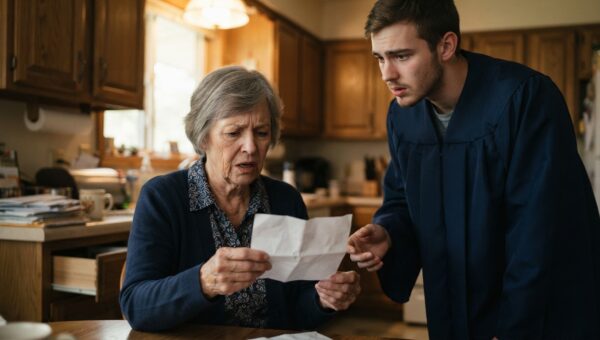
That night, sitting at my kitchen table, Mom told me everything she had been too proud and too scared to share. How Lisa had gradually cut off her visits with old friends, intercepted mail at the front door, and made her feel like a guest in her own home. How Tom had visited with his laptop and printer, always cheerful, always offering to help handle her administrative tasks.
“I felt like I was losing my mind,” Mom confessed, wiping a tear from her cheek. “Every time I tried to speak up, Lisa told me my memory was failing. She made me feel like an old woman who didn’t know what day it was.”
The next morning, Robert laid the papers out across his large mahogany desk. He examined the lease under a magnifying glass, shaking his head.
“This is textbook elder exploitation and fraudulent notarization,” Robert said, looking up at us. “A contract signed under false pretenses through deliberate misrepresentation is legally void. Furthermore, a ten-year lease for one dollar an ordinary market value constitutes unconscionable duress and fraud, especially given the medical vulnerability at the time of signing. And if your brother notarized or witnessed this under false pretenses while knowing it was a fraudulent conveyance, he has severe legal exposure.”
Robert didn’t waste time. He drafted formal demand letters demanding the immediate surrender of the property, backed by copies of Mom’s medical records proving her recent eye surgery on the exact date of the signing, along with a notice of impending criminal referral for forgery and fraud.
Two days later, Tom showed up at my front door unannounced.
When I opened it, he looked rattled, his tie loosened and his usual easy charm completely gone. He tried to brush past me into the hallway, but I stood my ground, blocking his path.
“Where is Mom?” he demanded, running a hand through his hair. “What is this nonsense Robert sent us? Lisa is hysterical. You are blowing this way out of proportion. We were just trying to give Lisa stability.”
“Stability by stealing Mom’s house out from under her?” I asked, my voice dangerously low. “You witnessed a fake lease while Mom was recovering from surgery, Tom. You used your own family as a mark. Don’t you dare stand on my porch and pretend you were being charitable.”
Tom stared at me, his mouth opening and closing. He realized then that we weren’t just angry sisters having a domestic spat. We had the evidence, the medical timeline, and a lawyer who knew how to use them.
“It was just supposed to buy Lisa some time,” Tom muttered, looking down at his shoes.
“Time is up,” I said, and closed the door in his face.
ENDING
It took three weeks of legal pressure, certified notices, and the very real prospect of criminal charges before Lisa finally packed her boxes and left Mom’s house. She didn’t call us to say goodbye. She simply dropped the house keys into Robert’s office drop-box and vanished.
Tom didn’t call either. His number remains blocked on both mine and Mom’s phones, and the Sunday visits have stopped permanently.
Two months after that rainy Tuesday, Mom moved back into her house. The air inside smelled different now. It smelled clean, quiet, and entirely her own.
On a bright Saturday morning in May, I drove over to help her replant her front garden. Mom was kneeling on a foam pad by the flower bed, wearing her old gardening gloves and pressing bright red geraniums into the rich black soil.
She paused, wiping a smudge of dirt from her forehead with the back of her hand, and looked up at the front porch steps where Lisa had stood waving that fake paper. Then she smiled, picked up her green plastic watering can, and poured a steady stream of water over the roots.
She didn’t say a word about the past. She didn’t need to. The water soaked quietly into the earth, and the house behind us stood tall and solid in the spring sun, belonging to no one in the world except the woman who built it.