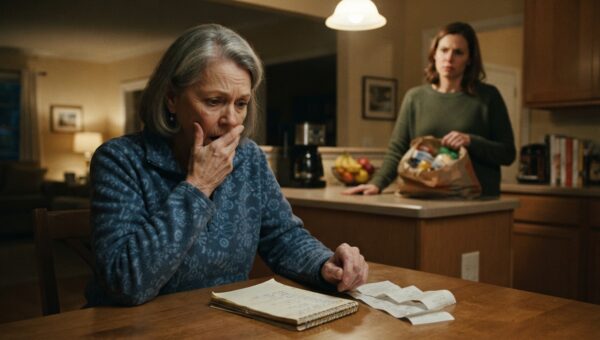
My granddaughter told me she wanted to repair cars while we were standing in line at the grocery store, and I laughed because I thought she was joking.
“I’m serious, Grandma,” she said.
I looked at the shopping cart. We had bread, apples, and the ingredients for a pot of chili. “You want to work on cars?”
“I want to go to the technical program at the community college. They have automotive service and diagnostics.”
“You’re good at school.”
“That’s why I can get in.”
I heard the edge in her voice and knew I had said the wrong thing. But I was seventy-one, and my first thought had been the same one her parents would have: Why would you choose something so hard when you have other choices?
Her name was Grace. She was eighteen, tall, and careful with money. She had worked at a grocery store after school since she was sixteen, and she kept her pay stubs in an envelope in her bedroom. Her father, my son, wanted her to apply to a university. Her mother wanted her to choose something stable. Grace wanted to know how engines worked and why dashboard lights came on.
“I can teach you some basics,” I said. “If you want.”
She looked at me. “You know how to work on cars?”
“I used to.”
“I thought you were a nurse.”
“I was. I can also change a spark plug.”
Her mouth turned up. “Okay. Teach me.”
The next Saturday, she came to my house in work pants and a sweatshirt.
I had an old lawn mower in the shed and a car that needed an oil change. She brought a notebook. I had not planned a lesson, so we started by checking the tire pressure and finding the oil dipstick.
She listened carefully. She wrote down everything I said. When I asked her to hand me the wrench, she picked the wrong one, then corrected herself before I could. I saw the nervousness in her shoulders.
“You don’t need to know it all today,” I told her.
“I know. I just don’t want to look stupid.”
“Everybody looks stupid the first time they do something new.”
She smiled. “You too?”
“Especially me.”
Grace had first become interested in cars the year her mother’s sedan stopped starting in the grocery-store parking lot. She and her mother were late for a dentist appointment, and the battery made a clicking sound when Grace turned the key.
Her father was at work and could not come. They called roadside assistance, but the estimated wait was ninety minutes.
I happened to be in the store buying coffee. I heard them talking near the entrance and went out to take a look. The battery cable had loosened. I tightened it with the small wrench I kept in my trunk. The car started. Grace watched my hands the whole time.
“You can just know how to do that?” she asked.
“You can learn how.”
She told me later she had thought about that afternoon more than I realized. At school, she had been good at science but bored by worksheets. She liked being able to look at a problem and test an answer. At the grocery store, customers came through her line and complained about the prices or the wait. At the garage, nobody could pretend a broken part was fixed just because they said it was.
She had not told her parents right away because she knew they would ask whether she had considered a university. She had considered it. She had toured one campus with her mother, and she liked the library and the old brick buildings. She just could not picture herself sitting in a lecture hall for four years because other people thought that was the safe choice.
“I don’t want everyone to think I’m giving up,” she said to me while we looked at the tire pressure.
“Learning a trade is not giving up.”
“I know that. They may not.”
“Then you can show them what the program asks of you. You don’t have to argue from a feeling alone.”
She nodded and wrote the college’s name in her notebook. I realized she had been doing her own research for months. She had the course sheet folded in the back pocket, a list of questions, and a screenshot of a scholarship page. I had thought she was just telling me an idea. She was already trying to make a plan.
“How long have you been thinking about this?” I asked.
“Since last summer.”
I felt a small sting of pride that she had trusted me with it before she was ready to tell everyone else. I also felt protective. I wanted to make sure my son would hear her before he decided what was best.
I had learned to work on cars because my father did not believe girls needed to know such things. He said the car was a man’s responsibility. When I was nineteen, I got stranded on the highway during a snowstorm and waited two hours for a tow truck. After that, I started reading the repair manual in the glove box. A mechanic at the local garage taught me how to change a tire. I never became a mechanic, but I never had to wait by the roadside again.
Grace listened while I told her. “Did you want to do it professionally?”
“Maybe. I wanted to do a lot of things when I was young.”
“Why didn’t you?”
I tightened the oil cap. “I had a family. I needed a steady job.”
“That doesn’t answer the question.”
I stopped. “No. It doesn’t.”
I had not considered that my granddaughter might hear the sentence as a warning. I did not want my own unfinished choices to become a reason for her to choose a smaller life.
That evening, my son called. Grace had told him about our time in the garage.
“Mom, I wish you hadn’t encouraged her before she talked to us,” he said.
“She’s eighteen.”
“She’s still figuring things out.”
“So are you.”
He sighed. “She’s been working so hard to get into college. She has good grades. She could do anything.”
“She could do automotive technology.”
“Is that what you want for her?”
“I want her to decide what she wants.”
He said he was worried about the cost and the job prospects. I understood that. I had worried about the same things when he was young. But I heard something else beneath his concern: he had expected her future to look familiar to him.
I told him she should learn what the program involved and compare the costs. I did not tell him to agree with her. I did tell him not to dismiss her before she had a chance to explain.
After the call, I thought about why my son had reacted so quickly. He had started college and stopped after two semesters because he was working nights and helping pay the rent. He later earned a business certificate while working full time. He had told me once that he wished someone had insisted he finish a degree. I understood why he wanted a different road for his daughter. I also knew that his own road had taught him that life did not follow a neat plan.
The next day, he called Grace and asked her to tell him more about the program. She put him on speaker while I was in the kitchen. She described the classes, the shop hours, the scholarship, and the jobs she had researched. He asked questions about safety and wages. He did not say he agreed. He said he wanted to understand.
After they hung up, Grace stood in the doorway. “He didn’t tell me I was wrong.”
“That’s a start.”
“I think he’s scared I’ll end up stuck.”
“You can hear his fear without letting it choose your life.”
She considered that, then put her course sheet on the table. “I want to show him the open house.”
“I think he’ll come.”
The next week, Grace and I toured the community college. The shop was bright and clean, with rows of engines, tool cabinets, and two cars lifted off the floor. The instructor, Ms. Alvarez, spoke to Grace as if she were already a student. She explained the course schedule, certification options, and the fact that many graduates worked at dealerships, fleet shops, or independent garages.
Grace asked more questions than anyone else on the tour. She wanted to know how often students worked on electric vehicles. She wanted to know whether women had trouble finding internships. She wanted to know whether she could keep her grocery job while taking classes.
On the way home, she was quiet.
“What did you think?” I asked.
“It’s real,” she said. “I thought it might feel like a hobby. It feels like a job I could be good at.”
“Those things can overlap.”
“I know.” She looked out the window. “My dad’s going to ask whether I’m sure.”
“Are you?”
“I’m sure I want to try.”
I liked that answer. It did not pretend she knew everything.
At dinner that Sunday, Grace told her parents about the program. My son listened without interrupting. Her mother asked about the cost. They talked through tuition, books, work hours, and the possibility of applying for a scholarship. My son kept his arms crossed.
When Grace finished, he said, “I just don’t want you to limit yourself.”
“I’m not limiting myself,” she said. “I’m choosing a path.”
He looked at me. I stayed quiet.
“You could get a four-year degree and still work with cars,” he said.
“I could. But that’s more expensive, and I don’t want to spend four years wondering whether I should have started here.”
Her mother took her hand. “If this is what you want, we’ll help you figure it out.”
My son did not answer right away. Then he asked to see the course list.
The next month, Grace submitted her application. She continued working at the grocery store and started saving for tools. My son helped her research scholarships. He did not suddenly become comfortable with the decision, but he stopped referring to it as a phase.
The acceptance letter arrived in April. Grace called me from the parking lot at school. She was crying and laughing at the same time.
“I got in.”
“I knew you would.”
“You did not.”
“I hoped you would.”
She asked if I could come with her to buy a basic set of tools. We went to a store that smelled of rubber and metal. She compared two socket sets for nearly twenty minutes. I told her to choose the one that felt sturdy in her hands. She chose the less expensive one and saved the difference for safety shoes.
Her father came along. He carried the box to the car and asked the salesperson about warranty coverage. On the drive home, he said, “I don’t know much about this program.”
Grace looked at him. “You can come to the open house.”
“I’d like that.”
The first semester was harder than she expected. She had to get up early, work evenings, and study in the library between classes. She called me once after a lab when a diagnostic scan showed a fault she could not identify.
“I’m not sure I’m cut out for this,” she said.
“What happened?”
“I got the wrong answer.”
“How many times?”
“Four.”
“That sounds like learning.”
She sighed. “You make everything sound simple.”
“It isn’t simple. It’s just not a reason to quit.”
The next weekend, she brought a textbook to my house. We sat at the kitchen table and worked through the diagrams. I did not know all the answers. We looked them up together.
At the end of the semester, the program held a small student showcase. Grace had worked on an older sedan that had been stalling. She explained the problem to us using a diagram on a whiteboard. My son stood with his hands in his jacket pockets, listening closely.
“You found the bad sensor?” he asked.
“And a loose connection.”
He nodded. “That’s impressive.”
Grace smiled, but she did not make a show of it. She had earned the moment without waiting for anyone to approve it.
Afterward, my son thanked me for encouraging her. I told him she did not need me to convince her. She needed us to listen long enough to hear what she had already decided.
He looked through the glass wall at Grace talking with her instructor. “I thought I was protecting her.”
“You were trying to.”
“I know.”
“She’ll still need you to be worried sometimes. Just don’t let worry make the choice for her.”
He gave a small laugh. “You always know how to make me feel like I’m twelve.”
“I had practice.”
Grace finished the program the following spring. She received an offer for an entry-level position at a dealership, with a path toward advanced certification. Her parents came to the ceremony. I sat between them, holding a small bouquet of yellow flowers.
When Grace saw me, she whispered, “You brought flowers.”
“Only for you.”
She hugged me tightly. “I’m glad you said yes.”
“I’m glad you asked.”
We took a picture in front of the shop doors. My son stood on one side of her, her mother on the other. I was in the back row, one hand on Grace’s shoulder. She looked confident. I looked older than I felt and happier than I expected.
She works on cars now. Some days are long and dirty. Some customers assume she is there to write invoices until she starts explaining the repair. She calls me when she wants to talk about a stubborn engine or a customer who doubts her. I listen, and sometimes I give advice. Often I just ask what she wants to do next.
The most important thing I taught her was not how to use a wrench. It was that she could learn a skill she loved without asking permission to become the person she wanted to be.
She still keeps the first socket set in the trunk of her car. When she visits, she checks my tire pressure before she leaves. I tell her I can do it myself. She says, “I know, Grandma. Let me help.” I let her.
Last month she called after a customer told her to find “the actual mechanic.” She had already diagnosed a loose sensor connection and explained the repair, but the man kept asking for someone older. I asked what she did.
“I showed him the scan results and asked if he wanted the service manager to confirm them,” she said. “Then he said he’d take my recommendation.”
“What did you tell him?”
“That I’d already given it.”
I laughed so hard she laughed too. She did not need me to rescue her. She only wanted to tell somebody who understood why the moment mattered.