PART 1
The smell of melted butter and warm maple syrup made my empty stomach turn over.
I had clocked out of the pediatric intensive care unit at seven fifteen that morning. My scrub top was still in my canvas tote bag in the car, and my feet throbbed inside my running shoes. I had been on my feet for twelve hours straight, titrating IV drips and holding the hand of a four-year-old girl whose oxygen kept dropping every time she drifted off to sleep.
I was surviving on three hours of broken sleep from the day before and a paper cup of lukewarm hospital coffee that tasted like cardboard.
My mother, Eleanor, had insisted on brunch at ten thirty sharp at the country club. She had texted me four times during my shift to make sure I would not be late.
“Jeffrey worked ninety hours this week closed on three new commercial accounts,” my mother announced, lifting her mimosa glass so high the orange juice caught the morning sun through the clubhouse windows. “Three point two million in gross revenue this fiscal quarter alone. A real leader. Let us toast to a son who knows what building a legacy actually looks like.”
My older brother, Jeffrey, gave that easy, practiced nod he used whenever people praised him. He adjusted the cuff of his pressed linen shirt and took a sip of his sparkling water.
His wife, Amanda, smiled down at her plate, smoothing a cloth napkin over her lap.
My father, Robert, clinked his glass against Jeffrey’s. “Proud of you, son. Hard work pays off. It shows in the numbers.”
I sat quietly between my father and the window, wrapping my fingers around a glass of ice water just to keep my eyes open. I had not eaten since midnight, when I choked down half an apple between charting notes at the nursing station.
My mother set her flute down with a delicate clink against the linen tablecloth. She turned her eyes directly on me. The smile on her face was thin, practiced, and familiar.
“Barbara, dear,” she said, loud enough for the elderly couple at the adjoining table to hear every syllable. “Be honest with us. How does it feel being the daughter who never quite keeps up?”
The table went quiet, except for the clatter of silverware from the kitchen doors.
Jeffrey let out a short, quiet chuckle into his napkin. My father did not look up from cutting his poached egg.
Two days earlier, my father had called my cell phone while I was pulling into my driveway after a daytime shift. He did not ask how my patients were doing or how my week had gone. He told me, in that matter-of-fact tone he always used when managing family logistics, that the resort on Maui required the final balance for their tenth-anniversary family trip by noon today. He said the remaining balance was twelve thousand dollars. He told me I needed to log into the group reservation portal and clear it from my account because Jeffrey had already put down the initial deposits for the flights and the catamaran excursion.
I had agreed. I had scheduled the transfer to go through the travel agency portal on Sunday morning.
Now, Jeffrey leaned across the table. His smirk was wide, sharp, and dripping with pity.
“Careful, Barb,” Jeffrey said, his voice carrying easily over the clinking glasses. “Don’t overdraft your checking account paying for your eggs.”
I set my water glass down. The cold from the glass lingered on my fingertips.
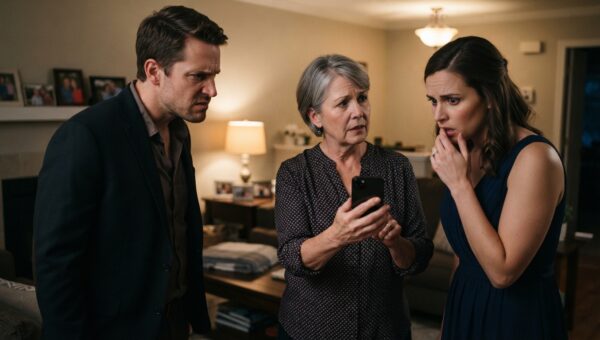
I reached into my bag, pulled out my phone, and unlocked the screen. The travel company app was still open in my background tabs, showing the pending wire transfer of exactly $12,000.00 marked for the oceanfront villa suite under my father’s name.
I looked up at Jeffrey, then at my mother, whose chin was tilted upward, waiting for me to apologize or make an excuse about my public hospital salary.
My thumb moved across the glass. I pressed the red prompt on the screen.
The notification flashed once: *Transfer Canceled. Funds Returned to Available Balance.*
I laid my phone flat on the white tablecloth between my plate and my father’s coffee saucer.
“How does it feel,” I asked quietly, looking straight at my mother, “reworking your vacation budget?”
PART 2
The screen stayed lit for thirty seconds.
The bold green confirmation message sat right in the center: *Reservation #84109 — $12,000.00 Payment Canceled by Account Holder.*
My father set his fork down. The metal hit the porcelain plate with a sharp crack. He reached for his wire-rimmed glasses, hooked them behind his ears, and leaned over to stare at the phone.
“Barbara,” he said, his voice dropping into that low, warning register he had used on me since I was ten years old. “What did you just tap?”
“The cancel button, Dad,” I said.
My voice was steady. It surprised me a little, considering my heart was hammering against my ribs, but fifteen years in an emergency pediatric ward teaches you how to keep your hands still when a room starts spinning.
Jeffrey scoffed, leaning back and shaking his head. “Stop playing games, Barb. You didn’t cancel anything. You don’t even have twelve grand to put toward Maui.”
“Jeffrey, be quiet,” my father snapped. He picked up my phone by the edges, squinting at the ledger. “Barbara, this says the balance is unpaid. The final deadline is noon Hawaiian time. That is two hours from now. If that twelve thousand doesn’t clear, they drop the villa hold and keep the thirty-percent non-refundable room deposit.”
“I know,” I said. “You reminded me three times on Friday.”
My mother looked between my father and Jeffrey, her painted eyebrows pulling together. “Robert, what are you talking about? Why would Barbara have anything to do with our villa? Jeffrey arranged the family suite. He told us he had everything handled through his corporate concierge account.”
I looked at my brother.
The confident posture Jeffrey had worn five minutes ago was gone. His neck had gone blotchy and red above his stiff collar. He reached across the table, his hand darting toward my phone, but I slid it back toward my side of the table before his fingers touched the case.
“Jeffrey,” I said, “do you want to explain it to Mom, or should I read the email thread from Tuesday?”
“Barbara, don’t do this here,” Jeffrey muttered, his voice dropping to an urgent, ragged whisper. “We can settle this outside.”
“No,” my mother interrupted, her voice rising in pitch. “Settle what? Jeffrey, what is she talking about?”
“She’s trying to make a scene because she’s jealous,” Jeffrey said, though his eyes would not meet hers. “She’s embarrassed because I mentioned her finances.”
“You didn’t just mention my finances,” I told him. “You sat there and bragged about three point two million dollars in revenue while knowing damn well that your LLC is currently operating under a cash flow freeze.”
The color drained right out of my brother’s face.
I knew about the freeze because Jeffrey had called me six weeks ago, sounding completely different than he did at this table. He had called me at midnight on a Tuesday, practically hyperventilating in his home office, begging me to spot him four thousand dollars for his daughter’s private school tuition because his business line of credit had been temporarily capped during an audit. I didn’t give him the four thousand then. I told him he needed to manage his overhead.
Instead, he had gone directly to our father.
Dad had covered the school bill for Jeffrey. And then, when the Maui trip came up, Dad came to me with a carefully constructed story about how Jeffrey had already paid the lion’s share of twenty-five thousand dollars for flights, private boat charters, and island transport. Dad told me my contribution was the remaining twelve thousand for the lodging, claiming it was only fair since I was bringing myself and my niece for the full ten days.
I had believed my father. I thought I was pulling my weight in an equal family arrangement. I worked six extra overtime night shifts over two months to cover that twelve thousand dollars in cash without touching my retirement fund.
I pulled up the primary booking confirmation on my screen and turned it toward my mother.
“Look at the billing breakdown, Mom,” I said.
PART 3
My mother took the phone with trembling fingers.
The original contract was issued by the resort’s private booking office. It listed four line items: the master ocean villa, the adjoining double room, the resort dining credit, and the ground transit.
There were no private boat charters on the invoice. There were no five-figure flight packages paid for by Jeffrey’s company.
The initial deposit paid three months ago was four thousand dollars, drawn directly from my father’s retirement savings account. The remaining balance of twelve thousand dollars was the entire rest of the bill.
Jeffrey hadn’t paid a single cent.
Not for the rooms. Not for the flights. Not for the deposit.
He had simply booked the reservation under his name using Dad’s credit card for the initial hold, promised our parents that he was covering the bulk of an extravagant luxury holiday, and then quietly told Dad that I needed to wire the twelve thousand because his own funds were tied up in short-term commercial paper until next quarter.
“You let me work seventy-two hours a week on a pediatric floor,” I said, looking at my father, “so you could protect his image.”
My father didn’t answer. He stared down at his half-eaten eggs, his jaw working silently. He had known the whole time. He had known that Jeffrey was broke, that Jeffrey was running on leveraged credit, and that the grand story about the successful, wealthy son was a house of cards. Dad had covered for him because he couldn’t bear the thought of his golden boy looking like a failure in front of our mother.
And to make it work, Dad had leaned on me. The dependable daughter. The nurse who always had savings because she lived in a modest two-bedroom bungalow, drove a six-year-old Subaru, and didn’t spend four hundred dollars on golf club luncheons.
“Jeffrey,” my mother whispered, the paper napkin in her lap twisting into a tight knot under her hands. “Is this true? Did your father pay that deposit?”
“Mom, it was a timing issue,” Jeffrey stammered, pulling at his collar. “The accounts receivable on the concrete contract were delayed by forty-five days. I was going to pay Dad back the minute the state voucher cleared. It’s just cash flow. Any real business owner understands cash flow.”
“You don’t have forty-five days,” I said. “You have one hour and forty-five minutes. The resort desk opens their cancellation queue at noon.”
“Barbara, put the payment back through,” my father ordered, his voice suddenly sharp with panic. “We will sort out the details when we get home. Your mother has been looking forward to this trip for a year. You cannot ruin this for her over a petty disagreement at a breakfast table.”
“I am not ruining anything, Dad,” I said. “Jeffrey is a three-million-dollar businessman. He just told everyone within twenty feet of us how successful he is. Let him put down his corporate card.”
I reached across the table, took my phone from my mother’s numb hands, and dropped it into my canvas bag.
“Put your card down, Jeff,” I said, leaning toward him. “Cover the twelve thousand. Show Mom how a real leader builds a legacy.”
Jeffrey stared at me. His mouth opened slightly, but no words came out. His hands stayed flat on the table, nowhere near his wallet.
He couldn’t do it. He didn’t have twelve thousand dollars of available credit left to his name, and we all knew it.
My father looked at Jeffrey, waiting for the miracle. When Jeffrey simply looked down at his water glass, Dad’s shoulders dropped two inches. The pride, the authority, the stern patriarch act, it all collapsed into a tired, frightened old man sitting over cold food.
“I gave thirty-six hours of my life to the county hospital this week,” I told my mother, keeping my voice entirely calm. “I watched a mother lose her toddler on Thursday night. I held a syringe for forty minutes while a surgical team tried to stop an internal bleed. I don’t need to keep up with anyone at this table. And I am done paying for the privilege of being insulted.”
I pulled a twenty-dollar bill from my pocket and set it beside my untouched water glass to cover my coffee.
Then I stood up, swung my canvas bag over my shoulder, and walked away from the table.
ENDING
My mother called eight times before I reached the highway.
I didn’t answer. When I pulled into my driveway, my father left a voicemail. His voice sounded thin and strained. The resort had held firm on their contract policy; without the twelve-thousand-dollar final payment, they had canceled the reservation and retained the four-thousand-dollar deposit. There was no Maui trip.
Later that afternoon, my sister-in-law Amanda texted me from her personal cell. She didn’t yell or accuse me of anything. She simply wrote: *I am sorry. I didn’t know he had asked your dad for money again. You did the right thing.*
The house of cards didn’t take long to fall completely. Over the next three weeks, Jeffrey had to downsize his firm’s office space and surrender the lease on his luxury SUV to avoid defaulting on his commercial loans. He and my father stopped speaking for nearly two months after Dad refused to take out a second mortgage on the family home to bail out Jeffrey’s payroll account.
My mother stopped hosting the Sunday brunches at the country club. The public illusion of the flawless, wealthy family had cracked, and she couldn’t bring herself to sit near those same tables where she had spent years boasting about a life that was financed on borrowed time and my quiet labor.
Two months later, in early April, my father drove over to my house on a Tuesday morning.
He didn’t come inside. He stood on my front porch, holding an old leather-bound ledger he had used for thirty years to track his home expenses. His hair looked whiter, and he seemed smaller inside his windbreaker.
“I shouldn’t have asked you for that money, Barbara,” he said, looking at the floorboards between our feet. “I knew Jeffrey was drowning. I just thought if I could keep the boat steady for another month, he would pull out of it. I used you as a shield because you were the only one who never complained.”
“You didn’t just use me as a shield, Dad,” I told him gently. “You let him treat me like dirt while I was paying for his seat at the table.”
He swallowed hard and nodded once. He didn’t offer an excuse. He handed me an envelope. Inside was a cashier’s check for four thousand dollars, the exact amount he had lost on the non-refundable deposit.
“I don’t want this,” I said, trying to hand it back. “That was your money you lost to the resort, not mine.”
“It’s not for the resort,” he said, his voice rough. “It’s to remind me what it costs when I lie to my daughter.”
He turned and walked down the steps before I could argue.
I didn’t cash the check right away. It sat on my kitchen counter next to my stethoscope and my work badge for two weeks.
Eventually, I opened a separate high-yield savings account and deposited it under my niece’s name for her college expenses, ensuring that when she grows up, she will never have to depend on the false promises of proud men who measure their worth in borrowed money.
On Friday morning, I came off another long shift in the pediatric wing. The sun was warm against the windshield of my old car.
I drove past the turnoff for the country club without looking at the gates. I went straight to the small diner two blocks from my house, ordered two fried eggs and rye toast, and ate my breakfast in absolute silence.
For the first time in my life, I wasn’t running to catch up with anyone. I was already home.