PART 1
The envelope was heavy, off-white, and postmarked three weeks ago.
I almost threw it into the recycling bin with the supermarket circulars because the return address had a surname I did not recognize. But right below the return address, written in clean, dark blue ink, was my full name and the address where I had lived alone for thirty-two years.
I opened it over the kitchen sink with a butter knife.
Inside was a thick card with silver embossed lettering: “Dr. Hannah Porter requests the honor of your presence at her wedding.”
My mouth went dry.
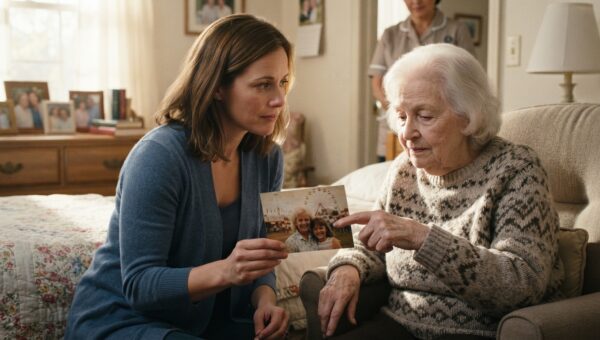
Underneath the formal text was a glossy four-by-six photograph. It showed a young woman in a dark green blazer standing between two older women. All three were smiling into the camera outside what looked like a brick university hall. The woman on the right was Elise. The woman on the left, with gray threads running through her short dark hair and laugh lines around her hazel eyes, was my daughter, Sarah.
The last time I had seen Sarah in person was September 14, 2010. She was twenty-four years old.
She had stood in my living room by the front door, wearing a denim jacket, her knuckles white around the handles of two brown canvas suitcases.
I had just found out she had quietly married Elise at a municipal courthouse three towns over two weeks earlier. I had spent $18,000 from my savings to help her through her state college degree, paying her off-campus rent, buying her meal cards, and covering her books, thinking that gave me a voice in how she lived her life. I thought my money bought me authority. I thought it meant she had to listen to me when I told her what kind of family was acceptable.
When she told me she loved Elise and would not hide her marriage from anyone, I told her she was no longer welcome in my house. I told her that if she walked through that screen door, she walked out on everything we were.
She left with those two suitcases. I never called her cell phone. Over the years, when relatives mentioned her name at Thanksgiving or funerals, I changed the subject or walked into another room.
I told myself I was standing on principle. The truth was far uglier: I was too proud to admit that my daughter had chosen her own dignity over my approval.
Now, sixteen years later, this photograph was sitting on my laminate counter.
Hannah had Sarah’s high cheekbones and Elise’s wide smile. The card stated she was graduating with her doctorate in clinical psychology and marrying her partner in three weeks at a small chapel forty miles north in Oak Grove.
Hannah was my granddaughter. A girl born, raised, and educated entirely outside my life. A child whose scraped knees I never bandaged, whose school plays I never attended, whose name I had never once spoken out loud.
I did not sleep that night. Every time I closed my eyes, I saw those two brown suitcases sitting on my worn hardwood floor.
The next morning at eight, I put on my gray wool coat, took my car keys, and drove north.
I found the house from the return address on the corner of a quiet street lined with old maples. It was a modest cedar-shingled ranch with flower beds that had been cut back for the fall. A dark blue Subaru was parked in the paved driveway.
I sat in my sedan with the heater running, watching the front porch for forty-seven minutes. My hands rested on the steering wheel, stiff with fear. I had no right to be there. I knew that. I had spent sixteen years maintaining a silence I had built myself.
Finally, I switched off the ignition, stepped out into the cold morning air, walked up the three front steps, and knocked on the wood door.
The lock turned. The door swung inward.
Sarah stood there. She was wearing an oversized cream sweater and holding an unwashed coffee mug. She looked at me for five long seconds without blinking, without gasping, and without moving an inch.
“Before you come in,” Sarah said, her voice completely even, “tell me why you are here.”
PART 2
The screen door stood between us like a sheet of ice.
“I got the invitation,” I said. My voice sounded thin, almost stranger-like in my own ears. “Hannah sent me an invitation.”
Sarah did not look surprised. She looked tired. She unlatched the lightweight aluminum screen door and pushed it open just enough for me to step into the front hallway.
The house smelled like ground cinnamon and black coffee. On the small credenza by the entryway, there were framed photographs of a little girl with missing front teeth, a teenager in a high school soccer uniform, and a young woman wearing a graduation cap. Sixteen years of a human life, arranged neatly in silver frames, and I had not been present for sixty seconds of it.
“Elise is at the grocery store,” Sarah said, walking into the kitchen without checking if I was following. “Sit down, Mom.”
I sat on the wooden chair by the kitchen table. My joints were stiff, but the cold inside my chest was far worse.
“Why did she send it, Sarah?” I asked, looking down at my hands in my lap. “You didn’t want me to have that, did you?”
Sarah set her mug on the counter and leaned against the sink. She folded her arms across her chest. “Hannah found an old bank deposit book in a cedar chest in our basement two months ago. It had your name on it. It had carbon slips showing tuition transfers from 2008 and 2009. She asked me who Helen was. I told her the truth. I told her Helen was my mother, and that she decided sixteen years ago that she didn’t want a daughter who loved a woman.”
Every word hit like a flat palm against my ribs.
“I told her you wouldn’t come,” Sarah continued, her voice remaining quiet and factual. “I told her not to waste the thirty-five-cent stamp. But Hannah is twenty-four now. The exact age I was when you stood in your front hallway and watched me carry my bags to the curb. She wanted to look you in the face once in her life, even if it was just to see who had discarded us.”
“I was wrong, Sarah,” I said.
The words came out before I could dress them up or soften them. I had spent sixteen years practicing speeches in the shower, thinking about how I would explain that I was raised in a different era, how church had shaped my worldview, how scared I was of what the neighbors in our small town would say. But sitting across from my daughter, none of those excuses held any weight. They were just paper shields for cowardice.
“Being wrong doesn’t undo sixteen years, Mom,” Sarah said. She pulled out a wooden chair opposite me and sat down. “You didn’t just walk away from me. You made Elise feel like she was poison. You made me feel like the eighteen thousand dollars you spent on my education was a debt I had to pay with my own soul. Do you know what Elise did when you locked your door that day?”
I shook my head slowly.
“Her parents didn’t have much,” Sarah said. “Her father was a night custodian at the high school. But they put an air mattress in their spare sewing room, gave me a set of house keys, and told me nobody in this family gets left on a sidewalk. When Elise and I decided to have Hannah through an open donor two years later, they were in the waiting room with juice boxes and cold sandwiches. They were her grandparents. You were just a ghost with an old checkbook.”
The front door opened with a click, followed by the rustle of paper grocery bags.
A moment later, Elise walked into the kitchen carrying a cardboard carton of eggs and a loaf of bread. Her hair was completely gray now, cut neatly at her collar. She stopped dead when she saw me sitting at her table.
She set the groceries down on the island with deliberate care. She did not yell. She did not demand that I leave. She just looked at Sarah, then looked at me, her eyes clear and unyielding.
“Helen,” Elise said.
“Elise,” I managed to say. “I’m sorry. I came because of the card.”
“The wedding isn’t an open house,” Elise said calmly, resting one hand on the edge of the kitchen counter. “It is for people who love Hannah. It is for people who showed up when she had ear infections at two in the morning, and when she got rejected from her first choice of college, and when she worked three jobs to pay her own way through her doctorate so she wouldn’t owe anybody an explanation for who she is.”
“I know that,” I whispered.
“Then why are you sitting at our table?” Elise asked.
PART 3
I reached into the pocket of my coat and pulled out the invitation. I laid it on the table between Sarah’s coffee mug and a ceramic salt shaker.
“Because I realized something when I opened this yesterday,” I said, looking directly at Elise, and then back at Sarah. “I spent sixteen years telling myself that I was the one who cut you off. I told myself I was the one holding the line. But when I saw Hannah’s picture, I realized the line didn’t protect me from anything. It just locked me inside an empty house.”
I opened my leather purse and took out a small, flat box wrapped in faded green paper. It had been sitting in the bottom drawer of my jewelry box since the summer before Sarah left for college.
Inside was a simple gold locket on a delicate chain. Inside the locket was a tiny black-and-white photograph of my own grandmother, who had raised me on a small dairy farm when my parents died in the influenza outbreak of 1952.
“Your grandmother gave this to me when I was eighteen,” I told Sarah. “She told me that family is the only thing on this earth that doesn’t lose its value when the market drops. I took that gift, and then forty years later, I threw it away because I wanted to be right more than I wanted to be a mother.”
Sarah stared at the green box. She did not reach for it.
“I am not asking to sit in the front row at Hannah’s wedding,” I said. “I am not asking you to introduce me as the proud grandmother. If I come, I will sit in the last pew by the coat racks. I will leave before the reception starts so nobody has to make awkward conversation over punch. But I want to see the woman you raised. I want to see what you built without me.”
Neither of them spoke for what felt like ten minutes. The refrigerator hummed in the corner. The clock over the stove ticked softly.
Then we heard footsteps on the stairs.
A young woman walked into the kitchen wearing running shorts and a faded gray sweatshirt. Her hair was pulled back in a loose bun, and she was rubbing her eyes against the morning light.
It was Hannah.
She stopped when she saw three older women sitting in dead silence around the table. Her gaze moved from Sarah to Elise, and then settled on me. Her eyes narrowed slightly, not with anger, but with intense, clinical curiosity.
“You came,” Hannah said.
Her voice was lower than Sarah’s, steady and calm.
“I came,” I said, standing up on unsteady legs.
Hannah did not step forward to hug me. She did not offer a handshake. She walked to the counter, poured herself a glass of water from the tap, and turned around to face me.
“I didn’t send that card because I thought we were going to be a happy family, Mrs. Vance,” Hannah said. She used my married surname, polite and completely detached. “I sent it because I’m a therapist. I spend forty hours a week helping adults unlearn the shame their parents handed them like luggage. I wanted to see if the woman who broke my mother’s heart was a monster or just a coward.”
The room seemed to shrink around those words.
“I was a coward,” I said. The confession felt heavy, but it was the cleanest thing I had said in twenty years. “I chose my own stubborn pride over my daughter. And there is no way to fix what I took from her, or what I failed to give to you.”
Hannah drank her water, watching me over the rim of the glass. She set the glass in the sink with a quiet click.
“The wedding starts at two o’clock on the twenty-fourth,” Hannah said. “The doors close at one forty-five. If you sit in the back, don’t wear black. It isn’t a funeral.”
ENDING
I left ten minutes later.
Sarah walked me to the front porch, the aluminum screen door clicking shut behind us. The morning air was sharp, smelling of damp soil and fallen leaves.
“You don’t have to forgive me, Sarah,” I said, my hand on the painted porch railing. “You don’t owe me a single phone call.”
Sarah looked out toward the maple trees across the street. “I know I don’t. Forgiveness isn’t something you get because you drove forty miles and looked sad at a breakfast table, Mom. It takes work. And I don’t know if I have the energy to spend on rebuilding something you tore down with both hands.”
“I understand,” I told her.
“The chapel is on North Ridge Road,” she added quietly, her hand resting on the door handle. “If you show up, arrive on time.”
She went back inside and closed the heavy wooden door.
On the twenty-fourth, I ironed a pale blue dress I had bought five years ago for a cousin’s anniversary party. I left my house an hour early. I drove the forty miles in the right lane, keeping my speed steady at fifty-five miles an hour, my hands dry and calm on the wheel.
The chapel was small, built of gray fieldstone, tucked between two rolling apple orchards.
I arrived at one thirty. I walked in quietly, took a program from the basket near the foyer, and slipped into the very last wooden pew on the right, right beneath the coat rack just as I had promised.
The organ music started ten minutes later.
I watched Elise walk down the center aisle wearing a charcoal pantsuit, her head held high, escorting a lovely young woman in an ivory dress who was smiling through quiet tears.
Then came Hannah, walking beside Sarah.
Sarah was wearing a soft plum jacket, her eyes fixed firmly on the front of the church. She looked beautiful. She looked whole. She looked like a woman who had built a good, steady life with people who honored her.
As they passed my pew, Sarah did not turn her head. She kept her eyes on the altar.
But Hannah glanced over her shoulder for half a second. She caught my eye, gave one very small, imperceptible nod, and kept walking.
I did not go to the reception hall down the hill. When the final blessing was spoken and the crowd stood to cheer the couple down the aisle, I waited until the front rows emptied out into the autumn sunshine. I walked out into the gravel parking lot, got into my car, and drove south toward my house.
The house was still quiet when I unlocked the front door. The kitchen was still empty. The silence was still there, but for the first time in sixteen years, it did not feel like a wall I had built to keep the truth away.
I set the wedding program on my refrigerator with a small magnet, right next to the electric bill.
It was not a reunion. It was not a happy ending with tears and embraces. But on the counter sat my old landline phone, and for the first time in my life, if it ever rang, I knew I would have the courage to pick it up.