PART 1
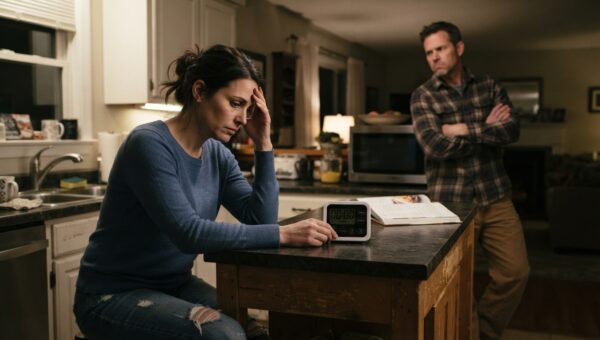
For four years, the sound of my mother’s voice on the telephone was something I avoided at all costs. Whenever her name popped up on my screen, my stomach turned into cold lead. On the rare occasions I did answer, the conversation never lasted more than two minutes. She would ask a short, polite question about my job or my garden, and then the chill would settle in.
Before hanging up, she would always find a way to let me know that the emptiness in her house was my doing.
She never had to say the exact words out loud anymore. The accusation had been carved into our lives on an overcast Tuesday morning in November, in the intensive care waiting room at St. Jude Memorial.
My father had collapsed in his workshop two nights earlier. It was a massive cardiac arrest, followed by severe oxygen deprivation. By the third morning, the neurologist and the attending physician had stood in front of us in a windowless family consultation room. They spoke in quiet, measured sentences that left no room for doubt. Dad’s brain activity was gone. His kidneys were failing. The only thing keeping his chest rising and falling was the mechanical ventilator whistling beside his bed.
I was thirty-eight years old, sitting on a low vinyl sofa, holding my mother’s shaking hand. Her wedding ring had felt icy against my knuckles.
“I cannot do it, Laura,” she had whispered, her face pale and sunken. Her voice was cracked, barely a thread of sound. “He is my husband. I promised before God I would hold on to him. If I tell them to turn those machines off, I will be killing him. You have to be the one to say it. You are his daughter. Please, Laura. Do not make me speak the words.”
I looked at her, terrified and grieving, but I loved her. More than that, I loved my father. I knew the stubborn, independent man he had been his entire life. He had spent thirty years working for the county road department, a man who built his own back deck and fixed his own truck. He had always told me that lying in a bed hooked to wires was his idea of hell.
So I stood up. I walked to the nurse’s station, signed the withdrawal of life-sustaining treatment paperwork, and stood by his bed holding his calloused thumb while the technician disconnected the tubes.
He slipped away twenty minutes later.
I thought my mother and I would grieve together. I thought surviving that terrible morning would knit us closer than ever. But grief does strange, ugly things to people. At the memorial luncheon, while people were eating ham rolls and potato salad in the church basement, my aunt Evelyn came over and gave me a long, sorrowful hug.
“Your poor mother,” Evelyn murmured softly, looking across the room where Mom sat staring into her lap. “She told me she begged you to give him another twenty-four hours. She said you just decided it was time to let him go.”
The air left my lungs in a rush. I turned and looked at my mother.
She caught my eye for half a second, then looked away, letting the women from her Sunday school circle pat her shoulder and whisper their condolences.
Over the next few months, that lie became her armor. Whenever relatives visited, she played the role of the devoted wife whose husband had been taken too soon because her daughter couldn’t bear to wait. When I finally confronted her in her kitchen three months after the funeral, she broke down in tears, slammed the cupboard door, and screamed that I had given up on him. She said I had rushed the doctors because I couldn’t handle watching him suffer.
After that, our family splintered. My brother took her side, convinced I was cold and impatient. My aunts stopped inviting me to Thanksgiving. I moved across town, buried myself in my accounting job, and learned how to live with the hollow ache of being made the villain in my father’s death.
Then, four years later, on a rainy Tuesday afternoon, my office phone rang.
“Laura Bennett?” the woman asked. “This is Margaret Vance from patient records and compliance at St. Jude Memorial. I apologize for disturbing you after so much time, but our department is currently conducting a mandatory four-year state audit of archived critical care documentation from that period.”
“Yes?” I said, my grip tightening on my pen. Just hearing the hospital’s name made my chest tight.
“We have a legal discrepancy in your late father’s physical file,” Ms. Vance said calmly. “We have your signature on the authorization to withdraw life support, timed at 11:15 AM on November 14th. However, during our physical ledger review, we located an earlier signed consent form in the backup intake envelope. It carries your mother’s signature, Helen Bennett, fully countersigned by Dr. Harrison and witnessed by the floor supervisor.”
I froze. “What did you say?”
“Your mother signed a complete legal authorization to withdraw life support at 8:10 AM that same morning,” Ms. Vance explained, her voice professional and matter-of-fact. “Three hours before you signed yours. It appears the paperwork was misplaced when the shift changed, and when you arrived, the staff had you sign a duplicate. Because the file contains two separate primary authorizations from two different family members, our risk management office requires you to come in and verify your identity on the audit form.”
I didn’t hear another word she said. The blood was roaring in my ears so loudly I had to lean against my desk to keep from falling.
Three hours before.
Before my mother wept into her handkerchief. Before she looked me in the eye and told me she couldn’t speak the words. Before she begged me to take the burden so she wouldn’t feel like a murderer.
She had already walked into that office, picked up a pen, and signed the paper herself.
PART 2
I left my desk without packing my bag, got into my car, and drove straight to St. Jude Memorial.
The compliance office was on the basement level, quiet and smelling of paper files and floor wax. Margaret Vance was a woman in her fifties with graying hair and kind eyes. She laid the original document out on the table under the fluorescent lights.
There was my father’s name, Arthur Bennett. Below it was the formal medical declaration of irreversible cessation of brain function. And right there, on the line marked Next of Kin, was my mother’s handwriting.
Helen Bennett.
The ink was dark blue ballpoint. Beside it, the date stamp read November 14, 8:10 AM. Witnessed by Nurse Supervisor R. Gable.
My own signature was on the second page, signed at 11:15 AM.
“Why would she do this?” I whispered, my fingers trembling against the glass tabletop.
“I cannot speak to your family’s personal circumstances, Ms. Bennett,” Ms. Vance said gently. “All I can tell you from the clinical log is that Dr. Harrison documented his final morning conference with your mother at 8:00 AM. She gave full legal consent immediately after that meeting. It looks like the ward clerk placed the chart in an auxiliary drawer during a resuscitation code in the adjacent room, and the mid-morning relief team thought consent had not been finalized.”
I signed the audit acknowledgment form with a hand that shook so badly the lines were jagged.
When I walked out into the hospital parking lot, the rain had picked up, drumming hard against the windshield of my sedan. I didn’t drive back to work. I took the state route north, heading toward the small brick ranch-style house where I had grown up.
Every mile felt like an eternity. For four years, I had carried the crushing guilt of that morning. I had questioned myself in the dark at three in the morning. Had I been too quick? Had I given up on my dad because I was scared? I had endured my mother’s cold distance, the whispering glances at family reunions, and the slow, agonizing death of my relationship with the only parent I had left.
She had let me carry that weight. She had watched me buckle under it, and she had stood by and let the entire family believe I was the one who gave the order.
I pulled into her driveway at two o’clock. Her small blue sedan was parked under the carport. The yellow mums she planted every autumn were blooming along the walkway, neat and tidy, just as they had always been.
I didn’t knock. I used the old brass key on my ring, pushed open the front door, and walked into the living room.
The television was on low, playing a daytime talk show. My mother was sitting on the floral sofa, a mug of tea resting on a knitted coaster on the end table. She had aged visibly over the last four years. Her shoulders were smaller, her hair entirely silver now, tucked behind her ears.
She startled when the front door shut, turning around with wide eyes.
“Laura?” she said, her voice unsteady. “What on earth are you doing here on a weekday? You didn’t call.”
“The hospital called me today, Mom,” I said. My voice was dangerously flat, stripped of every ounce of warmth.
The color drained from her cheeks instantly. It wasn’t the sudden surprise of an unexpected guest. It was the absolute, terrified stillness of someone whose oldest secret had just walked through the front door.
“The records department,” I continued, stepping into the center of the living room. “They did an audit of Dad’s file. They found your signature, Mom. November 14th. Eight-ten in the morning. Three hours before you begged me to sign. Three hours before you told me you couldn’t live with the guilt.”
My mother sat completely still. Her hands rested in her lap, fingers knotted together so tightly that the skin over her knuckles went chalk-white.
“You let Aunt Evelyn think I killed him,” I said, the words catching in my throat as four years of accumulated sorrow finally broke through. “You let Richard stop talking to me. You let me believe for four years that I made that choice alone while you were too gentle to do it. Why would you do that to me?”
My mother did not cry out. She didn’t shout or deny it. Instead, she let out a long, ragged breath that sounded like it had been trapped in her chest for years.
She stood up slowly, her knees cracking, and walked over to the oak secretary desk in the corner of the room. She unlocked the small center drawer with a tiny brass key she kept in her pocket.
From the drawer, she pulled out a thick, legal-sized white envelope. The paper was creased and slightly yellowed around the edges. On the front, written in my father’s heavy, left-handed slant, was my name: *For Laura.*
She turned back to me and held it out with both hands.
“I did what your father told me to do,” she said softly.
PART 3
I looked from the envelope to her face. Her eyes were red-rimmed, but for the first time in four years, the cold wall between us was gone. What took its place was an exhaustion so profound it made her look frail.
“Take it,” she whispered. “Arthur wrote it the week before he collapsed. He gave it to me in the kitchen while you were at work. He made me swear on our marriage vows that I would follow his instructions, word for word.”
My fingers felt numb as I took the envelope. The paper felt heavy. The seal was still completely intact, glued shut with dried clear tape across the flap.
“You haven’t opened this?” I asked.
“He told me it was only for you,” she said, leaning against the edge of the dining table for support. “He told me what was in the first part, because he had to give me my orders. But he said the rest was between him and his daughter.”
I tore open the top edge of the envelope with my thumb. Inside were three folded sheets of lined notebook paper, covered in my father’s familiar, steady script.
*Dear Laura,* the letter began.
*If you are reading this, it means my old ticker finally gave out, and you are sitting in the house without me. I am sorry to leave you to deal with the aftermath, baby girl. You have always been the strongest one in this family, even when you didn’t know it.*
*I have to tell you the truth about what is coming, because your mother will never be able to handle it on her own. Helen is a good woman, and she has loved me for forty-one years, but she carries guilt like a sack of rocks. If the doctors put me on machines, she will hold on until the bank accounts are dry and her own mind is broken. She will think every breath kept going by a pump is a sign of hope, and when the end comes, she will spend the rest of her days on this earth believing she failed me.*
*I made her promise me something last night. I made her sit down at the kitchen table and write it down. When the doctors say there is no recovery, she has to go in first and sign the release. She has to do it so the legal part is done and nobody can argue. But I told her she cannot be the one known for it.*
*I told her that when you arrive, she has to ask you to take the public step. I told her that our family, and especially her sister Evelyn, would eat her alive if she was the one who pulled the plug. They would spend every family dinner reminding her that she gave up on Arthur. Helen would crumble under that, Laura. She doesn’t have your backbone. She doesn’t know how to stand up to people.*
*I asked her to let you carry the public decision. I told her you were tough enough to take Evelyn’s sharp tongue, and that eventually, everyone would understand you were just being practical. I know that is a terrible, selfish thing for a father to ask of his daughter. It is the coward’s way out, making one child take the fire to shield the other person. But I was terrified of what would happen to your mother if she had to bear the blame of my death alone.*
My heart hammered against my ribs. The room seemed to tilt.
My father had planned it. He had engineered the entire arrangement out of a desperate, misguided attempt to protect his fragile wife from the judgment of her own family. But as I read on, my eyes caught the beginning of the fourth paragraph, and my breath caught in my throat.
*What neither of you knows,* my father wrote, *is why the doctors said there was no chance in the first place. When they examine my chart, they will tell you it was a sudden massive event. But it wasn’t sudden.*
*Three months ago, Dr. Patel called me into his office after my six-month blood panel. The heart failure wasn’t just worsening; the high-dose medication had triggered severe, irreversible toxicity in my kidneys and liver. He told me the honest truth: I had less than six months left, and continuing the treatment would only prolong the pain by a few agonizing weeks while draining every dime of our emergency savings. If I stayed on the medication, I would spend my final days bedridden, confused, and leaving your mother with a mountain of medical debt she could never repay.*
*I made my choice right there in his parking lot. I stopped taking the pills that afternoon. I didn’t tell your mother because she would have forced me back into the hospital, cried herself sick, and emptied our retirement accounts on private home nursing that couldn’t change the outcome.*
*I chose to go out on my own terms, working in my garage, with the sun shining and my mind still clear. I didn’t want Helen to know that I chose this, because she would think I didn’t love her enough to stay. And I didn’t want you to know, because you would have tried to save me from myself.*
*Forgive me, Laura. Forgive your mother. She only did what a dying old man begged her to do.*
ENDING
I lowered the pages into my lap. The silence in the living room was so thick I could hear the rhythmic ticking of the mantle clock Dad had built twenty years ago.
I looked up at my mother.
She was standing there, her shoulders hunched, tears finally spilling over her wrinkled eyelids and running down into the corners of her mouth.
“He made me promise, Laura,” she said, her voice barely louder than a breath. “He made me swear on his mother’s Bible. He said if I signed it, Evelyn and the church ladies would whisper behind my back for the rest of my life. He said you were strong. He said you lived your own life and didn’t depend on what this town thought of you.”
“And what about us, Mom?” I asked, the words raw and aching. “Did Dad tell you to hate me? Did he tell you to sit at the luncheon and tell Aunt Evelyn that I rushed the doctors?”
A sob broke from her chest, ugly and sudden. She sank down onto the edge of the sofa and covered her face with her apron.
“No,” she wept, rocking slightly. “No, he didn’t tell me to do that. That was my own cowardice, Laura. That was the most shameful thing I have ever done in my life.”
She lowered the apron, looking at me with eyes full of four years of buried self-loathing.
“When we walked out of that hospital room after he died, the guilt hit me like a train,” she cried. “I knew I had signed that paper at eight in the morning. I knew I had already agreed to let him go before you even got there. When Evelyn took my hands and said how terrible it was, I was so terrified of them finding out what I had done that I just… I let her think it was you. And once I told that first lie, I couldn’t climb back out of it. Every time I looked at you, I saw my own weakness. I couldn’t face you because you were the one who had the courage to do what I did in secret.”
I stood there, holding the letter that explained the quiet, deliberate way my father had chosen to leave this world.
He thought he was being noble. He thought he was saving his wife from financial ruin and social cruelty. Instead, he had handed her a poison that slowly destroyed the only family she had left. And my mother, overwhelmed by grief and terrified of judgment, had used that poison to build a fortress of self-pity around herself.
I walked over to the sofa and sat down beside her. I didn’t hug her right away. The pain of the last four years was too deep, too real to be erased by three handwritten pages on lined paper.
“Dad stopped taking his medicine, Mom,” I said quietly.
She froze, looking up at me, tears glistening on her cheeks. “What?”
“He didn’t have a sudden collapse,” I told her, holding out the last page of the letter so she could see his handwriting. “His organs were failing from the toxicity. Dr. Patel told him he had months left. He hid it from you so you wouldn’t spend your savings trying to keep him alive in a hospice bed.”
My mother read the lines, her lips moving silently as she traced the familiar slant of his letters. When she reached the bottom of the page, the paper fell from her fingers.
She didn’t speak. She just leaned forward, rested her forehead against my shoulder, and let out a wail that sounded like it had been locked inside her chest since the day he died.
I put my arm around her thin, shaking shoulders.
We didn’t fix four years of estrangement that afternoon. You don’t repair a shattered family in an hour, and you don’t instantly forget the sting of being blamed for a parent’s death.
The next Sunday, however, my mother called Aunt Evelyn and Richard over to the house. She sat them down at the dining table, placed the original hospital consent form from St. Jude Memorial right in the middle of the lace tablecloth, and told them the truth from beginning to end. She told them she had signed the papers, she had made the choice, and she had lied about me to protect herself.
Evelyn didn’t know what to say. Richard apologized to me in the driveway before he left, his eyes red and his head down.
My mother and I see each other every Sunday now. We have coffee on the back deck Dad built, looking out over the yard he used to mow. We talk about the flowers, we talk about the neighbors, and sometimes we talk about him.
The scar is still there, across both of our lives. But for the first time in four years, we are carrying it together, instead of using it to tear each other apart.