PART 1
My daughter-in-law, Brenda, hired a home aide for me three days a week at ninety dollars a visit, and I resented every single one of them.
I am seventy-one years old. I worked thirty-four years as a county clerk, filed my own taxes, kept my own garden, and buried my husband, Arthur, without asking a living soul for a handout.
But six months ago, after I had a dizzy spell in the grocery store parking lot and clipped a concrete light post with my bumper, Brenda decided I was falling apart. She sat at my kitchen table with her tablet open, crossed her legs, and laid out the schedule. Monday, Wednesday, Friday. Nine in the morning until noon.
“It comes out of your social security check, Helen,” Brenda told me, her voice smooth and brisk, the way people talk to children or dogs. “David agrees with me. You need supervision. We can’t be driving forty minutes out here every time you get lightheaded.”
My son, David, sat on the stool by the refrigerator, looking down at his work boots. He works sixty hours a week managing a regional plumbing supply depot. He has dark circles under his eyes that never go away, two teenage boys needing braces and college funds, and a wife who treats family life like an audit.
I didn’t want to make his life harder than it already was. So I bit my tongue, signed the checkbook over for the agency fees, and prepared to hate whoever walked through my front door.
The first two aides didn’t last three weeks between them. One spent three hours on my sofa watching reality television on her phone, and the other smelled like stale cigarettes and tried to rearrange my pantry without asking.
Then came Etta.
Etta was fifty-something, built solid and quiet, with gray threaded through her short black hair and hands that looked like they knew what real work was. She wore clean navy scrubs, wiped her sneakers twice on the welcome mat, and never once raised her voice to that patronizing pitch people use on the elderly.
She also watched everything.
On her fourth visit, a rainy Wednesday morning in late October, Etta made a pot of vegetable soup.
She chopped carrots, celery, and potatoes into neat, tiny dice, simmered them in low-sodium broth, and set a warm bowl on the table in front of me with two saltine crackers.
“Eat up, Miss Helen,” she said softly, turning back to the sink to wash the cutting board. “You need some color in your face.”
I picked up the spoon. My stomach was hollow, aching with a dull, constant hunger that had lived with me since late winter. But the moment I smelled the cooked carrots and warm broth, the panic rose in my chest.
I dipped the spoon into the bowl, lifted only the clear liquid, and brought it to my mouth. I swallowed carefully, waiting for the painful, tight squeeze in my throat to pass. Then I pushed the diced vegetables around with the tip of the spoon, hiding them under the rim, pretending to chew on a saltine that I actually dissolved against the roof of my mouth until it turned to paste.
Etta didn’t say anything right away. She dried the wooden board with a dishtowel, folded the towel over the stove handle, and walked over to the table. She pulled out the opposite chair and sat down.
Her dark eyes rested right on my bowl, then moved up to my neck.
“Miss Helen,” she said, her voice dropping low and steady. “How long have you been hiding that you can’t swallow?”
The air went out of me all at once. My hand began to tremble, and the silver spoon clattered against the porcelain bowl.
I had been living on strained broth, hot tea, and melted ice cream for nearly eight months. Whenever David and Brenda came by on Sunday afternoons, I always told them I had eaten a late lunch. I told David I just wasn’t hungry anymore, that old women didn’t burn calories like working men. I had lost thirty-two pounds since March. My cardigans hung off my shoulders like they belonged to someone else. I took safety pins to the waistbands of my slacks so they wouldn’t slide down my hips.
A heavy, suffocating weight pressed down hard on my chest.
“I’m fine, Etta,” I whispered, my voice cracking. “It’s just an old woman’s digestion. Please don’t make a fuss. David has enough on his shoulders. He has the warehouse, he has Brenda riding him about the house payments, he has the boys. I won’t be a burden to him. I can manage.”
Etta reached across the table. Her hand was warm, calloused, and firm. She took my shaking fingers and held them tight. She didn’t let go.
“This isn’t picky eating, Miss Helen,” Etta said, her eyes dead serious. “I watched your throat when you took that broth. You’re straining. Your neck muscles are corded up like rope. Something is closing up in there, and the longer we wait, the worse it gets. Being quiet isn’t saving your son. It’s going to kill you in this kitchen.”
Before I could pull my hands away or beg her to stop, Etta stood up. She took her phone out of her scrub pocket, walked over to the kitchen counter, and dialed David’s cell phone directly from the contact card taped to my refrigerator.
She didn’t ask my permission.
The phone rang three times on speaker. When David picked up, his voice was rushed and distracted, machinery humming loud in the background. “David Miller here. Is this about my mother?”
Etta didn’t hesitate for a single second.
“David, this is Etta, your mother’s aide. Drop whatever paperwork you’re doing and come get her right now. Your mother is starving to death on water and broth, her esophagus is shutting down, and if we don’t get her to an ear, nose, and throat clinic today, you’re going to find her collapsed on this linoleum.”
PART 2
David was at my front door in thirty-five minutes.
His truck was parked crooked in my gravel driveway, driver’s door left half-latched, engine ticking hot in the damp air. He came through the front door without knocking, his yellow safety vest unzipped and his face pale beneath the warehouse dust.
“Mom?” he called out, his voice sharp with terror. “Mom, what’s going on?”
I sat frozen at the kitchen table, tears burning my cheeks, humiliated to my core. Etta stood beside my chair, her hand resting firmly on my shoulder. She pointed straight down at the bowl of soup.
“Look at that bowl, David,” Etta said quietly. “Then look at her collarbones. Really look at them.”
David stopped in the middle of the kitchen. For eight months, he had looked at me during quick Sunday visits, but he hadn’t truly seen me. He had accepted my excuses because accepting them was easier than adding another crisis to his day. Now, seeing me through Etta’s eyes, the color drained from his face entirely. He walked over, dropped to his knees beside my chair, and took both of my cold hands into his work-roughened palms.
“Mom,” he choked out, his voice cracking like it hadn’t since he was a boy. “Why didn’t you tell me? Why didn’t you say something?”
“You have so much on you, Davey,” I whispered, using his childhood name without thinking. “Brenda said the household budget was tight with the aide visits. You’re working overtime every Saturday. I thought… I thought it would pass. I thought it was just nerves.”
“Nerves don’t make your throat close up,” Etta interrupted, her tone not unkind, but entirely devoid of nonsense. “We aren’t debating this. David, call the regional medical center’s outpatient clinic. Tell them your mother has severe progressive dysphagia and has had zero solid intake for months. We need an urgent evaluation.”
David didn’t argue. He dialed right from my kitchen floor.
Within two hours, David and Etta had me sitting in a small exam room at the hospital’s gastroenterology department. The nurse weighed me first. The digital scale read one hundred and four pounds. A year ago, I had weighed one hundred and thirty-eight.
A young doctor with sharp, attentive eyes named Dr. Vance examined my throat with a small light, felt the glands along my jawline, and listened to me try to swallow three small sips of water. Every sip produced a wet, hitching sound that made David flinch against the wall.
“We need a barium swallow study right now,” Dr. Vance said, typing rapidly on his portable computer. “And if that shows what I suspect, we’re doing an urgent endoscopy tomorrow morning.”
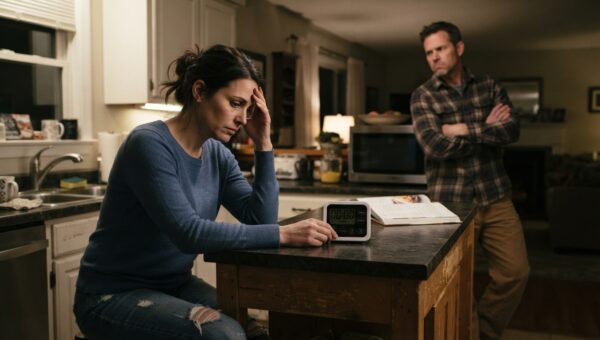
While David stepped into the hallway to sign the financial responsibility forms, his phone rang. It was Brenda. The hallway was quiet, and Dr. Vance had left the exam room door ajar to grab a wheelchair.
I heard Brenda’s voice through the receiver, sharp and piercing even from ten feet away.
“David, what do you mean you left work? Are you out of your mind? You have inventory audit this afternoon! If you lose that shift bonus, we can’t pay the second installment on the boys’ private tutoring. And why is the aide calling you instead of me? I’m the one who hired her agency!”
“Brenda, stop,” David said. His voice was lower than I had ever heard it, stripped completely of his usual placating tone. “My mother has lost over thirty pounds. She can’t swallow a cracker. She’s been hiding it because she thought she was in our way.”
“Well, she should have seen her primary doctor months ago instead of creating an emergency during work hours!” Brenda snapped back. “You know how she exaggerates things for attention, David. She probably just has acid reflux. Don’t let that home aide blow this out of proportion. We’re paying ninety dollars a day for that woman to keep things calm, not start fires.”
David didn’t shout. He just took a slow, heavy breath.
“Don’t call my phone again today, Brenda,” he said. And then, for the first time in his twenty-two years of marriage, my son hung up on his wife.
PART 3
The next morning, Dr. Vance performed the endoscopy.
David had stayed in the waiting room all night, refusing to go home to Brenda. Etta had stayed past her paid three hours, sitting in the hard plastic chair beside him until past midnight, bringing him black coffee from the lobby machine and making sure he had my insurance cards and medical history squared away.
When Dr. Vance came into the recovery alcove where I was slowly waking from the sedation, his face was grave, but not defeated.
“Helen,” he said, pulling a rolling stool close to my bed. David stood right behind him, gripping the chrome railing with white knuckles. “You have a severe, tight stricture in your lower esophagus, accompanied by an advanced pouch known as a Zenker’s diverticulum. The passage into your stomach was narrowed down to less than three millimeters. That’s about the width of a coffee stirrer.”
A cold chill ran down my arms. “Is it… is it cancer?”
“The biopsy results will take forty-eight hours to be official, but visually, the tissue appears benign,” Dr. Vance replied. “It looks like chronic, untreated severe reflux and scar tissue buildup that created a mechanical blockage. But benign or not, Helen, you were weeks away from complete esophageal closure or fatal aspiration pneumonia. If you had tried to force down solid food and it lodged in your airway, you wouldn’t have survived the night.”
He looked directly at David. “Whoever caught this and forced the issue saved your mother’s life. Literally.”
David put his face in his hands. His broad shoulders shook, the silent weeping of an exhausted man who had come inches away from losing the only parent he had left.
They kept me in the hospital for three days. Dr. Vance performed a gentle balloon dilation to open the stricture, followed by a minor endoscopic procedure to clear the pouch obstruction.
On Friday afternoon, Brenda finally showed up at the hospital.
She walked into my room carrying a designer coffee cup and an expensive flower arrangement from the florist near their subdivision. She was dressed in her neat blazer and polished loafers, ready to step in, take charge of the discharge paperwork, and regain control of the narrative.
“Helen, thank heavens,” Brenda said, stepping toward the bed with an outstretched hand and an over-bright smile. “David called me with the update. What an ordeal! I already spoke with the home care agency this morning. I told them Etta overstepped her professional boundaries by panicking David at his job instead of calling me first, so I had her reassigned. I told them we’d prefer a more protocol-driven aide moving forward.”
The room went dead silent.
David was standing by the window, watching the rain hit the glass. When Brenda said those words, he turned around slowly. The look on his face wasn’t anger. It was complete, cold clarity.
“You did what?” David asked.
“David, be reasonable,” Brenda said, her smile faltering slightly. “There are rules. Aides are supposed to follow the family contact protocol. She created chaos during your work week when a calm, scheduled appointment would have handled it.”
“A calm appointment wouldn’t have handled it,” David said, his voice terrifyingly quiet. “A calm appointment would have happened three weeks from now, when Mom was dead in her bed.”
He walked over to the nightstand, picked up his car keys, and looked at his wife.
“Etta isn’t reassigned,” David said. “I called the agency manager from the waiting room yesterday morning. I took your name off Mom’s account entirely. I am the sole point of contact. And I hired Etta privately for four days a week, paying her direct from my personal savings, at thirty dollars an hour.”
Brenda’s jaw dropped. “You used our savings without asking me? David, we have the boys’ tuition—”
“My mother is not a line item on your spreadsheet, Brenda,” David said, cutting her off without raising his voice. “For eight months, you made her feel like a burden. You made her feel like every dime spent on her care was stolen from our family. She starved herself rather than ask us for help because you treated her like an inconvenient expense.”
Brenda turned red, her mouth opening and closing. “Helen, tell him he’s being ridiculous. I’ve managed everything for you!”
I looked at Brenda. For the first time since Arthur died, the fear in my stomach was completely gone.
“Take the flowers with you when you leave, Brenda,” I said clearly. “I don’t care for the smell of lilies.”
ENDING
Brenda left the hospital room without another word, her heels clicking fast and furious down the tiled corridor.
David didn’t follow her. He pulled a chair up next to my mattress, sat down, and reached through the guardrail to hold my hand. We didn’t talk about Brenda, or the agency, or the money. We just sat together in the quiet room while the rain tapped against the glass. For the first time in five years, my son looked at me without checking his wristwatch.
Dr. Vance discharged me on Saturday morning.
When David drove me back to my small brick house, the gravel driveway looked cleaner, the porch light was on, and smoke was drifting from the chimney. Etta was standing on the front porch, wearing her navy scrubs and an old wool cardigan, waiting for us.
She had aired out the bedrooms, stripped the musty linens from my bed, and washed every sheet in lavender soap. On the kitchen counter, a slow cooker was running on low, filling the house with the rich, savory smell of chicken simmered with soft sweet potatoes and rice.
David carried my small overnight bag into the bedroom, kissed my cheek, and told me he would be back on Sunday morning with my grandsons to clean out the gutters and plant winter bulbs in the flowerbeds. He didn’t ask Brenda’s permission. He didn’t check his phone.
After he left, I sat down at my kitchen table.
Etta brought over a small ceramic bowl and a silver spoon. The soup was smooth, warm, and fragrant. She sat down in the chair across from me, folded her hands, and watched.
I picked up the spoon. My fingers still had a slight tremor, a leftover memory of eight months of fear, but I dipped the spoon into the warm broth, lifted a spoonful of mashed sweet potato and shredded chicken, and brought it to my mouth.
I swallowed.
There was no blockage. There was no sharp, tearing spasm in my chest. The food slid down smoothly, warm and rich, filling a stomach that had been hollow for nearly a year. A tear slipped over my eyelid, ran down my cheek, and dropped straight onto the table.
“Tastes alright?” Etta asked softly.
“It tastes like life, Etta,” I whispered.
Etta nodded once, satisfied. She reached across the wooden table, patted my knuckles with her warm, steady hand, and picked up her dishtowel.
“Good,” she said, standing up to check the kettle on the stove. “Eat slow, Miss Helen. We’ve got plenty of time.”