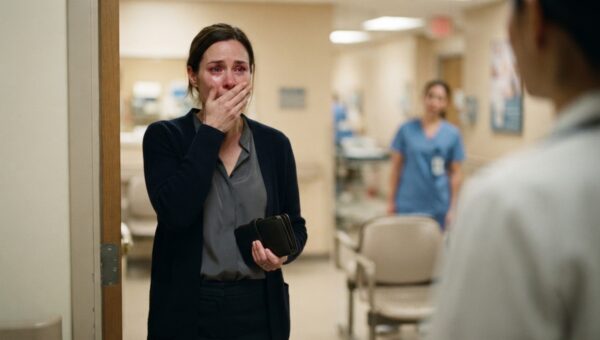
The phone call came at 12:08 PM on a Tuesday. I remember the exact time because I was looking at the digital clock on my microwave while waiting for the kettle to whistle. It was the kind of silence that feels heavy. The woman on the other end introduced herself as the nurse at Oak Creek Elementary. She sounded rushed, professional, and entirely unaware that she was about to dismantle nineteen years of my life.
“I need to reach Mr. Calhoun,” she said. “Spencer had a bad fall on the monkey bars. He’s in the infirmary and he’s asking for his dad.”
I didn’t answer right away. I don’t have a son. I certainly don’t have a son named Spencer. I told her she must have the wrong number. I told her she had the wrong house. She didn’t argue. She just sighed, a sound of practiced patience, and read the address back to me. It was my house. The street, the number, the zip code. It was all mine. She said the emergency contact card listed an Arthur Calhoun with my husband’s cell phone number.
I hung up the phone. I didn’t say goodbye. I didn’t ask if the boy was okay. I just sat down on the bottom stair of my mudroom because my legs stopped listening to me. Nineteen years. That is how long Arthur and I had been a “we.” Nineteen years of Tuesday and Thursday delivery routes that took him across the state.
Nineteen years of me carefully filing away the $1,600 monthly allowance I gave him for gas, tolls, and the occasional motel stay when the weather turned.
It wasn’t gas. It was never gas.
I didn’t wait for him to come home. I didn’t call him and ask him to explain himself, because I already knew what he would say. Arthur had a way of explaining things that made the world feel flat and simple. I drove three towns over to Oak Creek. I didn’t go inside at first. I sat in my sedan in the parking lot and watched. It felt like watching a movie where I knew the ending but couldn’t look away from the screen.
At 2:45 PM, the front doors opened. I saw him. Arthur, my husband, walked out with a seven-year-old boy limping beside him. The boy had Arthur’s hair, that same messy, stubborn cowlick that I had spent nearly two decades teasing him about.
A woman walked out behind them. She was younger, maybe thirty-eight, dressed in a retail uniform. She leaned into Arthur, her hand resting on his arm in a way that told me everything. She called him Arthur. He kissed the top of the boy’s head.
I watched them drive away in a compact SUV I had never seen before. I didn’t follow them. I went home and I opened the safe.
I have always been the one with the ledger. I am a bookkeeper by trade and by nature. Everything in my life has a column and a row. I spent the next six hours looking at bank statements I had ignored for years. I saw the patterns now. Every Tuesday and Thursday, money moved. It wasn’t for tolls. It was for a rental lease, for school supplies, for dance lessons, for life insurance. He had been building a parallel universe while I was busy balancing the checkbook.
Wednesday was the blur. I didn’t eat. I didn’t sleep. I gathered the duplicate utility bills I found stashed in the lining of his old duffel bag. I found a second tax filing. I found everything. The dread wasn’t a sharp pain anymore; it was a cold, thick fog that settled into my chest. Every time I looked at a photo of us, I felt like I was looking at a stranger.
I decided on Wednesday night that I wouldn’t do this at home. If he wanted to live his life in public, then I would finish it in public. The school newsletter on the counter said the elementary school open house was Thursday at seven.
Thursday morning, Arthur left as usual. He kissed my forehead. He smelled like coffee and the lie he’d been telling for seven years. “Be home by Friday night?” he asked.
“I’ll be around,” I said.
I spent the day preparing. I organized the documents. I put the marriage certificate on top. I didn’t cry. I think I had run out of tears before the sun even rose. I felt like a machine, humming along a track I hadn’t built.
I arrived at the school gymnasium at 6:55 PM. It was loud, filled with parents and kids and the smell of floor wax. I saw Arthur near the art display boards. He was holding a bag of cupcakes. He looked so comfortable, so domestic, so utterly in control of the two lives he had stitched together. Chloe, the woman from the school, was standing right next to him. She was laughing at something he said.
I walked up to the folding table they were standing near. I didn’t yell. I didn’t scream. I just laid the documents down, one by one. The marriage certificate. The bank statements showing the diversion of the $1,600. The duplicate insurance policies.
Arthur stopped talking. He turned and saw me, and for the first time in nineteen years, I saw the exact moment he realized his world was ending. His face didn’t go white. It just went blank.
“Elena?” he whispered.
“Tell her, Arthur,” I said. My voice sounded thin, like glass. “Tell her who you are.”
Chloe looked from him to me, then down at the papers. She picked up the marriage certificate. Her hands were shaking so hard the paper rattled. She looked at the date. Then she looked at the photos of us. She looked at Arthur, who was standing there holding a bag of cupcakes like they were a shield.
“Who is she?” Chloe asked. Her voice was barely a breath.
“She’s my wife,” I said.
The gymnasium went quiet around us. I don’t think it actually did, but to me, the sound of the children and the chatter just dropped away. Arthur tried to reach for Chloe, but she recoiled like he had touched her with a hot iron.
“You said you were a widower,” she said. She wasn’t yelling. She was just stating a fact. “You said your wife died.”
“I can explain,” he said. He sounded pathetic. He sounded small.
“Don’t,” she said.
She walked away. She didn’t look back. She didn’t even grab the boy. She just walked out of the gymnasium doors and into the parking lot. Arthur stood there for a second, looking at the cupcakes on the table, then at me. He didn’t know what to do with his hands.
“I need to go,” he said.
“You don’t have anywhere to go,” I told him.
I walked out after her, but I didn’t follow her. I got into my car and drove home. I sat in the dark for a long time. I listened to the house. It was quiet. It was a different kind of quiet than the one I had lived in for nineteen years. It was the quiet of something that had finally been put to rest.
Friday morning was cold. I woke up before the sun. I went out onto the front porch with a cup of coffee that tasted like nothing. The driveway was empty. There was no hum of his delivery van. No idling engine. No schedule.
I had his spare house keys in my pocket. He had left them on the kitchen counter the last time he walked out of this house, thinking he was going to his other life. I pulled them out and looked at the keychain. It was a souvenir from a trip we took fifteen years ago. I didn’t feel anything for it. I didn’t feel anything for the history it represented.
I walked over to the recycling bin at the end of the driveway. The sun was just starting to crest over the neighbors’ roofs, painting everything in a sharp, unforgiving light. I dropped the keys inside. They made a small, metallic clatter against the plastic.
I stood there for a moment, watching the morning break. I don’t know what happens next. I don’t know if Chloe will call the police, or if Arthur will come back here to beg, or if I will ever be able to look at a man and trust him again. I think that’s the only thing I’m sure of. I don’t have a plan. For the first time in my life, I don’t have a ledger. I don’t have a budget. I don’t have a schedule.
I turned around and walked back toward the house. The door was unlocked. I went inside and I started to pack the boxes. The sun was up now, and for the first time in a very long time, I could see the dust motes dancing in the air. They looked like they were finally free. I sat down on the kitchen chair and waited for the day to begin, and I didn’t check the clock once.