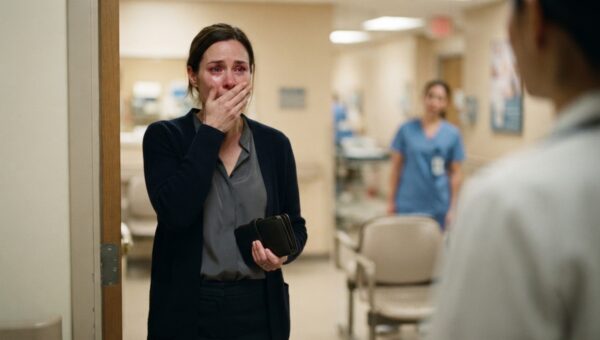
“Just put it on my tab.”
I said it so quietly that the receptionist had to lean over the granite counter just to hear me. My heart was thumping against my ribs like a trapped bird. Behind me, in the waiting area, Chloe Abbott was standing with her shoulders hunched up to her ears. Her seven-year-old son, Toby, was pressed against her leg, his face swollen on the left side, his eyes red and glassy from crying.
The portable card reader on the counter had just let out that sharp, digital chirp that meant one thing: the transaction had been denied.
I didn’t think about the office manager or the corporate policy manual that dictated we couldn’t seat a patient without a verified payment. I just looked at the way Chloe was trembling, her fingers gripping her purse like it was the only thing holding her upright, and I saw my own father standing in a drafty county clinic twenty years ago. The smell of floor wax in our lobby suddenly shifted in my mind, replaced by the sterile, medicinal scent of that old place in 2006.
“Are you sure, Maya?” the receptionist asked, her brow furrowed in genuine concern.
I just nodded, my throat feeling too tight to speak. I walked back into the clinic, my white sneakers squeaking on the linoleum, and waved for Chloe to follow me into Room Three.
I knew I was risking my position. I knew the billing department would be breathing down my neck by the end of the day. But when Toby climbed into the chair, his small hands clutching a threadbare stuffed rabbit, I knew I had made the right choice.
The next three days were a blur of nervous energy. Every time the office phone rang, I jumped. Every time the manager walked past my station, I braced myself for a conversation about unauthorized billing. But it never came. Instead, the clinic settled into its usual rhythm of polishing teeth and checking gums. I found myself thinking about the ledger, about the way kindness is supposed to be a circuit that never truly closes, just keeps flowing from one person to the next.
Then came Thursday afternoon. My schedule was light, and I was just finishing up some charting when the front desk signaled that my 2:00 PM appointment had arrived.
Leo Vance. The name didn’t ring a bell. I stepped out into the hallway to call him back, and there he was, sitting in the corner chair. He was a tall man, a bit stooped, with silver hair and hands that looked like they had spent a lifetime working on engines. He had a way of tapping his fingers against his knee that felt strangely familiar, a rhythmic, steady cadence that made me stop mid-step.
“Mr. Vance?” I said, smiling the way we were trained to do.
He stood up, his joints popping, and gave me a polite nod. As he walked toward my room, he moved with a slight hitch in his left hip. I followed him, my mind trying to place him. I had been in this practice for five years, but I couldn’t recall ever seeing him. Maybe he was a new transfer from the city clinic.
Once he was settled in the chair, I began the standard intake. I reached for his chart, but as he shifted to get comfortable, his leather billfold slipped from his coat pocket and landed on the instrument tray. He reached for it quickly, but not before a small, yellowed scrap of paper fluttered out. It looked like a carbon copy receipt, the kind they don’t even use anymore.
“Oh, sorry about that,” he muttered, reaching for it with a calloused hand.
I picked it up for him, my fingers brushing the edge of the paper. It was thick with age, the edges frayed and darkened from years of being folded and unfolded. As I held it, my eyes caught the writing on the back. It wasn’t a bank note. It was a ledger.
*68 dollars from the old man. 12 from the kid. Paid back at 2 dollars a month.*
My breath hitched. I felt the air leave the room. I looked at the date scrawled in the corner: October 14, 2006. I looked back up at Leo. The way he tapped his fingers. The hitch in his walk.
“Mr. Vance?” I asked, my voice barely a whisper. “Where did you get this?”
He paused, his eyes narrowing slightly behind his thick glasses. He looked at the paper in my hand, then up at me. For a long moment, nobody said anything. The hum of the suction machine in the next room sounded like a roar. Then, he sighed, a deep, rattling sound that seemed to come from the bottom of his lungs.
“That was a long time ago,” he said, his voice gravelly. “I kept it because I wanted to remember that there are still decent people in the world. Even when things are hard.”
I felt the tears start to prick at the corners of my eyes. I didn’t care about the patient chart anymore. I didn’t care about the schedule. I took a step closer, my hand trembling as I held the receipt out to him.
“I was the kid,” I said, my voice cracking.
Leo went still. He looked at me, really looked at me, searching my face for the ten-year-old girl he had helped two decades ago. He saw the eyes, the way I held my jaw when I was nervous, the tiny scar on my chin from when I fell off the swing set that same year. His own eyes welled up, and he reached out, his hand shaking as he took the paper back.
“Maya,” he breathed, the name sounding like a prayer. “I knew it was you when I saw your badge at the front desk. I didn’t think you’d remember an old man like me.”
“How could I forget?” I asked. “You saved me that day. My father didn’t have a cent to his name, and you and that other man, you just paid it. You changed everything.”
“It wasn’t much,” he said, shaking his head. “It was just sixty-eight dollars. But I saw your face, Maya. I saw how much pain you were in. And I saw your daddy’s heart breaking because he couldn’t fix it. I just couldn’t walk away.”
We sat there for a while, the medical instruments forgotten on the tray. He told me about how he had spent the last twenty years working as a mechanic, raising his own kids, and how he had kept that little piece of paper in his wallet through three different jobs and two moves. He hadn’t kept it to remind himself of the money. He kept it to remind himself that sometimes, the world actually works the way it’s supposed to.
When it came time for his cleaning, I didn’t use the clinic’s billing software. I logged into my own employee account, the one we were allowed to use for family and friends, and I cleared his entire balance. I wasn’t going to let him pay a single cent. He tried to argue, of course, but I just held up a hand.
“It’s been paid in full for twenty years, Leo,” I told him, smiling through my tears. “I’m just finally closing the ledger.”
The next week was different. Chloe and Toby came back for their follow-up, and I made sure they were scheduled at the same time as Leo’s final checkup. When I brought them into the waiting room, I saw them sitting together, Leo showing Toby a trick with a coin, and Chloe looking like she had finally been able to breathe for the first time in months. They didn’t know the history between us, but they felt the weight of it. We all did.
My manager, Sarah, came out of her office while we were standing there. She looked at the four of us, then at the receipt I had framed on my desk, and she didn’t say a word about the money I’d waived. Instead, she just sighed, pulled out her own checkbook, and asked me how we could start a fund for the other families who walked through our door with empty pockets and aching teeth.
That afternoon, I went to the breakroom and took a photograph of the three of us, me, Leo, and Toby. I pinned it to the corkboard next to the coffee maker. Underneath it, I placed a small glass jar, the kind we used for loose change. I put a dozen crisp one-dollar bills inside, right at the bottom, just to get it started.
It cost me my professional composure, I guess. I cried in front of a patient, and I skirted the rules of the clinic, and I’m probably going to have to explain the ledger entries to the corporate office at the end of the month. But as I look at that jar, I know that the ledger isn’t really about money. It’s about the fact that we’re all just waiting for someone to notice when we’re short. I’m just glad I finally got the chance to be the one who filled the gap.