The rubber chew toy was crusted with dried mud and slobber, a relic of a life that felt like it had belonged to someone else entirely. I didn’t even want to touch it. I had been clearing out the hallway closet for three hours, trying to justify the $2,800 a month I was paying for this shoebox apartment in Seattle.
It was sterile, quiet, and completely devoid of the mess that Leo used to bring into every room he entered.
Leo had been gone for six months. The accident was one of those things that just happens, or so the police said. A slick patch of road, a sharp turn, and a guardrail that didn’t hold. I had spent those six months drowning in compliance reports and quarterly audits, trying to convince myself that if I just worked hard enough, the hollow feeling in my chest would eventually get filled up.
Barnaby had been the last piece of Leo I had left. He was twelve years old, his muzzle turned a soft, dusty white, and he moved like he was wading through waist-deep water. When my building manager sent that third notice about the pet policy, I felt like I was being squeezed from all sides. I couldn’t keep him.
I told myself I was doing the right thing by finding him a place where he could be cared for properly.
Marcus Vance was the one who met me at the shelter gate. He had a way of talking that made you feel like you were doing the world a favor by handing over your burdens. He wore a crisp polo shirt and a smile that never quite reached his eyes.
“We specialize in senior hospice care for animals like him,” he said, his voice smooth as glass.
I handed him the fifty-dollar surrender fee, my hands shaking just a little.
“Will he be okay?” I asked.
Marcus patted Barnaby on the head, a gesture that looked practiced rather than kind. “He’ll be with friends.”
Two weeks later, the call came. It was a Tuesday, 4:12 in the afternoon, right when I was finishing up a review on a municipal contract.
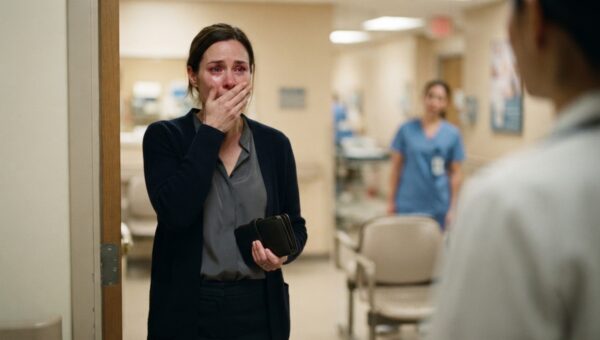
The voice on the other end was clipped and businesslike. They said Barnaby hadn’t woken up from a routine dental cleaning. Complications, they called it. I felt a surge of nausea so strong I had to sit down on the floor of my office. I had sent him there to be cared for, and he’d died alone in a metal cage.
That was why I was holding the chew toy. I wanted it gone. I wanted the guilt gone. I took a utility knife from the kitchen drawer and cut into the rubber, intending to snap it in half so it would fit into the trash bin without springing back up. The blade slipped, the rubber gave way with a wet, tearing sound, and something metallic clattered against the floorboards.
It was a rusted brass key. It looked like it had been buried in the rubber for years. Tucked inside the slit was a scrap of paper, the ink slightly blurred by dampness.
I didn’t recognize the handwriting at first, but then I saw the way the letters slanted to the left. It was Leo.
*If he gave you this, it means they finally found truth.*
I sat on the floor for a long time, the toy in one hand and the key in the other. My brain was racing, trying to connect the dots between my brother’s death, a senior dog shelter, and a key I didn’t recognize. I remembered how Leo used to get when he was working on his investigative pieces. He would leave notes everywhere, hidden in the most mundane places. He didn’t trust digital files. He didn’t trust the cloud.
I spent the rest of the night digging through the boxes I had stored in the back of my closet. I found his old flash drive, the one the police hadn’t been interested in because they said it was corrupted. I plugged it into my laptop. It wasn’t corrupted. It was just encrypted.
I looked at the key again. It was stamped with a small, stylized letter M. I spent three hours going through Leo’s bookmarks until I found a link to a downtown mercantile bank that had gone out of business four years ago. The building was still there, though. It was now a private storage facility.
I didn’t sleep. I just waited for the sun to come up, my eyes burning, my heart thumping against my ribs like a trapped bird.
At 8:00 AM, I was at the facility. The manager was a woman with sharp eyes who didn’t seem surprised to see me. When I showed her the key, her expression didn’t change, but she gestured toward a row of old, heavy steel boxes.
“Box 412,” she said.
I moved the key into the slot. It turned with a heavy, satisfying click. Inside was a single manila envelope. I pulled it out, my fingers trembling so hard I could barely open the clasp.
It wasn’t just files. It was evidence. There were bank statements for the shelter, showing huge, anonymous grants from a municipal development fund. There were copies of property deeds for elderly people who had died under mysterious circumstances. And there was a ledger, handwritten by Leo, documenting how Marcus Vance would suggest surrendering a pet to a grieving family, then use the intake process as a way to get a look at the house, the insurance papers, and the safe combinations.
The realization hit me like a physical blow. Barnaby didn’t die of natural causes. He was a witness. He was in the house when Leo was killed, and he had been taken to the shelter because Vance needed to get rid of the dog before someone realized he had seen something. When I surrendered him, I hadn’t been handing over a burden. I had been handing over the only thing that could have stopped them.
I felt a scream rising in my throat, but I forced it down. I wasn’t just some grieving sister anymore. I was a compliance auditor. I knew how to follow a trail. I knew how to build a case that couldn’t be ignored.
I went to the police precinct. I didn’t go to the front desk. I asked for Detective Sarah Lin. I had read her name in one of Leo’s files. She was the only one who hadn’t signed off on the initial accident report.
“You shouldn’t be here,” she said when she saw the envelope.
“He’s still doing it,” I said, my voice shaking but firm. “He’s using the shelter to steal homes from people who don’t have anyone left.”
“I need more than this,” she whispered, looking around the crowded room.
“I have the audit logs,” I said, sliding the flash drive across the table. “I have the match between the shelter grants and the property transfers.”
She looked at the drive, then up at me. “If this is what I think it is, we need to move fast.”
The next few days were a blur of meetings, hushed phone calls, and the cold, hard reality of what Leo had been fighting. We tracked the money. It was messy, complicated, and entirely damning. The shelter wasn’t a charity. It was a clearinghouse for theft.
On Friday, the raid happened. I was there, sitting in the back of an unmarked car, watching as the police swarmed the industrial outskirts of the city. I saw Marcus Vance being led out in handcuffs. He looked smaller than I remembered, his face gray and drawn, his eyes darting toward the street as if he were looking for an exit that didn’t exist anymore.
I got out of the car. I walked up to him, right there on the sidewalk. He looked at me, and for a second, I saw a flicker of recognition.
“You killed him,” I said. It wasn’t a question.
He didn’t say anything. He just looked away, his jaw clamped shut. I reached into my pocket and pulled out the split rubber chew toy. I dropped it on the ground at his feet.
“He was a good dog,” I said.
He didn’t look at it. The officers pushed him into the back of the cruiser, and the door slammed shut with a finality that echoed in the cold air.
The aftermath was long. There were depositions, court dates, and the slow, painful process of returning the seized properties to the families who had been targeted. I kept my job, but I changed the way I worked. I stopped looking at spreadsheets as just numbers. I started looking for the people behind them.
I moved out of the high-rise. I found a place with a small yard, a place where a dog could run without someone complaining about the noise.
I still have the key. It sits on my windowsill, right next to a photo of Leo. It’s rusted and old, but it reminds me that the truth isn’t something you find. It’s something you have to be willing to tear open a piece of your own life to uncover.
Today, I’m sitting on my living room floor. I’m holding a bright, neon-yellow tennis ball. Across from me, a golden retriever mix named Barnaby, a different Barnaby, a rescue from the county pound, is waiting with his tail thumping against the floor.
I throw the ball. He scrambles after it, his claws clicking on the hardwood, his ears flopping with every step. He looks happy. He looks safe.
I lean back against the wall and watch him play. The house is quiet, but it’s a good quiet. It’s the kind of quiet that feels earned. For the first time in a long time, I don’t feel like I’m drowning. I feel like I’m finally starting to breathe.