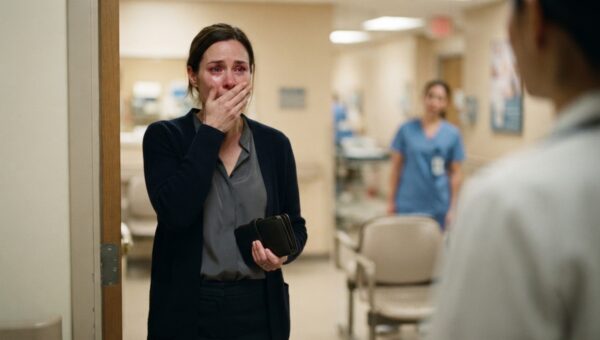
“Just leave the ice bucket on the vanity, Elena, I will be down in ten minutes.”
That was the last thing Kiry said to me before my entire life collapsed. It was 11:52 PM on New Year’s Eve, the twenty-second anniversary of the day we stood in front of a judge and promised to be honest with each other. I remember the sound of his voice, calm and steady as always, drifting from the master bedroom while I stood in the kitchen finishing the appetizers.
I didn’t think twice about it. I just grabbed the champagne, checked my reflection in the hallway mirror, and climbed the stairs with the kind of lighthearted anticipation that only twenty-two years of routine can build.
I pushed the bedroom door open with my shoulder, the ice bucket heavy in my arms. I didn’t knock because you don’t knock on your own bedroom door. I didn’t expect anything other than to see my husband adjusting his tie or maybe checking his watch. But the air in the room felt different the moment I stepped across the threshold. It was heavy, thick with a scent that didn’t belong in our house, a sharp, cloying perfume that made my stomach turn over before my eyes even processed the scene.
Kiry was there. And my mother, Sylvia, was sitting on the edge of our bed, her hand still resting on his forearm.
The silence that followed wasn’t just quiet. It was a vacuum. It sucked the air right out of my lungs until I couldn’t even manage a gasp.
I just stood there, the ice bucket slipping slightly in my grip, watching them freeze in a tableau of absolute, sickening familiarity. They weren’t strangers caught in a moment of weakness. The way they looked at each other, the way he didn’t even try to pull away from her, told me everything my brain was trying to reject.
“Elena,” Kiry finally said, his voice flat.
I didn’t say a word. I turned around, walked out of the room, and went straight to the garage. I didn’t scream. I didn’t throw the champagne. I just felt this cold, hard stone settling into the center of my chest, a weight so heavy it felt like it was pressing my heart into dust. I got into my car, backed out of the driveway, and drove into the whiteout conditions of the Ohio storm. I didn’t know where else to go, so I went to my father’s house.
Arthur was waiting up for the new year, just like he always did. When he opened the door and saw me, covered in snow and shaking, he didn’t ask questions. He just led me to the kitchen and poured a glass of whiskey. I sat there for three hours, and I told him everything. Not just what I saw. I told him about the way my mother had always inserted herself into our marriage, the way she had subtly undermined every decision I made, and how Kiry had always, always deferred to her.
“She was never just visiting,” I said, my voice sounding like it belonged to someone else. “She was running it.”
Three days later, Arthur sat me down at his kitchen table. He was a man of the earth, a retired surveyor who spent his life measuring boundaries and ensuring the ground was level. He looked at me with eyes that had seen enough to know when the earth was shifting.
He had already contacted a firm downtown. The results of the DNA panels he had ordered in secret were sitting in a manila envelope between us.
“We need to know, Elena,” he said. His voice was steady, but I saw his hands trembling for the first time in my life.
I opened the envelope. I don’t remember reading the words on the page, but I remember the feeling of the paper in my hands. It was crisp, official, and utterly final. It wasn’t just the affair. It was the children. The paternity markers, the genetic drift, the undeniable math of it all. It was all there in black and white. Kiry and Sylvia had been playing a game with my life since the very beginning, a game where the pieces were my own flesh and blood.
I looked at the numbers and realized I hadn’t just been betrayed. I had been erased. Every birthday party, every school play, every quiet night on the porch, it was all built on a foundation of sand. I went to the guest room and packed a single bag for me and the kids. I didn’t tell anyone where we were going.
The next week was a blur of legal motions and quiet, methodical survival. I spent 14 hours a day in the offices of a high-end firm, my architectural brain finally finding a use for its obsession with detail. I audited every account. I traced every penny. I found the hidden ledger in the floor safe in the office Kiry and I had shared for years. It was a joint account in his and my mother’s names, holding $49,404 in assets they had siphoned from my business over the last six years.
“They thought I wasn’t looking,” I whispered to my lawyer.
“They thought you were an architect who only looked at the roof,” he replied. “They didn’t realize you built the foundation.”
The final confrontation happened at Arthur’s house on a Tuesday. Kiry showed up, thinking he was going to charm his way back into a life he had already forfeited. He walked in with that easy, practiced smile, the one that had fooled me for twenty-two years. But the room was different this time. Arthur was standing by the fireplace, and I was sitting at the table with the files spread out in front of me.
“Elena, let’s just talk about this,” Kiry started, his smile faltering as he saw the look on my face.
“There is nothing to talk about,” I said. I slid the DNA report and the ledger across the table. “You and my mother have been sharing a life for twenty-two years. And now, you’re done.”
He looked at the papers, and for a second, I saw his entire mask slip. The arrogance, the charm, the practiced deception, it all vanished, leaving behind nothing but a scared, small man who realized he had finally pushed too far. He tried to reach out to me, to touch my hand, but I recoiled as if he were burning me.
“Don’t,” I said. “Just leave.”
He didn’t argue. He didn’t have a leg to stand on, not with the documents I had gathered. He turned and walked out the door, and that was the last time I ever saw him. My mother didn’t even try to reach out. She retreated into her house, surrounded by the silence of a life she had burned to the ground for a man who wasn’t even worth the effort.
I moved into a small apartment on the other side of the city a month later. It wasn’t much, just a sunlit space with tall windows and enough room for the kids to breathe. I set up my drafting table in the corner where the light hits the floor the best. It’s quiet here. There is no background noise of hidden agendas or secret phone calls.
I sit here every morning while the kids are at school. I look at the blank paper and I start to sketch. I don’t look at the past anymore. I don’t spend time wondering how I didn’t see it, or why they were so cruel. I just focus on the lines. I make sure they are straight. I make sure the load-bearing walls are exactly where they need to be.
Sometimes, late at night, I think about the ice bucket. I think about the way the silver caught the light in the kitchen, and how I thought that bucket was the most important thing in the world. Now, I see it for what it was. A prop in a play I didn’t even know I was acting in.
I take my pen and I draw a single, clean line. It’s a start. I don’t know what the house will look like when I’m finished, or if I’ll ever fully trust someone again. But that doesn’t matter right now. What matters is the ink. It’s blue, and it’s permanent, and for the first time in my life, I am the only one holding the pen. I look out the window at the morning sun, and I realize the foundation isn’t built on what they did to me. It’s built on the fact that I’m still here. I am still standing. And for now, that is enough.