I didn’t expect to be a hero, and I certainly didn’t plan on being a liability. I was just a kid working the night shift at the local pizza joint in Cincinnati, just trying to keep the lights on at my mom’s place. It was November 14th, a Tuesday, and the rain was coming down in those icy needles that cut right through your jacket.
The roads were slick, and I’d been on my feet for six hours straight, my shoes squishing with every step I took back to the sedan.
I had one last delivery to make before I could clock out and maybe get a few hours of sleep before my morning classes. The address was out by the industrial district, where the buildings are mostly rotting brick and broken windows. Unit 4B was at the very top of an exterior metal stairwell that shook every time the wind hit it. When I knocked, I wasn’t expecting much. I was just looking for a signature and a tip, in that order.
A woman opened the door, and I stopped breathing for a second. She couldn’t have been more than thirty, but her eyes looked like they’d seen fifty years of hard luck. She was holding a toddler on one hip, and another kid was huddled behind her leg, staring at the pizza box like it was made of gold.
They were shivering, and the apartment behind them looked bare, like they were already halfway moved out or never really moved in.
I looked at the bill, then at the kids, then at her. She didn’t say a word, just reached out a hand that was trembling so hard it looked like she had the tremors. She didn’t have the tip. She didn’t even have the full payment for the delivery fee. I could have called it in. I could have told her I couldn’t accept it, but I saw the way those kids were looking at the box. I felt a weird, sharp ache right in the middle of my chest.
I did something stupid. I reached into my own wallet and pulled out my last twenty-dollar bill. It was supposed to be my lunch money for the rest of the week, maybe a bit of gas for my clunker, but I pressed it into her hand anyway.
I told her to get them some milk and eggs. She didn’t even look up at me. She just clutched the money like it was a lifeline, and her whole body sagged. I turned around and walked back down those stairs, my own stomach feeling hollow, but somehow, I felt lighter.
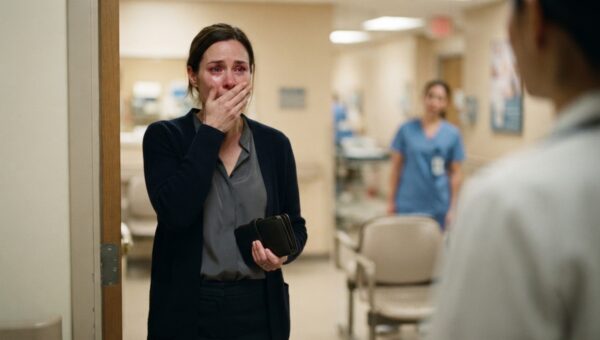
Two days passed, and I figured that was the end of it. Then, on Thursday afternoon, Marcus, our regional manager, pulled me into his office. Marcus is the kind of guy who measures human worth in pizza-per-hour metrics. He was sitting behind his mahogany desk, and he didn’t look happy. There was a woman sitting in the chair across from him, and she looked like she’d been crying for three days straight.
“Sit down, Leo,” Marcus said, his voice cold enough to freeze water.
I sat, my palms sweating into my jeans. I thought I was getting fired for the delivery or for breaking some obscure corporate rule about unauthorized charity.
I looked at the monitor on his desk. He’d pulled up a high-definition frame from a security camera. It was me on that porch, the exact moment I handed the twenty over to her. I felt like I was dying. I couldn’t think of a single thing to say.
“Do you know why corporate flagged this, Leo?” Marcus asked, his fingers drumming on the desk.
I tried to swallow, but my throat was tight. “I was just trying to help, sir. I’ll pay back the money if that’s the issue. Please don’t fire me.”
The woman in the chair, Sarah, finally looked up at me. She wasn’t my manager, and she didn’t look like she was there to fire anyone. She looked like she was mourning something. She stood up, her hand shaking, and pointed at the screen. “That’s my daughter,” she whispered.
The silence in that office was heavy. I realized then that I wasn’t just in trouble. I was the bridge between two people who hadn’t spoken in years. Sarah was the owner of the franchise, a woman who owned half the town, yet she’d been scouring the industrial side of Cincinnati for her own blood for half a decade. She’d cut off the kids from her own inheritance because of some bitter pride, and my twenty-dollar bill had been the catalyst that brought her daughter to the point where she finally needed someone to see her.
Sarah looked at me, not with the corporate detachment I’d expected, but with a raw, ugly desperation. “She didn’t want my money,” Sarah said, her voice cracking. “She wanted to know that someone in this world still cared, even when she had nothing left to give.”
I didn’t have any grand words. I just nodded, feeling like a total stranger to my own life. Marcus was looking back and forth between us, clearly trying to figure out how to spin this for the company, but Sarah didn’t care about the metrics anymore. She walked over to the desk and shut the monitor off. She looked at me and said, “You didn’t break any rules today, Leo. You just reminded me why I started this business in the first place.”
She tried to hand me a thick envelope, telling me it was a reward for my integrity, but I couldn’t take it. It felt wrong to monetize the night I’d seen a mother crying over a twenty-dollar bill. Instead, I asked for something else. I asked her to help the families in those apartments. I asked for a meal program, something steady, something that didn’t require a security camera to trigger a moment of grace.
The next few weeks were a blur of meetings and paperwork, but the fear eventually drifted away. I kept my job, but I wasn’t just a delivery boy anymore. We set up the outreach program, and it became a permanent fixture for the Fifth Street complex. I saw Clara, the woman from the porch, once more in the lobby of the main office. She didn’t say much, just gave me a quick nod that said more than a dozen speeches ever could. The wall between her and Sarah hadn’t vanished, but the door was unlocked, and that was enough.
My life changed in ways I still don’t quite understand. I wasn’t just working to keep the lights on for my mom anymore. I was working to keep something better going for the people who really needed it. I ended up getting a scholarship through the company foundation, something I never would have dreamed of while I was out there in the rain.
When I finally walked out of that pizza parlor for the last time, it was a Tuesday again. The sun was hitting the pavement in a way that made the whole city look like it was waking up from a long, cold dream. I had my acceptance letter for night school tucked into my back pocket, and my delivery visor sat on the front desk, just another piece of plastic that didn’t belong to me anymore. I stepped out into the crisp afternoon air, feeling the weight lift off my shoulders, and for the first time in eighteen years, I didn’t have a delivery to make. I just started walking.
I realize now that life isn’t about the metrics or the rules we follow to keep the machine running. It’s about the moments we choose to stop and pay attention, even when it costs us the last twenty dollars we have in our pocket. I don’t know if Clara and Sarah will ever be right again, but they have a chance now. That’s all any of us can ask for. The silence in the parking lot was quiet, but it was the kind of quiet that felt like peace. I finally understood that we aren’t just here to survive. We’re here to see each other. And I guess that’s enough to keep me moving forward.