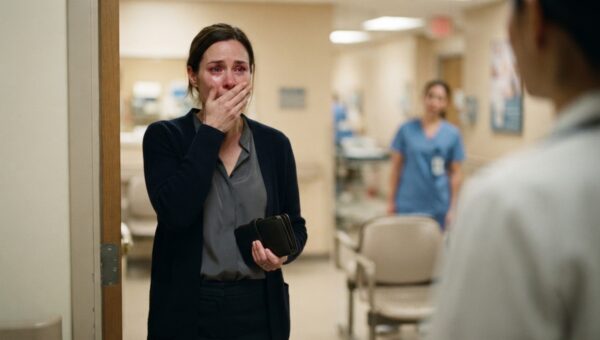
The smell of antiseptic and stale coffee in Maplewood Senior Living Room 212 was something I thought I would be able to shake off by the time I got to the parking lot. I was wrong. It clung to my clothes like a physical weight. My father, Arthur, had been gone for two days. I was just there to finish the job of clearing out his life.
He was a man who measured his world in wood grain and precise measurements, and his room reflected that. Everything was in its place, right down to the hand-carved cedar bird decoys he had spent his final, breathless weeks finishing for me.
I was wrapping the last decoy in bubble wrap when the door swung open. Brenda didn’t knock. She never had. She was my father’s ex-wife, a ghost who had vanished from our lives fifteen years ago after a divorce that left my father with nothing but his pension and a heart full of bitterness. She walked in like she owned the place, her heels clicking against the linoleum with a rhythm that sounded like a demand. She didn’t look at the photos of me on the dresser. She didn’t look at the chair where I had sat for weeks holding his hand while he fought for every gasp of air.
“I imagine you are surprised to see me, Elena,” she said. Her voice was thin, like dry paper. She dropped a heavy designer bag onto the bed, right on top of his folded sweaters. She didn’t offer a hug or a condolences card. She just reached into her bag and pulled out a single sheet of lined notebook paper. It was folded into thirds, the edges soft from being handled. “Arthur made his wishes clear before the end. He knew who really looked after him.”
She tossed the paper onto the mattress. I picked it up, my hands feeling heavy and slow. It was a will. It looked official enough at a glance, written in the sloping, distinctive cursive I knew better than my own. It named Brenda as the sole beneficiary of his life insurance policy, a payout I knew totaled $850,000. It was dated three days before he died, back when he was so heavily sedated he couldn’t even lift a glass of water.
My stomach did a slow, sickening roll, but I forced myself to keep my eyes on the page.
I scanned down to the witness section. That was where the floor should have fallen out from under me. I didn’t scream. I didn’t even gasp. I just felt a sudden, cold clarity settle into my bones. There was Brenda’s signature, loops and sharp angles. And right next to it, written in the neat, practiced hand I had spent eight years waking up to every morning, was the signature of my husband, Marcus.
“The insurance company has already been notified,” Brenda said, her eyes fixed on my face, waiting for me to break. “You should start packing. It is a long walk to the car.”
I looked at that signature again. Marcus. My husband. The man who had held me while I cried after the funeral service. The man who told me he had been working late at the accounting firm every night for the last two weeks, just so he could afford to take time off to help me with the estate.
I felt like I was standing in a room where all the oxygen had been sucked out. But I knew one thing: I couldn’t let her see me lose control. If she saw me panic, she would win.
“I need a copy of this for my records,” I said. My voice sounded foreign to me, tight and flat. I didn’t look up at her. “I have to send it to the estate lawyer.”
Brenda smiled then, a thin, hungry line. She clearly thought I was just another daughter being put in her place. She let me take the paper to the front desk, where I used the office copier. I watched the machine hum, the light flashing across the paper, and I realized I was documenting the end of my life as I knew it. When I walked back into the room, I handed the original back to her and kept the copy tucked deep inside my purse.
The drive home was a blur of gray highway and white knuckles. I didn’t turn on the radio. I didn’t answer the phone when Marcus called to ask how the cleanup was going. I just drove. By the time I walked into our colonial home in the suburbs, the sun was setting, casting long, bruised shadows across the kitchen island. I went straight to the home office. Marcus was at the gym. I had maybe an hour.
I sat at his desk, the one where he sat every night working on spreadsheets that were never there. I didn’t look for affection. I looked for debt. I went into his filing cabinet, pushing aside the folders for our taxes and our mortgage until I found the hidden one. It was tucked behind a false backing in the bottom drawer. Inside were bank statements from an account I didn’t even know we had. It was a disaster zone. Overdrafts, collections, and transfers to an offshore firm I’d never heard of. It added up to thousands. He was drowning. The insurance money wasn’t for Brenda, not really. It was a bailout.
I felt a sudden, sharp ache in my chest. He wasn’t just a traitor. He was a coward. I heard the front door open, the sound of his keys hitting the bowl in the foyer. I didn’t move. I heard his heavy footsteps coming toward the kitchen. He walked in, his gym bag over his shoulder, looking like the man I thought I loved. He saw me sitting there and stopped, his smile faltering as he caught sight of the folder spread out on the desk.
“Elena? What are you doing?” he asked. His voice was casual, almost practiced.
I didn’t answer. I just stood up and walked to the kitchen island, placing the copy of the will I’d gotten from Brenda right next to his bank statements. The silence in the room was deafening. Nobody said anything for a second and honestly that felt worse. I watched his face. I saw the moment the blood left his cheeks. I saw the way his eyes darted to the witness signature, then back to me, the color draining until he looked like a ghost.
“I went to the nursing home today, Marcus,” I said. I kept my voice steady, though every part of me wanted to scream. “I saw the paperwork. I saw your name.”
He started to talk then, a torrent of words. He said he was just trying to help us. He said he’d made a mistake, a bad investment, a series of losses he couldn’t stop. He talked about market downturns and temporary loans. He didn’t say the word forgery, but he didn’t have to. He was sweating, his corporate composure crumbling into a puddle of panic. “I can fix this, El. It was just to cover the gap. We can talk to the insurance company together and say it was a misunderstanding.”
I didn’t want to hear it. I pulled a thick envelope from under the laptop. It was a formal separation agreement, one I’d drafted back when I was a law clerk before I shifted into design. I slid it across the quartz countertop along with the nursing home visitor logs I had secretly requested from the administrator on my way home. The logs showed he had visited my father’s room alone, late at night, on the Tuesday before he passed.
“I already contacted the fraud investigator,” I said. I watched his face go slack. “The account is frozen. The will is being flagged. You are done, Marcus.”
He looked at me, really looked at me, as if seeing a stranger. He reached out to touch my hand, but I stepped back. There was no more space for us. He knew it. I knew it. He didn’t even argue. He didn’t try to beg once he saw the look in my eyes. He just turned around, his shoulders slumped, and walked toward the bedroom to pack a bag. I stood in the kitchen and listened to the sounds of him moving, the closet door opening, the zip of a duffel bag, the heavy thud of a suitcase on the floor.
It took him twenty minutes. When he came back out, he didn’t say goodbye. He just let the front door click shut behind him, the sound final and hollow. I walked over to the kitchen windowsill, where the last of the evening light was catching the edges of the jars I kept for herbs. I unclasped my silver wedding band, the one he had placed on my finger eight years ago in a church that feels like it belongs to another woman.
I opened the jar. I dropped the ring inside. I watched the heavy metal settle against the bottom with a dull, flat thud. It was over. I was finally alone, but for the first time in months, the air in the house didn’t taste like lies. I sat there in the dark and waited for the quiet to become my own.