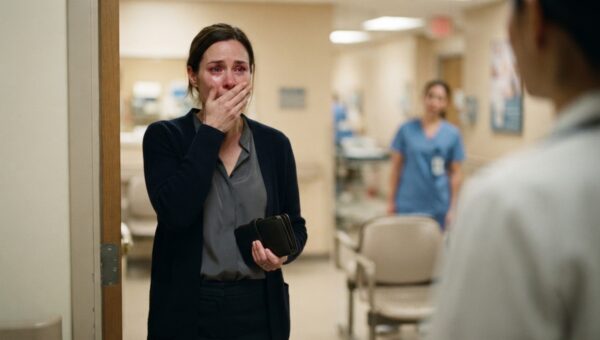
The plastic snap-lock on Leo’s lunchbox made a sharp, familiar click. I slid the turkey sandwich, the sliced gala apples, and the little juice box into his bag just like I had every morning for the last two school years. It was 7:22 AM, the kitchen was still draped in that early morning blue light, and my biggest concern was whether he would actually eat the crusts today.
I was an accountant by trade, so I lived my life in rows and columns, in predictable patterns that balanced out by the end of the day. Forty-five dollars a week in groceries. Five days of lunches. One happy seven-year-old boy. Everything had a place. Everything had a reason.
The call came on a Tuesday, right in the middle of a spreadsheet reconciliation. My phone buzzed on the mahogany desk, displaying the school’s office number. I felt that quick, sharp prick of annoyance, wondering if Leo had forgotten his gym clothes again. When I answered, it wasn’t the secretary. It was Mrs. Gable, the cafeteria lead, and her voice sounded tight, like she was holding her breath.
“Elena, I need to talk to you about Leo,” she said. She didn’t sound angry, but she sounded worried. “He’s been giving away his entire lunch every single day for five months. Every last crumb.
The girl he gives it to never brings anything of her own. She looks like she’s fading away right before our eyes.”
I blinked at my screen. “Giving it away? Are you sure? Maybe he’s just not hungry.”
“He’s hungry, Elena,” she whispered. “And the girl, Lily? She wears long sleeves even when it’s eighty degrees. I saw a bruise on her wrist when she reached for his juice box yesterday. I think you need to come down here.”
I didn’t finish the spreadsheet. I didn’t even turn off my computer. I just grabbed my keys and drove to the school, my hands gripping the steering wheel so hard my knuckles turned a dull, aching white. I kept telling myself it was just a misunderstanding, a case of a kid who forgot his lunch money, but the word bruise kept circling in my brain like a vulture.
I found them near the edge of the playground during recess. Leo was sitting on a bench, handing a small container of carrot sticks to a girl who looked no older than him, but a thousand years more tired.
Her eyes were sunken, her skin a pale, papery gray. When I knelt down beside them, the girl flinched so hard she nearly fell off the bench. I saw the sleeve of her oversized, dirty sweatshirt hike up just an inch, and there it was. A ring of dark, purplish bruising around her wrist, jagged and deep.
“Lily?” I said, trying to keep my voice steady, trying not to let the scream I felt in my throat escape.
She wouldn’t look at me. She just clutched the carrot sticks to her chest like they were gold. Leo reached out and touched her hand, his voice small and terrified. “She told me her dad locks the kitchen, Mom. She told me there’s no food there.”
I didn’t wait for the principal. I didn’t wait for a meeting. I walked back to my car, my lungs feeling like they were full of broken glass, and I dialed the number for children’s services.
I told them everything. I gave them my name, my address, and the location of the house I’d seen Lily walking toward after school. I waited in the parking lot for forty minutes, watching the school building until a silver sedan pulled in.
The caseworker was a woman who looked as tired as I felt. We walked to the address together, trailed by a local patrol officer. It was a nice street, one of those cul-de-sacs where the lawns were manicured and the mailboxes were all uniform. The house looked perfect from the outside. Arthur Chen answered the door, his smile bright and polished, his hair combed neatly to the side.
“Can I help you?” he asked, his tone dripping with fake, practiced warmth.
The officer explained why we were there. Arthur’s face didn’t twitch, but the air around him seemed to grow cold. “That’s ridiculous,” he said, his voice dropping into a smooth, condescending register. “Lily is a sensitive girl. She bruises easily. And as for lunch, she’s a picky eater. You’re harassing my family over nothing.”
He started to close the door, his hand firm on the frame. “You need a warrant to step foot on this property. Leave now, or I’ll have my lawyer calling the chief.”
But then, it happened. From somewhere deep inside the house, a sound drifted out. It wasn’t a cry. It was a rhythmic, muffled thumping, like someone kicking against a wooden door, over and over, with no hope of being heard.
The officer didn’t hesitate. He put his boot against the frame and shoved. “Police, step aside!”
The house was dark, the curtains drawn tight in the middle of the day. We followed the sound to the back hallway, where a heavy, solid-core door had been fitted with a high-end deadbolt. It didn’t look like a pantry. It looked like a tomb. Arthur tried to tackle the officer, his charming mask finally cracking into a snarling, desperate mess of rage, but he was pinned against the wall in seconds, the sound of the handcuffs clicking shut echoing off the floorboards.
The officer twisted the key. The door swung open, and the smell hit us first. Stale, sour, and suffocating. Lily was curled in the corner of a windowless pantry, surrounded by nothing but cleaning supplies and empty boxes. She was unresponsive, her skin waxy and cold, her eyes staring at a spot on the wall as if she’d long ago stopped expecting anyone to look for her.
“Get the paramedics in here now!” the officer roared.
The rest of the afternoon was a blur of flashing lights and shouting. I sat on the grass, trembling, watching them carry her out on a stretcher. She was wrapped in a thermal blanket, her tiny, frail hand hanging off the edge, silent and still. Arthur was screaming on the porch, not about her, but about his rights, about his reputation, about how this was all a misunderstanding. He looked small. He looked pathetic.
I don’t remember the drive home. I don’t remember walking through my front door. I just remember the silence. It was 8:00 PM when I finally sat down on the rug in our living room. The house felt like it was spinning, the walls closing in, the weight of the last twelve hours pressing down on my chest.
Leo was in the corner, his wooden blocks stacked in a perfect, silent square. He was peeling an apple, his movements slow and careful, just like he had learned from watching me. He didn’t ask where she was. He didn’t ask what happened. He just sat there, safe and sound, in a house where the kitchen was unlocked and the pantry was only for food.
I took a breath. It was the first real breath I’d taken in weeks. I looked at my son, at the way the sunlight caught the edges of the blocks, at the simple, beautiful fact that he was here, and he was whole. I reached out and pulled him toward me, holding him so tight that for a second, I thought I might break him, but he just leaned into me, smelling of soap and apples. The nightmare was over for her, and it was over for us, but the silence of that room would stay with me for a long time. I just watched him build, and for the first time in my life, I didn’t care about the rows, or the columns, or the math. I just sat there, watching the evening settle, trying to find my way back to being human.