The cold came right up through the floorboards that first winter after Dad died, smelling of coal dust and damp wool. I kept the thermostat low because the oil bill was terrifying on my salary, and I spent most of November wrapped in a thrift-store afghan that didn’t quite cover my ankles. Everyone in town knew how the estate split up before the ink on the death certificate was even dry.
Vance down at the probate office didn’t bother keeping his voice down when he told the diner crowd that the house went to Russell and the savings accounts went to Brenda. I was the runaway, after all. I was the daughter who packed a suitcase twelve years ago after that screaming match in the mudroom and didn’t look back until the hospital called to say the old man’s lungs had finally stopped clearing the fluid.
Brenda handed me the hanger in the hallway outside Vance’s office with a look that could curdle whole milk. She wore that pearl-button cardigan Aunt Clara had left her and stood with her hands folded over her stomach like she was guarding a vault. Russell stayed out by his pickup truck with the engine idling because he never could stand the smell of floor wax in government buildings. I stood there holding that heavy canvas Carhartt coat by the metal hook, feeling the salt stiffened right into the collar where Dad used to wipe his brow when he came in from clearing the drive.
“You walked out on him,” Brenda said, and her voice didn’t shake at all. “You can have his old work coat and the guilt that comes with it.”
Russell didn’t even look at me when I climbed back into my little sedan with the rust hole in the fender. I tossed the coat onto the passenger seat, and it smelled so strongly of pipe tobacco and cedar shavings that I had to roll the window down despite the freezing sleet. When I got home to my tiny apartment above the hardware supply, I hung that coat straight in the back of the bedroom closet behind my winter coats and closed the louvered door. I didn’t touch it for eleven months. Every time I reached in for a wool sweater, my knuckles brushed against that stiff canvas, and I’d feel a little hot prickle right behind my eyes. I didn’t deserve to wear it.
I was the one who missed Thanksgiving three years running. I was the one who wasn’t there when the heart attack first hit back in ninety-four. But I was also the one who wiped the cold sweat off his forehead every afternoon for four months while Brenda called twice a week from her kitchen to ask if the nurse was doing her job right.
By October, the apartment felt smaller. The lease was coming up for renewal, and the landlord was talking about another twenty-dollar bump on the rent. I spent three solid evenings going through cardboard boxes from the move, throwing out old tax stubs and chipped mugs that didn’t have any business taking up space. That was when I finally pulled the Carhartt coat out into the light. The canvas had gone soft at the elbows where Dad’s forearms used to rub against the workbench in the lean-to.
The brass zipper was stiff with old grease, but it still pulled up smooth if you gave it a little wiggle.
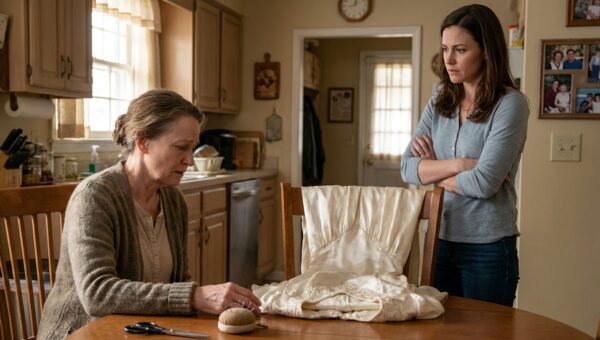
I don’t even know why I ran my fingers along the bottom hem. Maybe it was just habit, or maybe the way the fabric felt thicker in my left hand than it did on the right. I took my sewing scissors out of the mug on the desk, the little silver ones with the stork bill that belonged to Grandma, and I sat down right there on the braided rug with the coat in my lap. The light from the streetlamp outside was coming through the yellowed lace curtains, making long, bars across the floorboards.
The hem had been folded twice and stitched down with heavy saddler’s thread, the kind of waxed yellow nylon Dad used to mend horse harnesses down at the co-op before his hands went stiff with the arthritis. It wasn’t factory work. You could see where the needle had slipped a little near the corner, double-backing on itself in that stubborn way he had when he refused to ask for a magnifying glass.
I worked the tip of the scissors under the first knot and gave it a small tug. The thread made a dry, popping sound in the quiet room. Three more stitches gave way, and then the whole line started to peel back like a scab.
Something heavy slid out against my shins with a dull, muffled thud.
I reached inside the lining before I even looked down, my fingers catching on something wrapped in greasy brown butcher paper tied round with kitchen twine. My breath got caught somewhere in my throat. I pulled it out into the light, and my hands started shaking so hard I dropped the scissors on the rug. The package wasn’t big, maybe the size of a paperback book, but it had that thick, heavy feel of folded parchment and cold metal.
I didn’t call anyone. I sat there on the floor with my knees pulled up to my chin until the streetlamp clicked off at four in the morning.
Inside the butcher paper was a small oilcloth pouch, the kind Dad used to keep his turkey licenses in back when we still went out into the timber together. When I unfolded it, three things came tumbling out onto the wool rug. The first was a brass key with a stamped brass tag reading box 114 at the Farmers and Merchants Bank down on Main. The second was a sheet of yellow legal pad paper covered in that familiar, spidery handwriting that always looked like fence wire blown down in a gale. The third was a folded document with a blue legal backer that had a notary stamp from the county courthouse dated three weeks before Dad passed.
I held the legal paper up to the pale dawn light coming through the dirty glass.
“To whoever finds this,” Dad had written right across the blue lines, “and if it’s you, Clara, you’ve finally got around to cleaning out my old gear instead of burning it like Brenda wanted.”
My eyes blurred so fast I had to set the paper down on the floor and wipe my palms on my jeans. I didn’t read the rest of it right then. I just unfolded the document with the notary stamp. It was a holographic codicil, written out entirely in his own hand, witnessed and signed by old Doc Miller before his stroke and the postmaster down at the rural route. It didn’t leave the house to Russell and it didn’t leave the bank accounts to Brenda. It cut the whole pie into three exact piles, down to the last acre of timber and the last cent in the checking account, and it named me as the sole executor because, as Dad put it right there in ink that was already turning purple with age, “she was the only one who didn’t lie to me about how much time I had left.”
By nine o’clock I was sitting in a vinyl chair across from Mr. Vance in his stale-smelling office above the hardware store. Vance didn’t look up from his desk for the first two minutes. He just kept clicking his tortoise-shell pen against the blotter, the way he always did when people came in to complain about probate fees.
“We already settled the estate, Clara,” he said without looking up. “Russell’s got the deed recorded. Brenda’s already paid off her Jeep with the dividends from the creamery stock. You’re a bit late if you want to contest the burial plot.”
I laid the brass key and the yellow legal pad right on top of his stack of tax forms. Then I laid the codicil down beside them, flat and square, right where the light from the dusty window hit the notary seal.
Vance stopped clicking his pen. He picked up his half-moon reading glasses from the corner of the blotter, hooked them over his ears, and leaned in so close his nose almost touched the paper. I watched the skin at the back of his neck go red. He read through it once, very slowly, moving his lips the way old men do when they’re checking arithmetic. Then he took his glasses off, laid them down, and looked at me over the top of his frames with something very close to fear in his eyes.
“Where did you find this?” he asked.
“In the hem of his Carhartt,” I said. My voice sounded flat and steady, which surprised me. “Brenda told me it was all he left me.”
Vance didn’t say anything to that. He reached for his rotary phone and dialed four digits without looking at the directory. “Get Russell and Brenda down here,” he told the receptionist out front. “Tell them it’s about the house. Both of them. Now.”
They arrived twenty minutes later, looking like they’d been hauled out of bed by the sheriff. Brenda came through the door first, her coat unbuttoned, her face flushed from the cold and being put out. Russell lumbered in behind her, smelling of grease and stale cigarettes, wiping his boots on the mat twice because he always did that even when he was mad.
“What is this about?” Brenda asked, looking straight past me like I was a coat rack. “Russell’s got forty head of cattle to move over to the south pasture today, Vance. We don’t have time for this nonsense.”
Vance didn’t offer them coffee. He just pointed a thick finger at the yellow paper lying between the blotter and the brass key.
“Your father knew how to write a will,” Vance said, his voice dropping into that flat legal register he used when he was reading tax liens. “And under state law, a man has the right to amend his final wishes right up until the hour he loses capacity, provided he’s got two disinterested witnesses and his right mind.”
Russell took two steps forward, his boots heavy on the linoleum. He looked down at the paper, his jaw working side to side the way Dad’s used to when the tractor wouldn’t turn over in zero-weather. “That’s a fake. Dad didn’t write that. Dad couldn’t hold a pen by November. His fingers were swollen like sausages.”
“Doc Miller watched him sign it,” Vance said softly. “And the postman stamped the envelope it was in. It’s registered in the safety deposit box down at Farmers and Merchants as of October twelfth. That box is in Clara’s name now.”
Brenda made a sharp, whistling sound through her teeth and lunged for the desk. “You tricked him,” she screamed, her voice cracking right in the middle like dry pine. “You starved him out until he signed whatever you put in front of him while we were busy running the farm! You walked out on this family twelve years ago! You don’t get a dime of that house!”
I didn’t yell back. I just reached into my pocket and pulled out Dad’s letter, the one written on the yellow legal pad, and unfolded it until the crease was flat.
“He didn’t sign it because I tricked him, Brenda,” I said, and the room got so quiet you could hear the furnace kicking on down in the basement. “He signed it because he spent forty-two days watching you drive twenty miles out of your way just to drop off a casserole at the front door and leave before the dishes were done. He said you didn’t even stay long enough to take your coat off.”
Brenda stopped dead. Her mouth stayed open for a second, her teeth showing small and white against her red lips, and then she turned her face toward the window like she’d been slapped.
Russell didn’t look at either of us. He reached out with one big, grease-stained thumb and touched the corner of the brass key where it lay beside the bank stamp. “The house needs a new roof,” he muttered to nobody in particular. “I already ordered the shingles.”
“Then you’d better start figuring out how to buy me and Brenda out of our two-thirds,” Vance said, leaning back in his leather chair with a small, dry creak. “Or we can put it on the courthouse steps by spring.”
We didn’t talk in the hallway. Brenda walked out without her boots even hitting the rubber runner right, her head down and her purse clutched against her ribs like a shield. Russell followed her out to the truck without looking my way once, his shoulders hunched inside his canvas jacket just the way Dad’s used to when the snow was coming down heavy from the north.
I stayed behind long enough to sign three copies of the probate notice and put the brass key back into my pocket.
When I walked out of the office and down the wooden stairs onto Main Street, the wind had picked up off the river, carrying that sharp, dry smell of woodsmoke and old iron. I didn’t go straight back to the apartment. I stood on the corner by the feed store for a long minute, pulling the zipper of the Carhartt coat all the way up to my chin. It was still a little too wide in the shoulders, and the sleeves came down past my knuckles until I turned the cuffs back once. But as the first hard flakes of the afternoon started to drift down through the telephone wires, the canvas didn’t feel heavy anymore. It just felt warm.