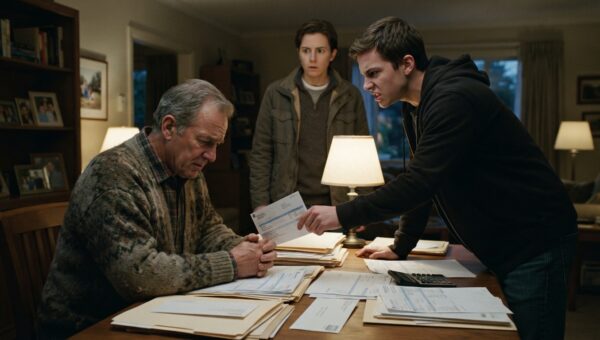
For twenty years my uncle Ray pitched a fit any time somebody brought up selling my grandfather’s house. Turn red, talk lawyers, one Thanksgiving he flipped the dining table over because a cousin from Denver asked about the property taxes. We all figured it was sentiment. Grandpa’s place, Ray being the oldest man, clinging to memories of a family that had mostly scattered across the high plains.
We were wrong. Lord, were we wrong. Ray passed away last winter of a chest that finally gave out after sixty years of unfiltered Luckies, and the house came down to me out here in Casper.
It is a little clapboard thing on two acres of yellow grass and blowing Russian thistle, sitting empty going on a year now. I kept putting off sorting through the place. No particular reason. Just didn’t want to deal with the dust and the ghosts of old arguments. Last Saturday morning, I finally pulled my truck up the gravel drive, grabbed a flashlight and a pair of bolt cutters from the bed, and walked up the front steps. The screen door gave that familiar, sagging groan it had made since I was eight years old. Inside, the air smelled of stale liniment, old carpet pad, and the peculiar, dead quiet of a house that had stopped breathing.
I hauled myself up the narrow pull-down stairwell into the attic around ten in the morning. Hundred and ten degrees up under that corrugated tin roof, dust so thick it hung in the flashlight beam like yellow smoke, bat mess crusting the corners near the eaves. It felt less like a storage space and more like a tomb. I had to crawl on my hands and knees over old floor joists, my knees popping against the pine. And back under the far rafters, where a grown man would have had to crawl on his belly to reach it, there was a trunk. An old canvas-covered steamer trunk, wrapped tight three times in a heavy industrial chain. A padlocked chain, in an attic where nothing had lived but bats and dry rot for twenty years.
I sat back on my heels in all that filth, wiping sweat out of my eyes with the back of a dirty hand.
My heart was already beating a little too fast, not from the climb, but from the sheer wrongness of it. You do not lock an empty trunk with a heavy steel chain unless you are terrified of what might fall out if the wind catches the lid. I hooked the jaws of the bolt cutters around the steel link of the chain, braced my boots against the floorboards, and squeezed until my palms burned. The metal gave a sharp, ringing snap that echoed off the tin roof like a pistol shot.
I threw the lid back and put my flashlight down inside the dark cavity. And I went cold, not from the heat of the attic. Because I knew that face. Everybody in my family knew that face, because for thirty-odd years it had hung in a cheap frame over my grandmother’s sewing machine until she died and Ray took the house.
Except the man in the photograph was young, maybe twenty-two, with dark hair combed straight back and a sharp, stubborn jawline that belonged to my grandfather.
It was Uncle Daniel. The youngest brother who supposedly ran off to California in the winter of nineteen-seventy-eight following a bitter family split and a missing trust fund. Except as I stared down under the flashlight beam, I saw the date stamped on the back of the polaroid in my grandfather’s neat, sharp cursive: January 14, 1979. Six weeks after his supposed departure for the coast.
I reached in with fingers that felt thick and clumsy and pulled out a bundle of letters tied with faded yellow kitchen twine. The top envelope was unmailed. The stamp was canceled with a local Casper postmark dated February third of that same year. I pulled the folded sheet of lined notebook paper out and read the messy, panicked handwriting under the weak beam of the flashlight.
“Daddy, let me out,” the page read, the ink smeared by what looked like sweat or tears. “I didn’t mean to sign your name to the timber deed. Ray knows I’m down here. Please. It’s freezing.”
I sat back in the choking dust of that attic, the paper rattling in my hand. Three weeks later. Daniel had never gone to California. He had never caught a Greyhound bus out of Cheyenne or started a new life in Bakersfield. He had been right underneath us.
Three days later, I was sitting across from Sheriff Miller down at the county courthouse on North Center Street. The old man didn’t look up from his desk for a long time as I laid the rusted padlock, the polaroid, and the stack of letters across his blotter. He just turned the edge of the first letter over with the eraser end of a yellow pencil, his face gray and flat like river silt.
“Your uncle Ray came by here every election cycle,” Sheriff Miller said quietly, not looking at me. “Always brought a box of cinnamon rolls from the bakery. Never missed a year.”
“He wasn’t checking in,” I said, my voice sounding hollow in the small office. “He was checking to see if anyone was digging around the property lines.”
“Ray carried a lot of water for your grandfather,” the sheriff muttered. “Old Arthur was a hard man. You remember that. When Arthur said a man went to California, the county didn’t ask questions because the land titles were clear and nobody wanted trouble with the bank.”
“He was down in that root-cellar space beneath the pantry,” I told him, the realization clicking into place with the cold certainty of a tumbler falling in a safe. “The one with the double brick wall Ray always kept padlocked from the outside. He didn’t run off. They walled him in when the title dispute got violent, and when he died down there, they moved whatever was left up into the rafters.”
The sheriff sighed, reached for his telephone, and told me to leave the trunk where it was until his deputies could get out to the property with a warrant. “I am sorry you had to find that, son. Some doors are better left rusted shut.”
I walked out of the courthouse into the bright Casper sunlight, the kind of glare that makes your eyes water even through polarized lenses. The town looked just the same as it always had. Pickups parked by the hardware store, old men leaning against the brick storefronts talking about the price of hay and the coming winter freeze. But the ground beneath my feet felt different now, like thin ice over deep water.
I drove back out to the clapboard house on the edge of town. I didn’t go inside. I just walked around the perimeter of the tall weeds, looking at the sagging roofline and the small, high windows of the pantry cellar on the north side where the sumac bushes had grown up thick and wild. Uncle Ray hadn’t fought to keep this house because he loved the memories. He had stayed because he was the warden of a prison he hadn’t built, guarding a secret that would have ruined what little was left of our name.
The property sale is canceled indefinitely now. The state is bringing in ground-penetrating radar and forensic teams to tear up the back rooms and check the mortar under the pantry floorboards. The family name is going to be dirt in this county by the time the papers get hold of the trial transcripts, and every church lady in town is going to have something sharp to say about my grandfather Arthur at the next potluck.
I left the front door unlocked when I drove away for the last time. Inside the dark, silent attic, the heavy, rusted chain still sits coiled on the bare pine floorboards by the rafters, right where I dropped it. The afternoon sun cuts through the dusty windowpane, hitting the open lip of the trunk where Uncle Daniel’s young, frozen smile finally rests in the light.