We saved for eighteen years to send our grandchildren to college. It is at $118,000 right now, and I know every single cent of it down to the dollar because I am the one who balanced our green ledger every Friday night after supper. I always figured that passbook was our quiet promise to the future, a way to make sure Ellie and Noah got the start we never had.
We kept it tucked away in the back of the metal lockbox behind the canned peaches in the cellar, safe from the damp and safe from the world.
Then February came in like a slammed door. Edward got a diagnosis with a long name and a short timeline, spoken by a doctor in Portland who looked too young to be handing out death sentences. There is a treatment out of state, experimental and not covered by our secondary insurance plan. Ninety-five thousand dollars, and they hold your slot for exactly two weeks. Our slot expires Monday at nine in the morning, and the clinic back east does not take late arrivals.
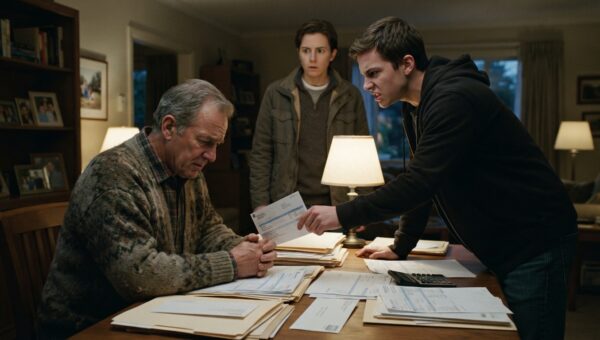
Edward says no. He says it plain and he says it every time I bring it up while he is sitting in his brown corduroy armchair with his reading glasses slipping down his nose.
“That money is their future,” he tells me, shaking his head until his gray hair catches the afternoon light. “I’ve had mine.”
He won’t budge. He looks at me with those tired blue eyes that have watched over our farm for forty-two years, and he acts like he is just packing a suitcase for a short trip he doesn’t want to bother anyone about.
The grandkids are fifteen and twelve now, old enough to understand the calendar and young enough to still run up the gravel drive when they come over on Sundays. They would hand him every dime without a second thought, but nobody has asked them, and Edward has forbidden me from saying a single word to them about the doctor or the clinic or the ledger.
The bank opens Monday at eight, and our town is small enough that the teller knows my maiden name and every check we have ever written.
Tuesday night was when the quiet house finally broke me. I was sitting at the kitchen table with the ledger open under the yellow glow of the overhead lamp, staring at the columns of numbers I had added up a hundred times. The ink was fading on the older lines from 2008, written when Ellie was just learning how to ride a bicycle without training wheels.
Upstairs, the floorboards creaked as Edward made his way down the hall toward the bathroom.
He didn’t come back out for a long time. I sat there in the dark kitchen with the refrigerator humming its low, steady song, listening to the murmur of his voice through the beadboard walls.
He wasn’t praying to die. That was the part that made my chest tighten until I could hardly draw a breath.
“Just a little longer, Lord,” I heard him whisper through the wood, his voice cracking on the rough edge of a sob he thought nobody could hear. “Just let me see them drive away to their first day of high school. Please. I’m not ready.”
He wanted to live just as badly as any man who ever walked the earth, but his pride and his terrible, heavy sense of duty had built a wall around him. He had convinced himself that taking our grandchildren’s money would make him a thief of their potential.
He would rather lie down in the dirt than touch a single dollar of that $118,000, even if it meant leaving us behind.
I sat there until the clock on the wall hit 11:15, watching the sweep hand tick around the face. Three weeks of arguing had led to this exact stalemate, and every day we lost was another grain of sand running out of the glass.
Three days later, on Sunday afternoon, I finally made up my mind while Edward was out in the garden trying to fix the tomato stakes. My hands were shaking so badly I dropped the pen twice onto the oilcloth table cover. I didn’t care about the rules anymore, and I didn’t care about what Edward would say when he found out I had crossed a line he drew in the dust.
I called Ellie and Noah into the kitchen. They came in through the screen door with dirt on their knees and grass in their sneakers, laughing about some foolishness down by the creek.
“Sit down,” I told them, and my voice sounded sharper than I meant it to be.
Ellie stopped pulling off her jacket, her eyes darting to my face. “Grandma? Is Grandpa okay?”
I slid the green ledger across the oilcloth right between them, open to the page with the $118,000 total written in black ink at the bottom. I told them everything right then. I told them about the diagnosis in February, the out-of-state clinic in Boston, the ninety-five thousand dollar fee, and the Monday morning deadline that was closing in like a freight train. I told them how Edward had forbidden me from breathing a word of it because he thought their education mattered more than his heartbeat.
Noah didn’t even look at the numbers. He just stared at the kitchen door where Edward was still out by the garden, his silhouette visible through the screen.
“He’s crazy,” Noah said, and his voice was thick and rough the way it gets when he is trying not to cry. “A college fund doesn’t matter if he’s not here to see us graduate. What is wrong with him?”
“He thinks he’s protecting you,” I said, wiping my palms on the front of my apron.
Ellie leaned over the table and tapped the ledger with her finger right above the total. “Take the money, Grandma. Call the hospital right now. If he gets mad, tell him we said so.”
They didn’t hesitate for a single second. That was the moment the heavy knot in my stomach finally loosened just enough for me to breathe.
Sunday night was the quietest night I can ever remember living through. Edward went to bed early, exhausted from putting up three tomato stakes before his strength gave out. I sat at the kitchen table until midnight with the bank withdrawal slips filled out in my best handwriting, the numbers $95,000 written out in words so there could be no mistake. The house was so still I could hear the mice moving behind the pantry wall.
Monday morning arrived before I had slept an hour. The red digital numbers on the microwave glowed 7:42 as I pulled my winter coat on over my nightgown and wool trousers.
Edward was still asleep upstairs, breathing slow and heavy in the back bedroom.
I walked out the front door into the sharp March air, the passbook clutched inside my coat pocket like a stolen secret. The frost was thick on the grass, crunching under my boots as I walked down the gravel drive toward the village center.
The bank doors were still locked when I got there at seven-fifty, but I could see Mr. Henderson inside behind the high wooden counter, turning on the desk lamps and pouring himself a cup of coffee from the glass pot. He looked up, saw me standing shivering on the sidewalk with my coat pulled tight around my throat, and unlocked the heavy glass door before the clock on the wall even hit eight.
“Morning, Martha,” he said, holding his mug in both hands. “You’re out early. Everything alright?”
“We need to make a transfer, Arthur,” I told him, laying the passbook and the filled-out slip on the smooth oak wood. “A wire transfer to Boston. Right now.”
He took one look at the amount written on the paper, and his eyebrows went up toward his hairline. He didn’t ask questions about Edward or why Edward wasn’t standing there beside me. In a small town like ours, people usually know when a storm is breaking behind a closed door, and Arthur Henderson had a kind enough heart to keep his mouth shut and his fingers moving on the keyboard.
The wire confirmation receipt was printed out by 8:22, the blue ink still slightly warm to the touch.
When I walked back up our driveway, Edward’s truck was still parked by the barn, but the kitchen light was on.
He was sitting at the kitchen table when I pushed the screen door open, wearing his flannel shirt and holding his empty coffee mug. He looked smaller than he had on Friday, his shoulders curved inward like a dried leaf. The green ledger was sitting open right in front of him on the table, exactly where I had left it the night before, but the page was turned to the back where the withdrawal slip receipt was now paper-clipped to the corner.
He didn’t look angry. That was the part that hurt the most. He just looked defeated, like a man who had tried to hold back the tide with his bare hands and finally watched the water wash over his shoes.
“You went to the bank,” he said softly, his voice barely louder than the hum of the refrigerator.
“I did,” I said, pulling off my gloves and laying them on the counter.
“That was for their tuition, Martha. I told you.”
Before I could answer, the screen door banged open behind me. Ellie and Noah walked into the kitchen without knocking, their school backpacks slung over one shoulder. They must have walked down early from their house just to see how the morning went.
Noah walked straight across the linoleum, pulled the blue hospital confirmation printout from his coat pocket, and laid it right on top of the open ledger next to Edward’s coffee mug.
“You’re not allowed to do that, Grandpa,” Noah said, his voice shaking just a little bit. “You don’t get to just quit.”
Edward stared down at the paper, his fingers tightening around the handle of his mug until his knuckles turned the color of chalk. He looked from Noah’s face to Ellie’s face, and then he looked up at me standing by the stove.
“I’m an old man,” Edward whispered, and his chin started to tremble for the first time since the doctor in Portland said the word terminal. “I didn’t want to be a burden on your future.”
“You aren’t a burden,” Ellie said, stepping up beside his chair and putting her small hand right over his gnarled old fingers on the table. “You *are* our future. If you aren’t here, none of that other stuff matters anyway.”
Edward looked down at her hand covering his. The silence in the kitchen stretched out for a long, heavy moment, longer than any silence we had shared in forty-two years of marriage. Then his shoulders gave one long, shuddering heave, and the hard, stubborn line of his jaw finally broke.
He reached out with his other hand and pulled the hospital confirmation closer, his eyes scanning the name of the clinic and the time of the slot hold that still had thirty-five minutes left before it vanished forever.
“Ninety-five thousand?” he asked, trying to sound gruff through the thick wall of his tears.
“Down to the dollar,” I told him, walking over to put my hand on the back of his neck, feeling the warmth of his skin beneath his collar. “The wire is already sent. We just have to call them back and tell them we’re coming.”
Edward sat there at the kitchen table on Monday morning, holding the hospital confirmation printout in one hand and his granddaughter’s hand in the other, while the old grandfather clock in the hallway ticked past nine toward a future we had just barely managed to save together.