Dust has a way of settling on things until you almost forget what lies beneath it. Last month, clearing out the spare room boxes in the attic, I came across my old family Bible with its cracked leather spine. I sat right there on the floorboards with gray motes floating in the afternoon sun and let the heavy cover fall open.
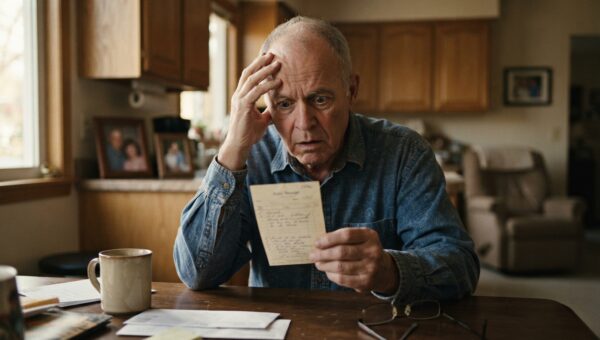
A single piece of stiff cardstock slid out from between Genesis and Exodus. It was an unpunched railway ticket dated November twelfth, 1957, issued for the evening express heading west out of New York. The ink had faded to the color of dry tea, but the destination station was still clear as day. My chest tightened immediately because I knew exactly whose handwriting was scrawled on the back in a hasty, looping hand.
I never told my children about Eloise. For fifty wonderful years, I built a quiet, steady life with my late wife, Martha, raising three kids and keeping the accounts down at the hardware store. Martha was a good woman, kind and patient, and our life was happy in that solid, Midwestern sort of way. But memory does not care about decades or routine. Sometimes, sitting on the back porch with a cup of coffee just as the sun dipped behind the garage, I would find myself back under the massive brass face of the station clock with my suitcase by my boots and six hours stretching out ahead of me until the porter finally locked the gates. I had spent sixty-three years believing she simply changed her mind.
My daughter Clara had come over that Saturday to help me sort through the remaining boxes of old books and winter coats. She saw me sitting there on the floor staring at that small strip of cardboard like it was a ghost. She knelt down beside me, resting a warm hand on my shoulder. “Dad, you look like you’ve seen a spirit,” she said, her voice gentle. I didn’t tell her the half of it. I just tucked the ticket into my shirt pocket and told her the dust was getting to my sinuses. Later that afternoon, when we took a break from the boxes, Clara suggested we drive downtown to see the new city museum. The city had spent millions gutting and restoring the old grand terminal downtown, keeping the iron frame and the massive stone arches while turning the waiting hall into a public gallery.
I almost said no. I had not set foot inside that cavernous stone hall since the autumn Eisenhower was in office. But Clara insisted, linking her arm through mine and saying the old clock had been restored to its exact original place right beneath the central rotunda. So I went along, letting the memory of train steam and coal smoke pull me back down into the city. The place looked entirely different and yet painfully the same. Polished terrazzo floors replaced the stained concrete, and tourists with digital cameras wandered around where ticket agents once barked departure times through brass microphones. But the air smelled faintly of old iron and damp stone.
We walked right toward the center of the hall where the grand clock hung suspended from its original iron brackets, ticking away the afternoon just as it had done when we were nineteen years old. I stood under the dial, tilting my head back, and let out a long, slow breath.
The silence around me felt thick, filled with the ghosts of six decades of missed birthdays and unspoken grief. That was when I saw her standing by the marble pillar ten feet away. She wore a simple wool coat the color of winter wheat, and her hair had turned the soft, bright silver of spun wire. She was staring up at the clock face with the exact same slight tilt of the head I had memorized over half a century ago. My breath hitched in my throat, and my knees felt suddenly hollow. Sixty-three years vanished in less than a second, folded up like an old map.
I took half a step forward before I even realized I was moving. My boots clicked against the polished floor, ringing out in the high-ceilinged hall. She turned her head as my shadow fell across the stone, and those bright, familiar eyes widened instantly. For a long, terrifying moment, neither of us breathed. The noise of the museum around us faded into a low, distant hum. I couldn’t find my voice for a second, my tongue sticking to the roof of my mouth.
“Pardon me,” she said, her voice just as I remembered it, raspy around the edges and carrying that distinct upstate lilt.
“Eloise?” I managed, the word scraping out of me like dry gravel.
She froze, her hand flying up to cover her mouth, the fingers trembling. She didn’t look away. She looked at me the way someone looks at a miracle they are afraid will vanish if they blink too hard. I reached into my coat pocket with shaking fingers, pulled out the weathered 1957 ticket I had found that very morning in the attic, and held it out toward her. She stared at the faded ink, then her breath caught. Without a word, she reached into her leather handbag with her other hand, fumbled for a second among her keys and coin purse, and pulled out her own weathered piece of cardstock. She held it up beside mine. They matched down to the serial number stamped in purple ink by the station agent back when Eisenhower was in office.
Neither of us spoke for a long count of ten. People walked past us, laughing and talking about the museum exhibits, completely unaware that two old ghosts were standing in the middle of their afternoon. Eloise’s eyes filled with tears, but she didn’t wipe them away. Instead, her fingers dipped back into her purse one more time, and she pulled out a small, folded scrap of yellowed notepaper, its edges frayed and soft from decades of being handled in secret. She unfolded it slowly, as if it might turn to ash in the open air, and held it out for me to see. I leaned in close, my eyes straining against the bright museum lights to read the faded pencil marks scrawled across the lined paper.
“I was here, waiting by the track, down when your father found me and told me you had already left with my sister,” I read aloud, the words tearing right through my chest.
I stared at the page, my brain refusing to process the sentence for a second. My father. My father had stood down on the cold concrete platform by the baggage cars while I waited six hours under the clock upstairs. He had walked right up to Eloise and told her a deliberate, calculated lie. He had told her I boarded the train west with her younger sister Martha because he never wanted us to marry, because he wanted me tied down to the family business in the valley. And at the exact same moment, he had climbed the stairs to the main concourse, tapped me on the shoulder, and told me Eloise had changed her mind at the last minute and gone back home to her mother. We had both believed the worst of each other. We had both gone home in silence, carrying a broken heart like a secret badge of honor, while the old man drove us back in his Ford without saying another word the whole way home.
“He told you that?” I whispered, my voice cracking right down the middle.
Eloise nodded slowly, a tear finally tracking down the side of her nose. “He looked right at me, Arthur. He said you couldn’t wait to get away from our town, and that you took Martha with you to start fresh out west. I went home and burned my other dresses. I didn’t leave the house for a month.”
I just stood there because my brain kind of stopped working for a second. The weight of all those years came crashing down not like a heavy blow, but like a soft, suffocating blanket. Fifty years with Martha. A good life, children, grandchildren, quiet Sunday dinners, all built on the foundation of a lie told by a man who thought he knew what was best for his son. I looked at Eloise, really looked at her, seeing the fine lines around her eyes and the gentle set of her mouth that time had carved into her face. She wasn’t nineteen anymore, and neither was I, but underneath the gray hair and the weathered skin, we were still those two kids standing on opposite levels of the same station, waiting for a train that neither of us was allowed to catch.
Clara walked up behind me then, her footsteps light on the terrazzo. She stopped when she saw our faces, her eyes darting between my hand holding the old ticket and Eloise standing there with the tattered note. “Dad? Who is this?” she asked, her voice dropping to a cautious whisper.
I looked at my daughter, and for the first time in my life, I didn’t hide the past behind a polite smile or a closed door. I turned back to Eloise, who was folding the old note with trembling fingers and tucking it safely back into her purse beside her ticket. There was no anger left in either of us for the ghosts of our parents, only an overwhelming, breathless validation that cut straight through the fog of our old age. We weren’t foolish, and we hadn’t given up on each other. We had simply been ambushed by the people who were supposed to protect us.
We didn’t stay in the middle of the museum floor. We walked out together into the late afternoon air and found a small corner booth in a coffee shop across the square where the streetlights were just beginning to flicker on against the pale blue dusk. Clara sat with us, quiet and wide-eyed, listening as Eloise and I spent two solid hours trading sixty-three years of history piece by piece, filling in the empty spaces of our lives over lukewarm cups of black coffee. We talked about the jobs we worked, the houses we bought, the grief we carried in secret, and the strange, stubborn grace that brought us back under the exact same iron clock six decades later.
When it was time to part ways on the corner outside the café, Eloise wrote her phone number down on a paper napkin and pressed it into my palm with a warm, steady grip that felt like coming home after a very long winter away. I watched her walk down the sidewalk toward the bus stop, her silver hair catching the amber glow of the streetlamp until she turned the corner and disappeared into the evening crowd.
That evening, sitting at my kitchen table with Clara before she drove back home, I finally told her everything about my first wife Martha, about the life we built together, and about the girl who waited by the tracks downstairs while I watched the clock upstairs. I didn’t try to make my father out to be a monster, and I didn’t pretend my life with Martha was anything less than what it was. But as I laid the two weathered 1957 train tickets side by side on the laminate tabletop beside my coffee mug, I knew the ledger had finally been balanced. Time had stolen our youth, but it hadn’t stolen our truth, and for the first time in eighty-two years, the clock at Penn Station stopped ticking in my head.