PART 1
My daughter Sylvia began taking me to the memory clinic four months ago. She sat in the passenger seat of my sedan every Tuesday morning, smoothing her beige slacks and telling me how worried she was about my keys ending up in the fruit bowl. She told our neighbors I was forgetting to pay my water bill and leaving the kitchen stove burner glowing orange for hours.
I knew I had done neither. I kept my checkbook balanced down to the penny in a black ledger on my desk, and I still baked sourdough bread every Saturday morning without scorching a single loaf. But Sylvia had a soft, trembling way of speaking about me to others, as if I were a fragile glass vase she was trying to carry across a gravel driveway.
The clinic was located on the second floor of a brick medical building downtown, smelling faintly of lemon disinfectant and stale coffee. On a rainy Thursday four months into this routine, the receptionist called my name and handed me a thick manila folder to carry down the hall to Dr. Evans’s consultation room.
The receptionist got pulled away by the phone before she could point me toward room four, so I sat down on a blue plastic chair in the narrow hallway to wait.
My fingers traced the tab of the folder. The label had a name typed in black ink. It was not mine. It was Sylvia Grant, my daughter’s name, paired with a file number I had never seen before.
My pulse thudded in my ears, a heavy, rhythmic drumbeat that made the clinic walls tilt slightly. I lifted the corner of the heavy cardstock.
There were clinical notes typed across the page, dated just three weeks prior. My eyes caught the heading and stuck to it like burrs. Patient appears competent. Family requests diagnosis for guardianship review.
I stared at the words until they blurred into gray smears. My daughter, who held my hand in the parking lot and kissed my cheek at Sunday dinner, was trying to have me declared legally incompetent behind my back.
PART 2
Before I could turn the page to read more, footsteps clicked down the linoleum hallway.
The receptionist hurried toward me, her face flushed with apology as she snatched the folder from my trembling lap.
“Oh, Mrs. Grant, I am so sorry,” she stammered, pulling my actual blue folder from beneath her arm. “That was the file for your daughter’s power of attorney consultation. I mixed them up on the counter.”
She swapped the folders so fast the paper gave a sharp hiss. I went into Dr. Evans’s office with my tongue feeling like dry cardboard. I sat through the twenty-minute memory screening, naming animals, repeating a list of five words, and drawing a clock face with the hands pointing to ten past eleven, just as I had done three times before.
When Dr. Evans finished scoring my paper, he smiled warmly and told me my cognitive function was entirely normal for a woman of seventy-two.
“Thank you, Doctor,” I said, keeping my voice very steady. “Tell me, does Sylvia usually sit in on these evaluations?”
“Usually she meets with me afterward to discuss your daily care,” Dr. Evans said, tapping his pen against his desk. “She has expressed significant concern about your ability to manage your household finances, especially regarding your pension distribution.”
“My pension,” I repeated.
“Yes. She mentioned your six thousand three hundred dollar monthly disbursement requires oversight to prevent exploitation,” the doctor said, his expression completely earnest.
I thanked him, walked out to the waiting room where Sylvia was scrolling through her phone, and let her drive me home in silence. She chattered about a sale on winter coats at the department store, her voice bright and cheerful, while I watched the telephone poles blur past the passenger window.
I waited three days. On Monday morning, while Sylvia was at her part-time job as a real estate coordinator, I called Dr. Evans’s office directly from my landline. I asked to speak with him about the paperwork Sylvia had submitted on my behalf.
“Mrs. Grant,” Dr. Evans said, sounding surprised when he came on the line. “Your daughter provided three separate memory assessment requests from local geriatric specialists, but when I looked closer at the referral stamps, two of them were photocopies of an intake form dated from a different clinic across town.”
“Were those forms altered?” I asked.
“One of them had an amended checkmark in the cognitive decline box,” Dr. Evans admitted slowly. “Your daughter told me you signed a waiver giving her authority to request administrative control over your accounts while we completed the evaluation.”
“I never signed any waiver,” I said.
PART 3
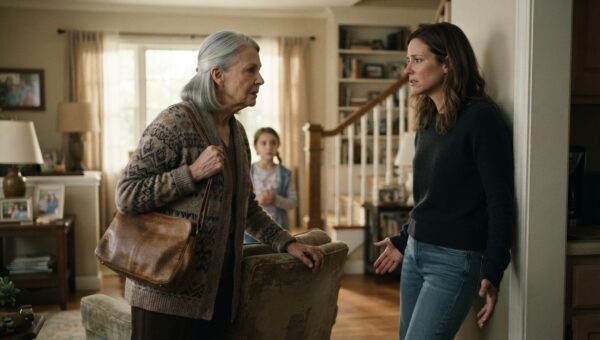
That evening, Sylvia came over for pot roast with a container of store-bought chocolate pudding in her hand. She kissed the top of my head and asked if I had taken my calcium pill.
I set a heavy white envelope on the kitchen table right beside her dinner plate. Inside was a printed copy of the bank routing transfer form I had pulled from the county probate office earlier that afternoon, showing a pending petition to assign my monthly pension payments to a joint account held in Sylvia’s name.
“Eat your dinner, Sylvia,” I said, sitting down across from her.
She took a bite of carrots, humming appreciatively before she noticed the paper. She glanced down, and the pleasant smile slipped right off her face, leaving her features stiff and pinched.
“What is this?” she asked, her voice dropping an octave.
“It’s the paperwork you filed to take over my pension,” I said. “Dr. Evans told me about the amended intake forms, too. You lied to the clinic, Sylvia. You tried to make it look like my memory was failing so you could lock down my accounts.”
For three seconds, she tried to put on the old performance. She blinked rapidly, her lower lip trembling with practiced grief. “Mom, you are being paranoid. I am only trying to protect you. With the way you misplace things—”
“I don’t misplace things,” I interrupted, my voice dropping until the kitchen was as quiet as a church. “I never forgot to pay the water bill. I never left the stove on. You made those stories up so the neighbors would agree with you when you finally went to court.”
She slammed her fork down against the ceramic plate. The loud clatter made the salt shaker jump. “You have no idea how expensive things are now! My mortgage payment doubled this year, and Dave’s business is failing. You have six thousand three hundred dollars coming in every month from Dad’s pension, and you just sit in this old house spending it on garden supplies and groceries!”
The words hung in the air between us, small and ugly.
“It was your father’s pension,” I said, feeling a cold stillness spread through my chest. “He worked thirty-two years at the railway so I wouldn’t have to ask my children for a dime when I got old. And you decided you were entitled to spend it before I even finished using it.”
“You don’t understand paperwork anymore,” she snapped, her face flushing red. “You’re old. You’re going to need a full-time care facility soon anyway, and those places cost ten thousand a month. I was just securing the funds before they got eaten up by inflation.”
“You were stealing,” I said plainly. “Get your coat.”
She stared at me, her mouth open in disbelief. “You’re kicking me out?”
“I am calling the bank in the morning to freeze every joint account we ever shared,” I told her, standing up from the table. “And if you ever step foot in Dr. Evans’s office again claiming my memory is gone, I will show him the police report for document fraud.”
ENDING
Sylvia grabbed her purse from the counter, her face dark with fury, and slammed the front door so hard the framed picture of my wedding day rattled against the wallpaper.
The house went dead quiet again.
I walked over to the kitchen sink, picked up the container of chocolate pudding she had left behind, and dropped it straight into the black garbage bin under the sink. Then I wiped down the counter with a damp yellow sponge, rinsed it out in the basin, and hung it neatly over the faucet.
My ledger was waiting for me on the desk in the den, open to a clean page with a row of sharp, clear numbers written in black ink. I sat down in my wooden chair, picked up my pen, and wrote down today’s date. My hand didn’t shake once.