PART1
The machines in the ICU didn’t beep so much as they hummed, a low, steady tone that I had learned to listen to over four days of hospital chairs and weak coffee. Arthur’s hand was still warm when his breathing finally stopped. I kept my fingers laced through his, feeling the familiar calluses on his palm, waiting for a doctor to say something that would change what had just happened.
But the doctor only placed a gentle hand on my shoulder and told me I could take my time. We had been married for thirty-four years. We built a home together in Ohio, raised two children who now had mortgages and kids of their own, and shared thirty-four years of quiet routines, Sunday dinners, and shared laundry. I thought losing him was the deepest pain I would ever have to carry.
A week later, I sat in the county probate courtroom wearing Arthur’s favorite navy blazer over a black dress, my daughter Sarah sitting stiffly to my right, and my son David staring straight ahead at the scuffed wooden defense table. We were there to handle the basic paperwork, just filing the initial notification of death and letting Arthur’s long-time attorney, Mr. Henderson, guide us through the standard steps. I had the funeral program folded into my purse alongside a packet of tissues.
The heavy oak doors at the back of the courtroom swung open, and a woman in her late forties walked in with an air of absolute ownership. She wasn’t dressed for a funeral or a probate hearing. She wore a tailored cream coat, gold hoop earrings, and heels that clicked sharply against the linoleum. Behind her walked two men in expensive charcoal suits carrying leather portfolios. They didn’t look like local lawyers who spent their mornings arguing over minor property disputes. They looked like attorneys hired out of the city with retainer fees larger than my annual grocery budget.
Mr. Henderson frowned, adjusting his glasses as the strangers took seats at the opposing table. I assumed they were creditors or perhaps representatives from the medical center dealing with final bills, though even that felt overly aggressive for a Tuesday morning.
The judge called the case, and Mr. Henderson stood to announce our presence.
Before he could finish, the taller of the two city attorneys stood up, smoothed his tie, and introduced himself as counsel for Ms. Elena Vance.
“Your Honor, we are filing an emergency petition for immediate probate administration based on a newly executed and legally binding last will and testament, signed by Arthur James Miller on April 18, 2025,” the attorney said, his voice carrying easily across the quiet room.
Elena Vance smiled faintly, leaning over to whisper something to her lawyer.
Mr. Henderson blinked, looking down at his own papers. “That is impossible, Your Honor. Mr. Miller’s established will has named his wife, Martha Miller, as sole beneficiary for nearly twenty years.”
“Times change, counselor,” the lawyer replied smoothly, sliding a fresh document across the clerk’s desk. “The decedent executed a revocation of all prior instruments sixty days ago. We have the original document, signed in front of two registered notaries and bearing his authentic signature.”
I felt a strange buzzing in my ears. April 18, 2025. That was just four months ago. Arthur had told me he was driving down to Columbus for a weekend hardware convention and to visit his brother. He had packed his overnight bag himself, kissed my forehead at the front door, and promised to bring home some of those local apples I liked.
The judge gestured for the clerk to hand up the document. “And what does the estate encompass under this filing?”
The attorney didn’t hesitate. “The primary residence in Worthington, the vacation cabin on Lake Erie, all joint and individual bank holdings, corporate accounts, two commercial vehicles, and investment portfolios totaling eight million nine hundred thousand dollars in liquid and fixed assets.”
The exact figure hung in the stale air of the courtroom. Eight million nine hundred thousand dollars.
Sarah let out a sharp gasp beside me, her hand flying to her mouth. David didn’t gasp. He didn’t move at all. His shoulders remained locked, his gaze fixed on the mahogany bench, his jaw clenched so tight the muscle twitched visibly beneath his skin.
I looked at David. I looked at the way he refused to turn his head toward me. And in that single, crushing second, the courtroom didn’t matter anymore. The money didn’t matter. The realization hit me with the force of a physical blow. David hadn’t just been quiet because he was grieving. David already knew.
PART 2
The silence in the courtroom stretched until the judge cleared his throat, asking Mr. Henderson if he wished to contest the immediate filing. My lawyer stammered, asking for a ten-day recess to examine the document authenticity. The judge granted the extension, warning both parties against asset dissipation, and banged his gavel.
Elena stood up, smoothing her cream coat. As she walked past our table, she paused. Her perfume smelled of expensive amber and vanilla, completely out of place in the dusty county building. She looked down at me with an expression that wasn’t triumphant so much as it was bored, like she was dealing with a minor administrative inconvenience.
“He stayed with you out of guilt, Martha,” she said softly, just loud enough for Sarah to hear. “Not love. He hadn’t loved this life in a very long time.”
She walked out the heavy doors, her two attorneys trailing behind her like bodyguards.
Sarah grabbed my arm, her fingers trembling. “Mom, what is she talking about? Who is that woman? Why didn’t Mr. Henderson know about a second will?”
I didn’t answer her. I turned my head slowly toward my son. David was still staring at the empty table across the aisle, his hands flat against the wood.
“David,” I said. My voice sounded thin, like dry paper tearing. “Look at me.”
He finally turned his head, but his eyes were bloodshot and hollow. He didn’t look surprised. He looked trapped.
“You knew,” I whispered.
Sarah stared back and forth between us, her face pale. “Mom, what are you saying? David didn’t even know Arthur had that kind of money. None of us did. Arthur was a retired regional manager for an industrial supply company. Where did nine million dollars even come from?”
“Ask your brother,” I said, standing up on legs that felt like dry twigs.
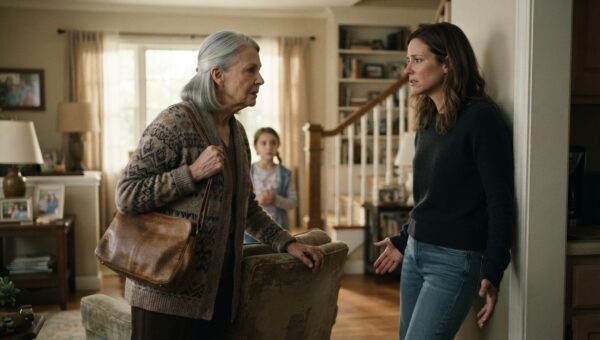
We drove back to the Worthington house in absolute silence. Sarah drove my Buick, her hands white-knuckling the steering wheel, while David followed behind us in his truck. When we got inside, the house smelled like the lemon furniture polish I had used the day before the funeral. It felt wrong to be back here. The mail was piled on the entryway table, mostly sympathy cards and utility bills.
David walked in last, closing the front door with a soft click. He didn’t go to the kitchen for coffee like he always did. He stood in the middle of the living room, right over the Persian rug Arthur’s mother had given us when we got married.
“Talk,” I said, sitting down heavily on the floral sofa.
David rubbed the back of his neck, his eyes finally filling with tears, though they weren’t tears of grief. They were tears of cornered panic. “Dad made some smart land investments back in the nineties near the interstate expansion corridor, Mom. He didn’t sell the acreage. He partnered with a commercial developer ten years ago. It sat in a private trust that he managed himself. I only found out about it three years ago when I helped him scan some tax documents for his accountant.”
“Three years ago,” I repeated. “And you didn’t tell me.”
“Dad swore me to secrecy,” David snapped, his voice cracking. “He said he was setting up a legacy fund for the grandchildren. He said if you knew about that kind of wealth, you’d worry yourself sick or give it all away to charity like your church group always wanted. He made me sign a non-disclosure agreement with his corporate lawyer.”
“And Elena Vance?” Sarah asked, her voice shaking with rage. “Who the hell bought her a $9 million estate and a new will in April?”
David looked down at the floor, his voice dropping to a whisper. “She’s his partner, Sarah. They’ve been together for six years. She runs the administrative side of his land trust downtown. Dad bought her a condo in the city two years ago. He… he kept a separate apartment downtown under an LLC. He told me he was going to tell you after Sarah’s youngest graduated high school, but then his heart gave out.”
Sarah lunged forward, her hands hitting David’s chest, shoving him back against the wall. “You knew he was cheating on Mom for six years? You helped him hide it? You helped him steal our entire lives and hand them to some stranger while Mom washed his socks and cooked his dinner every single night?”
David didn’t fight her back. He just let her hit him until her arms dropped to her sides and she collapsed into the armchair, sobbing into her hands.
I didn’t cry. The tears had dried up somewhere in the courtroom. I looked around my living room, at the framed family photos on the mantelpiece, at the small ceramic duck Arthur had bought me on our tenth anniversary in Gatlinburg. It all looked like painted cardboard now.
“Get out,” I said quietly.
David looked up, horrified. “Mom, listen to me. Mr. Henderson thinks we can break the will on grounds of undue influence. We can fight her. We can—”
“I said get out of my house,” I repeated, my voice steady and cold. “You took blood money from a stranger who spat on your mother’s face. You don’t get to stand in my living room anymore.”
He hesitated, looking like the little boy who used to scrape his knees in our driveway, before he finally turned and walked out the door. The latch clicked.
PART 3
For the next four days, the house was too quiet. Mr. Henderson called twice, explaining that Elena’s attorneys were pushing for immediate asset freezing, claiming I might tamper with the physical property or remove vehicles from the Worthington garage. They wanted me out of the house within thirty days while probate proceedings moved forward in the city.
Sarah stayed with me on the spare bed, her anger burning hot and bright, but we were both running on fumes. We spent hours going through old file cabinets in the basement, looking for anything Arthur might have left behind. Tax returns showed modest pensions and standard deductions. There was no trace of the commercial land trust, no mention of millions in hidden assets. He had compartmentalized his entire life with the precision of a professional accountant.
On Friday evening, the doorbell rang. I expected it to be a process server or another letter from Elena’s high-priced lawyers.
Instead, it was the young court clerk from the probate office, a quiet man named Thomas who looked like he barely graduated college. He stood on the porch holding a yellow manila envelope sealed with red wax tape.
“Mrs. Miller?” he asked, looking nervously down the driveway. “I’m sorry to bother you at home, but Mr. Henderson couldn’t reach you by phone, and the judge instructed me to deliver this directly into your hands tonight.”
I took the envelope, feeling the heavy thickness of paper inside. Across the front, written in Arthur’s familiar, left-handed slant, were the words: *Open Only If I Die.*
“Thank you, Thomas,” I said, my hand steady as I took it.
I closed the door, locked the deadbolt, and brought the envelope to the kitchen table. Sarah came running down the stairs when she heard the lock click.
“What is that?” she asked, her eyes wide.
“Your father’s handwriting,” I said.
I took a pair of kitchen shears and sliced open the top edge. Inside wasn’t a legal will, and it wasn’t a love letter. It was a thick stack of printed email printouts, bank transfer receipts bearing official corporate letterheads, and a single handwritten letter addressed to me.
I unfolded the letter first.
*Martha,*
*If you are reading this, it means my heart finally stopped and the truth has come out. I am sorry it has to happen this way. Elena is not who you think she is, and neither is the will she filed. The woman who walked into that courtroom is not my partner of six years. She is the daughter of my former business associate, Robert Vance, who embezzled four million dollars from our land trust in 2023 before fleeing to Canada. When Robert died last year, Elena inherited his legal debt to me, plus interest.*
I stopped reading, my breath catching in my throat. I looked up at Sarah, who was leaning over my shoulder, reading the lines as my eyes tracked across the page.
*I didn’t give her our money, Sarah,* the letter continued. *I used her greed against her. The ‘will’ she stole from my office safe isn’t a valid legal instrument. It was a draft I prepared with the state prosecutor’s office as part of an ongoing federal fraud sting against her network of offshore shell companies. The real will is registered with the state attorney general’s office under seal, dated three years ago, leaving everything—every cent, every property, every account—exclusively to Martha and the children.*
I turned the page, my hands shaking so badly I almost dropped the papers. Attached to the back was a certified copy of a federal indictment filed three days before Arthur died, listing Elena Vance and her two city attorneys for wire fraud, forgery, and grand larceny.
The front doorbell rang again.
This time, it wasn’t the clerk. Through the frosted glass of the front door, I could see flashing red and blue lights bouncing off our front porch.
ENDING
Sarah opened the door cautiously. Two county sheriff’s deputies stood on the porch, flanked by a federal postal inspector holding a clipboard.
“Mrs. Miller?” the lead deputy asked respectfully. “We need your cooperation with a federal execution warrant regarding Elena Vance. We have reason to believe fraudulent documents related to this household were filed under her direction.”
I looked down at the manila envelope on the kitchen table, then back out at the flashing lights cutting through the Worthington night.
“You’re a little late, Sheriff,” I said, my voice steady as I held up the envelope. “My husband already took care of it.”
I walked back into the kitchen, picked up the ceramic duck from the windowsill, and set it back down in its exact place.