PART1
The knock came at a quarter past two in the morning. It was not a polite rap of knuckles. It was a dull, frantic thud against the heavy oak front door, followed by the sound of someone sliding down the wood.
I was already awake in the downstairs guest room, staring at the ceiling and trying to figure out how my life had shrunk so small.
Six months earlier, my husband Greg had convinced me that we needed to move into his mother Evelyn’s brick two-story home in suburban Atlanta. He said we would save money for a down payment while helping her manage the house after her mild stroke. What it actually meant was that Greg worked fifty hours a week at his logistics firm, and I spent every waking minute scrubbing baseboards, cooking low-sodium meals, and listening to Evelyn remind me that I came from nothing and contributed nothing.
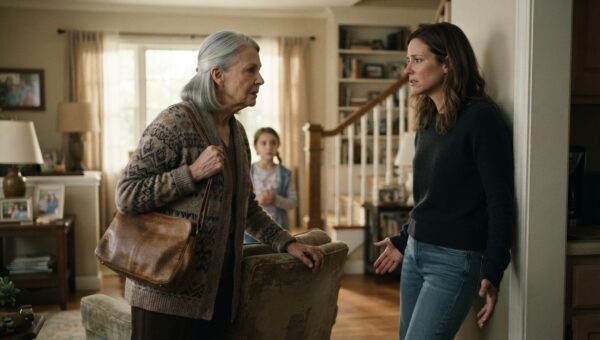
When the thud hit the door a second time, I pulled on my robe and hurried down the hall. Evelyn was already at the top of the stairs in her silk dressing gown, gripping the banister.
“Do not open that door, Carrie,” she snapped, her voice like cold gravel. “Call the police. It is probably some addict from the apartments down the road.”
I looked through the sidelight window instead. The porch light illuminated a young woman crumpled against the brick railing.
She was clutching her rounded belly with one hand. Her other arm hung at a strange, sickening angle, swollen thick around the wrist. Her lip was split, bleeding down her chin onto a torn gray t-shirt. She was shaking so violently her knees were knocking together.
It was Sarah, the quiet twenty-two-year-old who had moved into the small rental house across the street three months earlier with a tall, heavy-set man who rarely came out during daylight.
I unlocked the deadbolt and pulled the door open. The autumn chill rushed in immediately.
“Please,” Sarah gasped. Her voice broke on the word, wet and ragged. Tears had cut clean tracks through the dirt and dried blood on her cheeks. “Please help me. He locked me out. He took my phone and my keys. My arm… I think it’s broken. I can’t feel my fingers. I’m scared for the baby.”
I reached out to take her uninjured shoulder, but Evelyn came marching down the final three steps with terrifying speed.
She didn’t look at Sarah’s swollen belly or the crook in her forearm. She looked at Sarah’s bare, dirt-caked feet and the blood on her chin with pure disgust.
“Get away from my house,” Evelyn spat, stepping directly between us. “We don’t harbor trash here. Whatever trouble you brought on yourself, you take it back across the street. Don’t you dare bring that filth to my porch.”
“Evelyn, stop,” I said, my voice shaking with fury. “Look at her. She’s eight months pregnant. She needs an ambulance right now.”
“She needs to get off my property before I have her arrested for trespassing,” Evelyn snarled, turning her venom on me. “You don’t invite the ghetto onto my front porch, Carrie. You don’t own a single brick of this house. Shut the door.”
Before I could grab Sarah’s arm, Evelyn slammed the heavy oak door shut and turned the deadbolt with a loud, final click.
“You touch that lock and you can pack your bags tonight,” Evelyn warned, pointing a bony, trembling finger in my face. “Go to your room.”
She stood there, breathing hard, watching me like a warden. I didn’t argue.
I turned around, walked briskly down the hall into the kitchen, and grabbed my heavy winter wool coat off the peg by the back entrance. In the pocket was the folded envelope containing two hundred dollars in cash—the last of my emergency money from doing weekend bookkeeping for my sister. It was every dollar of personal money I had left that Greg didn’t monitor on our shared account.
I slipped out through the side laundry door into the shadows of the driveway.
Sarah was stumbling toward the curb, sobbing so hard she could barely stay upright, cradling her swollen stomach against the wind.
“Sarah!” I whispered loudly, jogging across the grass to reach her before she hit the asphalt.
She flinched violently, raising her broken arm before crying out in agony from the movement.
“It’s Carrie,” I said softly, stepping in front of her. “I’ve got you. Put this on.”
I gently draped my heavy wool coat over her shoulders, taking immense care not to touch her injured arm. Then I pulled the two hundred dollars from the pocket and pressed it into her good hand, folding her cold fingers around the bills.
“Listen to me,” I said, looking right into her eyes. “Walk straight past the corner to the 24-hour pharmacy on the main avenue. It’s two blocks. It’s brightly lit. Walk inside, tell the pharmacist behind the counter that you are in danger, and have them call 911 and a domestic violence advocate immediately. Do not go back to that house. Take this money for whatever you need. Go right now.”
Sarah looked down at the money, then up at me. Her lips trembled so hard she couldn’t form words, but she nodded once, clutched the coat tight around her belly, and hurried down the dark sidewalk under the streetlamps.
I watched until she turned the corner at the end of the block. Then I walked back inside through the laundry room, locked the door, and went to bed.
Across the street, the rental house stayed pitch black. By morning, a dirty white pickup truck that had been parked in that driveway for months was gone.
PART 2
For the next six days, the house across the street remained completely dead. No lights came on. The blinds stayed crooked and drawn.
Inside Evelyn’s house, the atmosphere turned toxic. At dinner the following evening, Evelyn told Greg that I had tried to let a “screaming lunatic” into the house in the middle of the night.
“She was beaten, Greg,” I said across the dining table, laying my fork down. “Her arm was broken and she’s due in four weeks. Your mother slammed the door in her face.”
Greg chewed his pot roast, took a slow drink of ice water, and looked at me with that exhausted, dismissive expression he had perfected over the last year. “Carrie, Mom’s blood pressure can’t take neighborhood drama. You know this area has been getting worse. If the girl needed help, she should’ve called the authorities herself. Mom did what she had to do to protect the house.”
“She didn’t have a phone,” I said, my chest tightening. “He locked her out with nothing.”
“And that is between her and her man,” Evelyn said coldly, cutting her meat with precise, vicious strokes. “A woman who ends up on a stranger’s porch at two in the morning made a hundred bad choices to get there. I will not have that element brought to my door. End of discussion.”
I looked at Greg, waiting for him to push back, to show even an ounce of basic human decency. He just kept eating. That was the moment something permanently snapped inside me. I realized that keeping peace with these two people wasn’t just wearing me down; it was making me complicit in their cruelty.
Over the rest of the week, I quietly started making my exit plan. I began transferring my freelance bookkeeping documents to an encrypted drive, contacted my sister about staying in her spare room in Savannah, and checked local classifieds for part-time work. If my husband could watch an injured pregnant girl get turned out into the cold and defend his mother for doing it, there was nothing left here worth saving.
On the seventh morning, Greg left early for a regional conference in Nashville. He would be gone for two days. The house was dead quiet. Evelyn was upstairs in her sitting room doing her needlepoint. I was in the kitchen running the dishwasher when a black sedan pulled up across the street.
A man in a navy suit got out, carrying a clipboard. He walked up the porch of the small rental house, knocked twice, and waited. When no one answered, he didn’t leave. He pulled out a phone, made a brief call, and then walked down the driveway to inspect the empty carport.
Ten minutes later, a second car arrived. This one was an unmarked silver cruiser. A female detective in plainclothes got out, met the man in the suit, and together they walked around the perimeter of the property.
I watched from behind the sheer curtains in the living room. Suddenly, the female detective looked across the street, right at our house. She pointed toward Evelyn’s front porch, said something to the man beside her, and both of them began walking across the asphalt toward our front walk.
Before I could reach the door, I heard footsteps scrambling on the stairs.
It wasn’t Evelyn’s usual dignified, slow descent. It was a chaotic, stumbling rush. She came crashing into the living room, gripping the doorframe to keep from falling.
Every drop of color was drained from her face. She was white as a sheet, her mouth hanging open, her chest heaving as if she had just run a marathon. Her hands were shaking so hard she couldn’t keep them still.
“Evelyn?” I asked, startled. “What’s wrong?”
She looked at the front door, then looked at me. Her pupils were dilated with sheer terror. She opened her mouth twice, but only dry air came out.
Finally, she gripped my forearm with painful force and whispered one sentence none of us were prepared for:
“The girl across the street… her name is Sarah Montgomery.”
PART 3
I stared at her, completely confused. “Yes. Sarah. I told you that last week.”
“No, Carrie,” Evelyn choked out, her knees buckling slightly until I had to catch her by the elbow and guide her to the sofa. “Montgomery. Julian Montgomery’s granddaughter.”
The name hit the room like a physical blow.
Julian Montgomery had been the senior partner at Montgomery, Vance & Hayes, the elite corporate law firm where Evelyn’s late husband, Arthur, had worked for thirty-five years. More importantly, Julian Montgomery was the sole executor and primary trustee of the Arthur Vance Henderson Family Trust.
Every dime Evelyn lived on—the house deed, the property taxes, her monthly widow’s stipend of sixty-two hundred dollars, her supplemental health coverage—flowed directly through that trust. Arthur had structured his estate so that Evelyn had a lifetime right to the house and income, but Julian Montgomery held absolute discretionary authority over the disbursement of funds and could audit or revoke housing provisions if there was evidence of gross negligence, illegal activity, or moral turpitude that threatened the family’s assets.
Arthur had died four years ago, but Julian was still very much alive, wealthy, powerful, and fiercely protective of his family.
“Arthur told me Julian had an estranged granddaughter,” Evelyn stammered, her voice thin and panicked as the doorbell rang. “A girl who ran off with some deadbeat mechanic two years ago. Julian hired private investigators to track her across three states. He… he bought that rental house six months ago through an LLC just so she would have a safe place to live near good hospitals, hoping she would leave the boy when the baby came. Carrie, oh God… Carrie, she came to my door.”
The doorbell chimed again, firm and persistent.
Evelyn grabbed the lapels of my sweater. “You can’t tell them. Do you hear me? If Julian finds out I threw his pregnant granddaughter into the street with a broken arm, he will destroy me. He will freeze the trust accounts. He will take this house. Carrie, please! You tell them nobody came here. You tell them we were asleep!”
I looked down at this woman who had spent six months humiliating me, who had treated a bleeding, pregnant neighbor like absolute garbage on the pavement, now begging me to save her from the consequences of her own cruelty.
“Sit down, Evelyn,” I said quietly, peeling her fingers off my sweater.
I walked to the front door and opened it.
The female detective held up her gold shield. “Good morning. I’m Detective Miller, Atlanta Police, and this is Mr. Bradley, an attorney representing the Montgomery estate. We’re conducting a follow-up investigation regarding an incident that occurred at 412 Elm Street across the street last Tuesday night.”
Behind me, Evelyn crept into the foyer, leaning heavily on the wall, her face slick with cold sweat. “Good morning, officers,” she said, her voice shaking violently as she forced a sickly sweet smile. “I’m Mrs. Henderson. We… we don’t know anything about across the street. We keep to ourselves. We were fast asleep all that night.”
Detective Miller didn’t look at Evelyn. She looked down at a clipboard in her hand, then looked up at me.
“Ma’am,” Detective Miller said, addressing me directly. “Are you Carrie Henderson?”
“I am,” I replied.
The attorney, Mr. Bradley, stepped forward. He reached into his leather briefcase and pulled out a clean, neatly folded dark green wool coat.
“A young woman named Sarah Montgomery was admitted to Grady Memorial Hospital last Tuesday night around three in the morning,” Mr. Bradley said, his voice measured and calm. “She had a fractured ulna, multiple contusions, and early labor contractions brought on by physical trauma. Her abusive partner was arrested three days ago attempting to cross the state line in Alabama.”
Evelyn let out a small, trembling gasp behind me.
“Sarah underwent successful surgery on her arm,” Mr. Bradley continued, looking straight into my eyes. “The baby is safe and stable. When the hospital social workers interviewed her, she gave them this coat. And she told them about the woman who wrapped it around her shoulders and gave her the cash she needed to reach the pharmacy and call for help.”
Mr. Bradley paused, turning his eyes toward Evelyn, whose mouth was trembling uncontrollably.
“Sarah also told us,” Mr. Bradley added, every word landing like lead, “that when she first knocked on this door begging for an ambulance, an older woman stepped out, called her filthy trash, and slammed the door in her face.”
ENDING
The silence in the entryway was suffocating.
Evelyn stepped forward, her hands fluttering in frantic denial. “Mr. Bradley, please, you must understand! It was two in the morning! I was half-asleep, I had no idea who she was! I thought she was a criminal, a vagrant! I was only trying to protect my home Arthur worked so hard for!”
Mr. Bradley didn’t flinch. His expression was cold stone.
“Julian Montgomery does not care what you thought, Mrs. Henderson,” the attorney said evenly. “Sarah recognized Arthur’s portrait hanging in your dining room through the sidelight window. She knew exactly whose house she was approaching. She came to you because she believed an old friend of her grandfather would show her mercy.”
Mr. Bradley unzipped a folder and produced a set of legal documents.
“As executor of the Arthur Vance Henderson Trust, Mr. Montgomery has exercised Section 9 of the trust agreement this morning. Due to conduct demonstrating severe moral depravity and an active failure to render aid resulting in aggravated harm to a trust affiliate, the discretionary monthly maintenance payments to Mrs. Evelyn Henderson are suspended pending a formal judicial review. Furthermore, the residential trust allowing your occupancy of this property will be reviewed at the end of the current quarter.”
Evelyn choked on a sob, grabbing the hall table to keep from collapsing. “You can’t do that! My husband built that fund! I will be destitute!”
“Your husband gave Julian Montgomery sole discretion over the administration of those assets to ensure they were handled with integrity,” Mr. Bradley replied. “You may retain private counsel to contest it, though I assure you, Julian has documented Sarah’s medical records and police statements thoroughly.”
Then Mr. Bradley turned away from Evelyn entirely and looked back at me. His tone softened.
“Mrs. Carrie Henderson?”
“Yes,” I said.
He handed me the folded wool coat, along with a sealed white envelope.
“Sarah asked me to return your coat personally. And Mr. Montgomery asked me to deliver this letter to you.”
I opened the envelope. Inside were two crisp one-hundred-dollar bills, along with a handwritten note on heavy cream stationery:
*Carrie—You gave my granddaughter warmth, courage, and the means to save her child’s life when she had nothing left. A decent heart cannot be bought, but a kindness must never go unanswered. Sarah wants you to know that the baby is a girl. If you ever find yourself needing a fresh start, the law firm of Montgomery, Vance & Hayes has an opening for a head estate bookkeeper in our Savannah branch, with relocation expenses fully covered. The position is yours if you want it. With profound gratitude, Julian Montgomery.*
I looked up from the paper, feeling a clean, sharp breath fill my lungs for the first time in six months.
Behind me, Evelyn was weeping openly against the base of the stairs, dialing Greg’s cell phone with trembling fingers, desperately trying to figure out how to explain why the money and the house were slipping through her fingers.
When Greg called me thirty minutes later, screaming that I had destroyed his mother’s life by giving the police a statement, I didn’t yell back. I didn’t argue. I didn’t even raise my voice.
“I didn’t destroy her life, Greg,” I told him calmly into the phone. “She showed everyone who she was when a dying girl begged for help on her porch. And you showed me who you were when you defended her.”
I hung up, went upstairs to the guest room, and packed my two suitcases.
By noon, I had loaded my car, draped my green wool coat over the passenger seat, and locked the guest room door behind me. As I pulled out of the driveway, Evelyn was sitting on the porch steps with her head in her hands, watching the quiet street where she used to believe she ruled the world.
I didn’t look back in the rearview mirror. I drove south toward Savannah, toward my sister’s house, a clean desk, and a life where decency was not an afterthought.