PART1
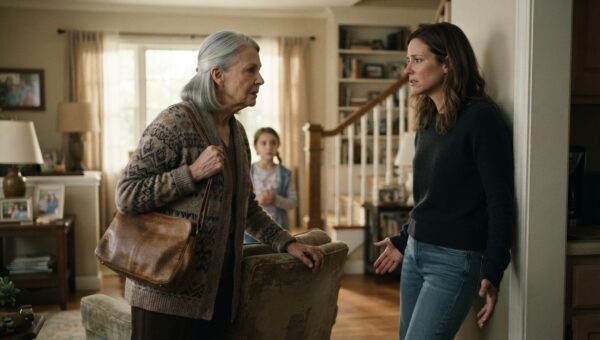
The smell of simmered chicken and celery was drifting down the hall from the kitchen, just like it did every Tuesday afternoon. In the front parlor, sitting across from me on the sofa my late husband Arthur bought thirty years ago, sat my son Devon and my granddaughter Amara. Between us, laid flat on the low oak coffee table, were two white manila folders from my attorney’s office.
Each folder held a last will and testament. Both bore my signature. Both carried the raised crimp of a notary seal.
The first document, dated October 2019, was pulled out of Arthur’s old mahogany rolltop desk three weeks ago by Devon. It left our three-bedroom brick ranch home in Canton, Ohio, entirely to him.
The second document, dated August 2022, was sitting in the legal archives of Mr. Robert Vance on Market Avenue. It left the exact same house entirely to Amara.
“Mom, you can’t just pretend the 2019 paper doesn’t count,” Devon said, leaning forward with his elbows on his knees. He was forty-six, wearing his good work jacket, his thinning hair brushed flat. “Dad told me right after we fixed the roof that this place was mine. I climbed up there every weekend for a month. I paid for half the shingles out of my own pocket. You signed it right after we finished the south gutter.”
He was telling the truth about the roof. In the late summer of 2019, before Arthur got sick, a heavy storm tore through Stark County and stripped the shingles down to the plywood. Arthur had bad knees and couldn’t climb the ladder. Devon drove down from Akron every Saturday, hauled thirty bundles of asphalt shingles up on his shoulder, and worked until his hands were raw. We had an estimate from a contractor for nine thousand dollars that we simply did not have in savings. Devon spent roughly three thousand on materials and did the labor himself.
After we drove the last nails and swept the driveway, Arthur and I sat at the kitchen table with him. Arthur had looked at me and said, “Evelyn, when we are gone, this roof ought to stay over the boy who patched it.” I agreed. We went to the local branch bank on a Thursday morning, signed the standard document Arthur had drawn up, had the teller notarize it, and put it in the metal lockbox inside the desk.
Then Arthur passed away in 2021. And six months later, my right hip gave out completely on the icy patch outside the side door.
I lay on the cold pavement for forty minutes before a neighbor walking his dog heard me crying. At the hospital, the surgeon put three pins into my joint and told me I could not live alone for at least six months.
I called Devon first. He came to the hospital twice. He brought a bouquet of grocery-store carnations and set them on the rolling tray. When I asked if he could stay in the spare bedroom for a couple of months while I regained my footing, he looked down at his phone. He explained that his regional sales route had expanded. He had to cover territory all the way down to Marietta and Wheeling. He said he would try to check in every other Sunday, but he suggested I look into a short-term rehab facility in Massillon that cost four thousand dollars a month.
My monthly Social Security check is eleven hundred and forty dollars. Arthur had a small pension of six hundred. There was no four thousand dollars.
That was when Amara showed up at the hospital with two duffel bags.
She was twenty-two then, Devon’s daughter from his first marriage. She had been working twenty-five hours a week at a dental office downtown while taking night classes for community college. She walked into my room, kissed my forehead, and said, “Grandma, my lease is up in three weeks. Pack your things when they discharge you. I’m moving into Grandpa’s study.”
She did not miss a single day. When I came home in a wheelchair, she built a sturdy wooden ramp over the back steps using scrap lumber and cinder blocks. She cooked every meal from scratch so my blood pressure wouldn’t spike. When I had to use the bedside commode at three o’clock in the morning because the pins in my hip were throbbing, she was the one who woke up without a word of complaint, held my arms, and helped me stand.
For two straight years, Amara drove me to physical therapy on Tuesday mornings, took me to the grocery store, washed my bed linens, and managed my prescriptions. She paid five hundred dollars a month toward the household utilities from her dental clinic paycheck.
In August 2022, after a doctor told me my hip had finally healed enough to walk with just a cane, I took a taxi downtown to Mr. Vance’s office. I didn’t tell Amara. I didn’t tell Devon. I sat in Mr. Vance’s leather chair and said, “Arthur wanted Devon to have the house because of the roof. But Devon left me to rot in a nursing home, and this girl kept me alive. Draw up a new will. Everything goes to Amara.”
Mr. Vance did exactly that. I signed it, two paralegals witnessed it, and the original went into his fireproof safe. I took a copy home and placed it inside my bedroom dresser under my winter sweaters.
I never threw away the 2019 paper in Arthur’s desk. I didn’t think about it. In my mind, when you write a new will, the old one just vanishes like smoke.
Three weeks ago, Devon came over to look for Arthur’s old fishing tackle in the basement. On his way down, he stopped in the study to look for an old tax form in the rolltop desk. That was when he found the 2019 document inside the unlocked metal box.
He didn’t know about the 2022 will until two days later, when he called to say he was listing the house with a broker to “protect the family equity” and I told him he couldn’t touch a single brick because the property belonged to his daughter.
Now, sitting in my living room, Devon tapped the 2019 paper with a thick forefinger.
“You had no right to undo Dad’s promise behind my back,” Devon said, his voice tightening. “Amara was family. Family helps family. She lived here rent-free for two years while I was out busting my back on the road.”
Amara came out of the kitchen, wiping her hands on a dishtowel. Her voice was quiet, but her hands were trembling. “I paid five hundred dollars every single month toward the electric and water, Dad. I have the bank transfer receipts on my phone. And I didn’t live here for free. I wiped Grandma’s tears when she couldn’t reach the toilet.”
“That doesn’t buy a two-hundred-thousand-dollar house, Amara,” Devon snapped. “I have a lawyer on retainer now. He says Mom wasn’t in her right mind after the surgery and that the 2019 will is the true intent of the estate. We go before the probate judge on the fourteenth.”
He stood up, grabbed his jacket, and walked out the front door, letting the screen slam hard against the frame.
Amara looked down at the coffee table, then at me. Her eyes were red. “Grandma, I don’t want you to lose your son over this. If he wants the house, let him have it. I just want you to be okay.”
I looked at the girl who had lifted me out of bed when my own flesh and blood couldn’t spare an hour on a Sunday afternoon.
“No,” I told her. “We are going to see Mr. Vance tomorrow morning.”
PART 2
The next morning, the rain was coming down in gray sheets over Market Avenue. Amara held a black umbrella over my head as we walked slowly from the municipal parking deck to the front steps of Mr. Robert Vance’s office.
Mr. Vance had represented Arthur when he bought our small hardware shop back in 1984, and he had handled Arthur’s estate settlement after the cancer took him. He was a man in his late sixties, with silver-rimmed spectacles and a deliberate, unhurried way of turning a page.
He laid both folders side by side on his green blotter.
“Evelyn,” he said, taking off his glasses and rubbing the bridge of his nose. “Devon’s lawyer sent over a formal notice of intent to contest yesterday afternoon. They are filing on two grounds. First, they claim you lacked testamentary capacity in August 2022 due to lingering surgical trauma and prescription painkillers. Second, they claim Amara exercised undue influence over you because she was your sole caregiver and controlled your daily movements.”
Amara let out a small, sharp breath. She sat up straight in her chair, her fingers digging into the straps of her purse. “I never asked her for this house. I didn’t even know she went to see you in 2022 until Dad started yelling three weeks ago.”
“I know that, young lady,” Mr. Vance said gently. “And the medical records will easily defeat the capacity claim. I had Evelyn’s primary care doctor sign an affidavit of competence before I even let her put pen to paper in 2022. I always do that when an elderly client executes a new instrument following major surgery. Her mind was as sharp as a tack.”
“Then what is Devon actually doing?” I asked, my knuckles white against the handle of my walking stick. “The 2022 will cancels the 2019 one, doesn’t it? That’s what you told me.”
“It does,” Mr. Vance replied. “Under Ohio law, a later validly executed will containing standard revocation language supersedes prior wills. But Devon isn’t relying only on the 2019 paper. He is asserting an equitable claim against the estate for detrimental reliance and breach of an oral contract to make a will.”
He slid a document toward me. It was a formal claim for forty-two thousand dollars, or full legal title to the property.
“Devon has submitted receipts for three thousand one hundred dollars in roofing materials from 2019,” Mr. Vance explained. “Along with a signed statement from your late husband Arthur, written on a piece of yellow legal pad dated September 12, 2019, stating: ‘Devon fixed the roof; the house belongs to Devon when we go.’ Arthur signed it. You signed it, Evelyn.”
My stomach dropped into my shoes. I remembered that yellow piece of paper. We had scribbled it after dinner, drinking coffee while Devon was rolling up the extension cords in the yard. Arthur had shoved it into the same lockbox with the 2019 will.
“Devon’s attorney is arguing that you and Arthur entered into a binding contract with Devon,” Mr. Vance said. “That Devon provided substantial home improvements in exchange for the promised inheritance of the property, and that you cannot unilaterally breach that agreement after Arthur’s death without compensating Devon for the property value.”
“He wants the whole house for three thousand dollars of shingles?” Amara asked, her voice cracking with anger.
“He wants the house, or he wants the court to force an estate sale so he gets paid out forty-two thousand dollars for his labor and equity claim,” Mr. Vance said. “If this goes to a full probate trial with depositions, expert property appraisals, and evidentiary hearings, you will spend fifteen to twenty thousand dollars just defending the 2022 will. And Evelyn, you don’t have that cash on hand.”
He was right. My total savings in the Canton Federal credit union stood at six thousand four hundred dollars.
“What happens if I refuse to fight?” I asked quietly.
“If you don’t answer the petition, the court could find that the contract claim is valid, or the parties might be forced into an estate partition,” Mr. Vance answered. “The house would be sold at auction. Devon would get his cut, and whatever was left would go to Amara. But you would lose your home while you are still living in it.”
We walked out of the office into the drizzle. In the car, Amara didn’t start the engine right away. She sat with her hands on the steering wheel, staring through the blurred windshield.
“Grandma,” she said softly. “I’m going to call Dad. I’ll tell him I’ll sign whatever waiver he wants. You can’t live like this, worrying every day that someone is going to put a lock on the front door.”
“You will not call him,” I said. My voice came out firmer than I felt. “Your grandfather loved Devon, but Arthur never intended for our son to throw me to the wolves. We are going home, and we are going to look through every drawer Arthur ever owned.”
PART 3
For three days, Amara and I dismantled Arthur’s study.
We pulled out the metal filing cabinets that held thirty years of receipts, utility stubs, tax returns, and warranty booklets. Arthur was a child of the Depression; he never threw away a canceled check or a handwritten receipt.
On the third afternoon, while Amara was sorting through an old cardboard box marked “Hardware Store Accounts 2015-2018” in the spare room, I sat on the floor of the study in front of the rolltop desk. I pulled out the false-bottom wooden tray beneath the center drawer, where Arthur used to hide cash before we went on our annual trip to Lake Erie.
The cash was long gone, but underneath a layer of yellowed felt, there was a thin, gray spiral notebook.
On the front cover, in Arthur’s tight, slanted handwriting, was written: *Devon Loans & Advances.*
My fingers shook as I turned the pages.
The entries began in June 2016.
*June 14, 2016: Paid $4,800 to Stark County Municipal Court for Devon’s second license suspension fine.*
*November 3, 2017: Wire transfer to Devon for truck transmission repair, $2,450. Promised to repay by Christmas.*
*August 19, 2018: Paid Devon’s back rent on the Cleveland apartment to stop eviction, $3,600.*
Page after page. Arthur had never told me the full extent of it. He had protected me from knowing how much Devon had bled our small commercial savings after the hardware store closed down. But the most important entry was near the very back, dated September 15, 2019, exactly three days after we signed that yellow note about the roof.
*Devon came for the roof money. He said he was broke. I gave him $5,000 cash from the floor safe. Told him that paid for the materials and his time in full. He agreed this settles all claims for the roof work. Evelyn was taking a nap.*
Taped directly to the notebook page was a bank withdrawal receipt from our local branch for five thousand dollars, dated September 15, 2019, signed by Arthur. Right below the tape was a piece of white receipt paper from a gas station, with Devon’s scrawling handwriting: *Received $5,000 cash from Dad for roof materials and labor. Devon Vance.*
Devon had already been paid.
He had not spent a single penny of his own money on that roof. He had taken three thousand from Arthur, pocketed two thousand in cash for four weekends of work, and then kept Arthur’s handwritten promise about the house in the metal box, waiting for the day he could use it as leverage.
I sat on the carpet with that notebook clutched to my chest, and for the first time since my hip broke, I wept. Not out of sadness, but out of the bitter realization of what my son had turned into.
I didn’t call Devon. I called Mr. Vance.
Two hours later, Amara and I were back in his office. Mr. Vance put the spiral notebook under his desk lamp, reading every line through a magnifying glass. He compared the signature on the gas station receipt to the signature on Devon’s court petition.
“This completely dismantles his contract claim,” Mr. Vance said, his eyes hard. “He accepted cash compensation in full satisfaction of the roof repairs seventy-two hours after the note was signed. That extinguished any equitable obligation. Furthermore, he failed to disclose this satisfaction to his attorney or the court, which verges on fraudulent misrepresentation.”
Mr. Vance picked up his desk phone and dialed Devon’s attorney. He put the call on speaker.
“Harold,” Mr. Vance said without greeting. “I have Arthur Vance’s handwritten ledger and a signed receipt from your client, Devon, showing he accepted five thousand dollars cash on September 15, 2019, in full satisfaction for the roof repairs he claims formed the basis of an oral contract. We have his signature acknowledging payment in full.”
There was a long silence on the other end of the line.
“Are you certain of that, Bob?” Harold’s voice came back, thin and uncomfortable.
“I have the original signed receipt in front of me, Harold. I also have Evelyn Vance’s 2022 will, backed by an affidavit of capacity from her physician. If your client does not withdraw his caveat and his claim against this estate by five o’clock tomorrow, I am filing this ledger with the probate judge along with a motion for sanctions and attorney’s fees against Devon for filing a frivolous and fraudulent claim.”
“Let me speak to my client,” Harold said, and the line went dead.
ENDING
The formal notice of withdrawal arrived by certified courier at nine o’clock the following morning. Devon’s attorney filed a complete dismissal of the contest with prejudice.
Devon did not come to the house. He sent a single text message to my phone that evening: *You always took everybody else’s side over mine. Don’t bother calling me.*
I didn’t answer it. I sat by the living room window, watching the rain stop and the evening sky turn a pale, washed-out blue.
The hearing date on the fourteenth was canceled. The 2022 will remains the sole, uncontested legal document governing my estate. The house belongs to me for as long as I draw breath, and when I close my eyes for the last time, every single board, nail, and brick will pass directly to Amara.
The law told me I had to choose, and in the end, the truth made the choice for me. Devon chose money over his mother five years ago when he charged his dying father five thousand dollars to put shingles over our heads. Amara chose me when she carried my laundry down the basement stairs and held my hand through the worst pain of my life without ever asking for a deed or a promise.
Last night, Amara finished her soup and brought two bowls to the dining room table. She sat down across from me, her study guides for her dental hygienist license spread out beside her spoon.
“Grandma,” she said, looking up from her book. “Tomorrow after your therapy, do you want to stop at the garden center? The flower beds by the porch look empty.”
“I’d like that,” I told her, taking her warm hand across the oak table. “Let’s plant yellow marigolds this year. They take root easily, and they can survive just about anything.”