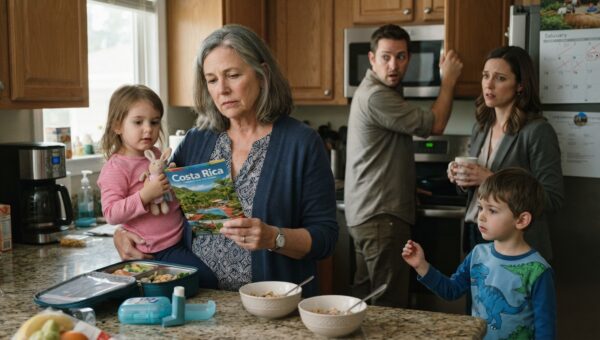
The coffee pot on my counter had that little metal hiss it always makes when the water gets down to the last drop, but I didn’t move to turn it off. I just stood there with my tea mug half-full, looking at the hallway rug.
My granddaughter Posy is seven, and last month she started keeping a chart taped inside her closet door.
Little weather pictures she drew with colored pencils, one for every day. Suns, clouds, lightning bolts. I figured it was a school project. Kids love coloring calendars.
Her mama married Kurt last spring, a twelve-thousand-dollar wedding I helped pay for. He built Posy a pink wooden swing set in the backyard and calls her sweet pea when anyone is watching.
Saturday she stayed with me because my daughter Brenda had an evening shift at the clinic and Kurt had some work meeting across town. Posy slept with the bedroom light on. Not just the little plug-in nightlight by the baseboard, but the overhead ceiling light burning bright through the frosted glass globe until past midnight.
When I went in to check on her, she was sitting straight up against the pillows, clutching the corner of her quilt so tight her knuckles were white. I sat on the edge of the twin mattress and pushed her fine brown hair out of her eyes.
“You can turn that big light off, honey,” I said, keeping my voice low and soft. “The moon’s out. It’s plenty bright enough.”
She shook her head so fast her chin brushed her collarbone. She wouldn’t look at me, just stared hard at the embroidered flowers on her quilt cover.
I asked about her pretty chart. The one taped right on the inside of her bedroom closet door at home.
She got quiet. The kind of quiet that feels heavy, like the air right before a summer squall rolls in off the lake.
“The storms are the bad days,” she said. Her voice didn’t sound like a seven-year-old. It sounded small and tired, like an old person who had given up on arguing. “I have to know before he gets home.”
Sunday morning, Brenda and Kurt stopped by to pick her up, but Kurt stayed in his silver truck idling in the gravel drive with the radio playing low.
Brenda came inside to grab Posy’s jacket and her small canvas overnight bag. She looked tired, the dark circles under her eyes deeper than they were six months ago, but she smiled that bright, manufactured smile she puts on whenever anyone asks how married life is treating them.
“He’s been so wonderful helping with her reading homework,” Brenda said, zipping Posy’s jacket while the little girl stood frozen by the screen door, staring down at her sneakers. “I don’t know what I’d do without him around the house.”
I didn’t say anything to that. I just told Brenda I needed to drop off some canned peaches at their place later that afternoon, just an excuse, and watched them walk down the driveway together.
An hour later, I drove my old Buick down their street. Brenda’s car was gone from the driveway, and Kurt’s truck wasn’t parked in the side carport.
They had gone to the warehouse store across the county line for groceries, the big Sunday trip that always took at least two hours.
The front door key I kept for emergencies turned smooth in the deadbolt. The house smelled faintly of lemon cleaner and stale coffee. It was too quiet, the kind of stillness that feels rehearsed.
I walked straight down the narrow hallway to Posy’s room. The door was half-open, showing the white painted wood of the closet door inside.
I reached out and pulled the closet door open all the way. There it was. A piece of lined notebook paper taped at the corners with yellowed Scotch tape.
Sunday had a bright yellow sun. Monday had a fluffy cloud. Thursday and Friday were slashed through with crude, heavy black lightning bolts drawn with a sharpie marker.
I peeled the chart off the door. The paper was thin and worn soft at the edges from being touched over and over again. I had to see.
Underneath the first lightning bolt, written in shaky, oversized second-grade printing, were the words: *Dropped the glass. He said I’m clumsy like my real dad and put me in the dark.*
My stomach gave a hard, sickening lurch. I turned the paper over. Every single lightning bolt had a line beneath it, written in that same careful, terrified hand.
*Cried too loud when he threw the game controller. Locked in the pantry for two hours.*
*Spilled juice on the rug. He told me mama will leave if I don’t stop ruining things.*
I stood there in the middle of that pale pink bedroom, holding a piece of lined paper, and the twelve-thousand-dollar wedding photos downstairs in the hallway suddenly looked like props on a stage. The swing set outside in the grass wasn’t a gift. It was camouflage.
I folded the paper twice and put it deep into my coat pocket. My hands didn’t stop shaking the whole drive back to my house. I sat at my kitchen table for an hour, the paper smooth under my palm, watching the clock on the microwave tick past noon.
When Brenda walked through my back door later that afternoon with a plastic bag of leftover casserole I’d sent home earlier in the week, I didn’t offer her tea. I laid the weather chart flat on the oilcloth table between us.
Brenda stopped with her hand still on the strap of her purse. “What is this?”
“Look at the lightning bolts, Brenda,” I said, and my voice sounded like gravel grinding under tires.
She leaned over the table, her eyes scanning the lines of awkward handwriting. I watched the color drain right out of her face, leaving her skin that dull, greyish white people get when they realize they’ve walked off the edge of a cliff.
“She made this,” Brenda whispered, shaking her head. “Kids have wild imaginations. She watches too many cartoons with storms, “
“Don’t,” I cut her off. The word came out harder than I meant it to, sharp enough to make her flinch. “Don’t do that to your own child. She sleeps with the light on because she’s terrified in her own bed.”
Brenda dropped into the wooden chair across from me, her fingers trembling as she touched the edge of the paper where Posy had written about the pantry. “He told me she was just being difficult. He said stepfamilies take adjustment.”
“That’s not adjustment,” I said. “That’s a cage.”
We sat there in the quiet kitchen for a long time, the hum of the refrigerator filling the space between us. Brenda started crying then, not loud, just the quiet, miserable leaking of a woman whose whole life had just cracked right down the middle.
“He’s coming back here after he drops the groceries,” Brenda muttered, wiping her eyes with the sleeve of her sweater. “He said he needed to check on the mower.”
“Let him come,” I said, standing up from the table. I walked over to the landline phone on the wall and picked up the receiver, my thumb resting on the buttons. “You’re going to tell him to pack his clothes, Brenda. And if he gives you even a fraction of a second of that temper of his while I’m standing in your living room, I’m calling the sheriff before he can touch his car keys.”
Brenda looked up at me, her eyes red and swollen, and for the first time in a year, I saw my daughter again underneath the fog of that man’s charm. She gave a small, jerky nod.
We drove back to her house together in separate cars. Kurt’s truck was already parked in the driveway when we pulled in, the tailgate down. He was standing by the back bumper with a box of groceries in his arms, smiling as he saw us coming up the gravel.
He didn’t smile for long. Brenda walked past him without a word, her chin up and her keys tight in her fist, and unlocked the front door.
I stayed on the bottom step of the porch, looking up at him. I had the folded piece of notebook paper in my pocket, right against my hand.
“We need to talk about Posy’s closet door,” I said.
Kurt’s smile didn’t drop all at once; it just curdled around the edges, his eyes narrowing into two cold slits as he realized the game was over.
“She’s a dramatic kid,” he started, his voice dropping into that smooth, reasonable tone he used at family dinners. “You’re making a mountain out of, “
“Pack your bags, Kurt,” Brenda said from the open doorway, her voice shaking but clear. “And don’t bother coming back for the rest of your tools until Tuesday when I’ve got someone here with me.”
He stared at her for three seconds, his jaw working, the mask slipping so fast you could almost hear the plastic snap. But he looked at me, standing there by the porch rail, and he knew he wasn’t going to charm his way out of this one.
By evening, the truck was gone down the road, and the house was quiet again. Not the heavy, terrifying quiet of a storm day, but the quiet of an empty room after the wind finally dies down.
Posy sat at my kitchen table later that week with a brand-new, unlined artist’s sketchbook open wide to a clean, bright white page. The yellow crayon in her small hand moved smoothly across the paper, leaving behind a big, round, unclouded sun with thick, happy rays stretching out toward every corner. I pulled my chair in close beside her, watching the bright yellow color fill the page, and for the first time in months, the air in the room felt light enough to breathe.