My daughter-in-law announced at Easter brunch that she and my son were taking over the family lake house because I hardly use it anymore. I was seventy-two, not dead, and that cabin had belonged to my parents since 1974. Every single wall held forty years of our family history, from the notch marks measuring my children’s heights on the pantry doorframe to the smell of cedar and old lake water that always cleared my head.
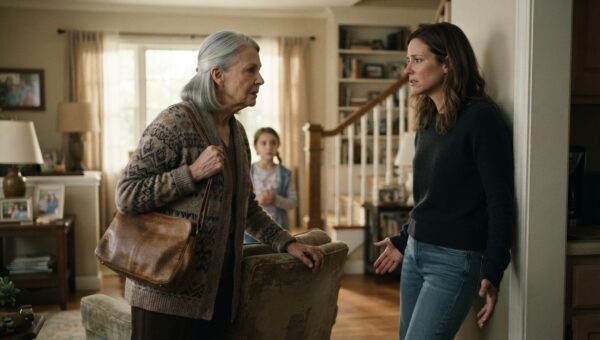
My son Ethan stared straight down at his deviled egg plate while Shelly described the open-concept kitchen renovations she had already priced out with some local contractor. I set my napkin down on the table very carefully so my hands wouldn’t shake. I asked, “Did you read the deed?” Shelly laughed and waved a hand like she was swatting away a gnat. “We don’t need a legal lecture, Carol.” I got my purse, walked out to my sedan without finishing my coffee, and drove home.
The house was quiet when I got back, just the hum of the refrigerator and the grandfather clock in the hall. Ethan had always been a good boy, but ever since he married Shelly eight years ago, he had acquired this way of nodding along while she rewrote reality. I kept telling myself marriage required compromise, but compromise shouldn’t look like theft in broad daylight.
I spent the rest of Sunday afternoon sitting on my back porch staring at the hydrangeas, trying to convince myself I had overreacted. Maybe they were just being thoughtless. Maybe modern young couples talk about property like it is a shopping list. But my parents bought that land with cash from my father’s auto body shop, and my name was the only one on the title that sat in my fireproof box upstairs.
Monday morning started with the kind of phone call that makes the room tilt slightly to the left. The man introduced himself as Jake, a local contractor based out of Oolitic, and asked where I wanted the twenty-yard dumpster dropped for the demo work starting Wednesday. I told him no work had been approved on my property and he must have the wrong address. Jake sounded confused on his end, shuffling some papers around. He said, “No, ma’am, I’m looking right at the authorization form signed by Ethan and countersigned by the primary deed holder.” I asked him to forward me whatever he was looking at right then.
Ten minutes later, a PDF hit my email inbox. Ethan’s signature was there, neat and small. And right below it was mine, copied so clumsily I could spot the pixelated edges of a digital paste job without my reading glasses.
I didn’t call Ethan. I didn’t text Shelly. I picked up my car keys and drove straight down to the Lawrence County Courthouse, walking past the bronze veterans plaque and into the recorder’s office where the air always smelled of damp paper and floor wax. Martha was behind the high counter, a woman I had known since our kids were in middle school together. She took off her half-moon glasses when she saw my face. I gave her the parcel number and asked to pull the most recent filing history for the lake property. Martha typed away on her chunky monitor, her eyebrows drawing closer together with every click. The room was so quiet I could hear the wall clock ticking clear across the room.
Martha looked up from her screen with a slow, heavy expression. “Ma’am,” she said, her voice dropping an octave, “you need to come around the side. There’s been another filing.” I walked through the swinging gate and stood behind her chair. She pointed a manicured finger at a line item dated just three weeks prior. It wasn’t just a repair permit or a utility easement. It was a full quitclaim deed transferring one hundred percent of the title from my sole individual name into a joint survivorship deed bearing my forged signature, notarized by a mobile notary service out of Bedford whose license had been suspended six months ago. Shelly hadn’t just planned a kitchen remodel. She had locked me out of my own inheritance while I was busy planning Easter dinner.
I sat in my car in the courthouse parking lot for twenty minutes with the engine running and the air conditioning humming. My chest felt tight, the way it did right after Arthur passed away five years ago, but that tightness quickly turned into something cold and hard. I called Marcus Vance, the real estate attorney who had handled my husband’s estate, and told him to clear his afternoon. By two o’clock, I was sitting across his walnut desk while he laid out the certified copies Martha had printed for us. Marcus shook his head, running a thumb over the forged notary stamp. “This is felony forgery, Carol,” he said plainly. “They didn’t just try to borrow the cabin. They tried to erase you.”
We spent the next two days building a paper wall. Marcus drafted an emergency injunction, a notice of fraudulent conveyance, and a formal trespass warning that would make the local sheriff’s department jump if anyone stepped foot on that gravel driveway without my express written consent. I didn’t cry once. Grief is for losses you can’t prevent; anger is for when people mistake your quietness for stupidity. Ethan tried calling me Tuesday night at 8:14 PM. I watched the phone light up on the kitchen counter, the screen flashing his face, and let it ring straight through to voicemail. He didn’t leave a message. He knew better than to try explaining a text message he couldn’t talk his way out of.
Thursday morning, Marcus and I drove out to the lake house together in his town car. As we turned down the tree-lined gravel lane, I saw Jake’s pickup truck parked right next to a massive blue steel dumpster sitting squarely on the grass where my mother’s prize peonies used to grow. Ethan’s Honda Civic was parked behind the porch, and Shelly was standing on the wooden deck pointing animatedly at the screen door while a young man with a tape measure nodded along. They looked so comfortable there, like owners taking inventory of their kingdom before the crown even cooled.
We pulled up right behind Ethan’s car, blocking him in completely. Marcus stepped out first, wearing his sharp gray suit and carrying a heavy leather briefcase that looked like business nobody wanted to argue with. I followed him out, my boots crunching on the limestone gravel with a sharp, familiar rhythm. Shelly turned around, her mouth parting in annoyance as she saw my sedan, but her expression died halfway when she saw Marcus step out behind me. “Carol,” she said, her voice sharp and brittle. “What are you doing here? We’re right in the middle of a contractor consultation.”
Ethan came sliding around the side of the porch, wiping his hands on a blue shop rag, looking like a boy caught stealing apples from an orchard. “Mom,” he muttered, stopping dead near the porch steps. “You shouldn’t have driven out here. We were going to talk to you about this tonight.” I didn’t look at Ethan. I looked straight at Shelly, who was already starting to backpedal toward the sliding glass door. “You don’t need to talk to me tonight, Shelly,” I said, my voice cutting through the morning breeze off the water. “You can talk to the county prosecutor about why you forged my signature on a quitclaim deed using a suspended notary.”
The color drained right out of Shelly’s face, leaving her looking like skim milk. She opened her mouth, but no sound came out except a dry little gasp. Ethan took two clumsy steps forward, his hands dropping the shop rag onto the dirt. “Mom, wait,” he stammered, his voice cracking like a teenager’s. “Shelly just… she thought we could manage the rentals better if the paperwork was streamlined. It wasn’t about cutting you out. It was just temporary for the tax season.” I finally looked at my son, really looked at him, and realized how small he looked standing there in his expensive work boots that had never seen a day of real labor. “You signed away your mother’s home for a tax break and a kitchen island,” I said quietly. “You didn’t even have the spine to tell me to my face.”
Marcus stepped forward and handed a thick manila envelope directly to the contractor, who was standing frozen with his tape measure still extended three feet in the air. “Mr. Miller,” Marcus said in his smooth, courtroom tone, “any further work on this parcel constitutes criminal trespass and aiding in property fraud. Here is the injunction signed by Judge Holloway this morning.” Jake looked down at the packet, then looked at Shelly, and then looked at me. Without saying a single word, he turned around, climbed back into his pickup, and fired up the engine with a roar that shook the gravel.
Shelly found her voice then, shrill and desperate as she pointed a shaking finger at me. “You can’t do this! We invested time in this plan! That cabin is going to be ours anyway when you’re in a home!” Ethan flinched like she had hit him across the face, but he didn’t defend me. He just stood there staring at his boots while the truth hung in the air between us like stale smoke. I didn’t yell. I didn’t let my voice rise an inch. I just looked at her with the absolute stillness that only seventy-two years of surviving this world can buy you. “Pack your things out of the guest room,” I told them both. “The sheriff will be back tomorrow morning to audit the keys.”
We stayed until they gathered up their clipboards and drove away in total, humiliated silence, Ethan staring straight ahead through his windshield and Shelly glaring out the passenger window like the world had personally offended her. Marcus left a few minutes later after confirming the local deputies had the trespass order on file. I walked around the side of the house alone, checking the screen on the porch where my father had patched a tear with copper wire back in ninety-eight. The lake was as smooth as glass, reflecting the gray clouds rolling in from the west without a single ripple of disturbance.
I walked back up the wooden steps, pulled the heavy brass key out of my coat pocket, and slid it into the original oak front door lock. The brass tumblers gave two solid, heavy clicks that echoed against the cedar siding, shutting out the sound of the driveway and the mess they had left behind. I stood there in the quiet hallway for a long time, breathing in the smell of old books and pine needles, entirely alone and entirely untouchable.