David told me he was too broke to drive down for Thanksgiving. I sat right here at this kitchen table with a plate of turkey from Mrs. Gable next door, staring at three cardboard boxes I had already packed and sealed with green tape for my grandchildren. He said the heating bill had jumped up and the truck needed a new alternator and honestly I just nodded into the telephone and told him not to worry about it.
People get squeezed. I know how tight things get when you have three kids and a mortgage that eats half your check before you even cash it.
Two days after the holiday, my sister Clara pulled up her phone while we were sitting on the porch and turned the screen toward me without a word. There was David in a pair of bright blue swim trunks, laughing under the yellow awning of a rented house right on the Florida gulf. My ex-husband Arthur was standing right behind him with his hand on David’s shoulder. Next to Arthur was Brenda, the woman Arthur left me for back when David was just starting middle school, holding a tray of margaritas like they were one big happy family portrait for a Christmas card. I looked at Clara’s phone for three seconds and handed it back. “Well,” I told her, and my voice didn’t even shake. “At least the weather’s better down there.”
I didn’t call him. I didn’t send one of those long, stinging text messages that people write when they want a fight they can screenshot. I just went inside, took the three boxes of Christmas gifts off the dining room chair, and put them up on the high shelf in the spare bedroom behind the spare quilts where nobody goes unless they are looking for mothballs. A week went by where the house was so quiet I could hear the refrigerator compressor click on from the living room. I spent those seven days cleaning out the pantry, throwing away spice jars that expired during the Bush administration, and thinking about thirty years of raising a boy alone in a drafty house while Arthur lived five miles away in a gated development with a second wife who had never washed a dish in her Sunday best.
Then the tablet screen lit up on the side table while the six o’clock news was droning on about a cold front moving down from Georgia.
It was Maya, my eight-year-old granddaughter, her little bangs stuck to her forehead like she had been running through the sprinkler. “Grandma?” she whispered, and she sounded scared, the way kids sound when they are hiding behind the couch during a thunderstorm. “Grandma, Daddy says we can’t tell you what Grandpa paid for.” Before I could even say her name, she turned the camera around and panned it across the granite countertops of that Florida kitchen. There was a thick blue leather folder sitting right next to a pile of lime rinds, the kind of folder they hand you at a bank when you are signing your life away on dotted lines. Then the screen went black.
I sat there in the dark for a long time watching the little grey reflection of my own face in the glass of the television. Arthur hadn’t invited David down out of the goodness of his cold, bitter heart.
Arthur didn’t even like children much when they were loud, let alone three of them under the roof of a twelve-hundred-dollar-a-night beach rental. Arthur was buying a second chance at a legacy because his own bloodline had turned out as hollow as he was. And David, my good, hardworking, ordinary boy who used to help me carry groceries up the back steps, had taken thirty thousand dollars or maybe fifty thousand to let the man who broke my heart write him a new family tree.
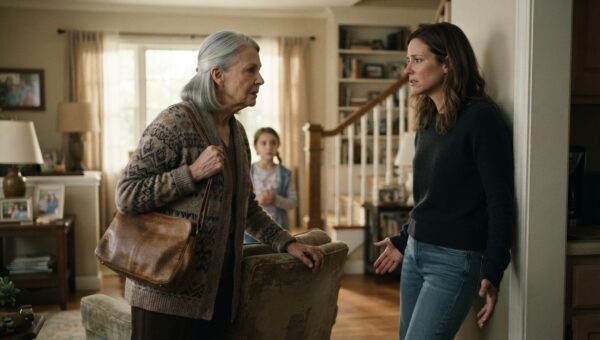
David drove back into my driveway three weeks later in the middle of a Tuesday drizzle. He looked tired. Not the tired of a man who worked forty hours on a framing crew, but the thin, grey kind of tired that comes from sleeping with your teeth clenched. He came up the steps carrying a cheap plastic bag with a Key West logo peeling off the side and knocked twice the way he used to when he was sixteen and came home past curfew.
“Mom,” he said when I opened the door, and he tried to give me that wide, crooked smile he uses when he wants me to forgive him for breaking a window with a baseball. “I wanted to swing by before I picked up the kids from school. We had a crazy week down south. Arthur and Brenda rented a place and they just happened to be down the road, you know? It was good for the kids to see the ocean.”
I didn’t move out of the doorway. I stayed right there with my hand on the brass knob, looking at the grey hairs sticking out above his ears. “You said you couldn’t afford the gas to come home for turkey, David,” I said, and my voice was so quiet it barely cleared the threshold.
He shifted his weight from one boot to the other, the gravel in the driveway grinding under his heel. “Well, things came together at the last minute, Mom. Arthur caught us at a good time. You know how it is. With the bank and everything.”
“I saw the folder on the counter, David,” I said.
The smile died right off his face so fast it looked like someone had turned off a lamp. He didn’t ask what folder. He didn’t pretend he didn’t know what I was talking about. He just swallowed hard and his Adam’s apple jumped under his flannel collar. “Maya shouldn’t have been on that tablet. I told her to put it down.”
“She’s eight years old,” I said. “She isn’t stupid. And neither am I. How much was it? Was it enough to pay off the balance on the back porch? Or did Arthur buy the whole foundation?”
“He paid off the mortgage, Mom,” David whispered, and he finally looked down at his own boots like they were the most interesting things in the world. “The whole thing. We don’t have a payment until the kids are through college. Brenda set up the trust herself. We just… we had to agree to spend the holidays down there from now on. They wanted the kids.”
“They wanted to wipe me out,” I said, and the words didn’t even feel heavy anymore. They just felt true. “They wanted to buy a new grandmother with an extra zero on the check, and you sold the only thing I ever gave you that money couldn’t touch.”
“That’s not fair,” he snapped, his voice cracking with that old, childish defense mechanism he always used when he was cornered. “You don’t know what it’s like to stare at those notices every month. You don’t know what it’s like to feel like a failure every time you look at your kids’ shoes.”
“I raised you by myself in this house for twelve years after he left us with three chairs and a broken refrigerator,” I told him, and I didn’t raise my voice once. “I never took a dime from him because my name wasn’t for sale at his kitchen table. You learned that from me, David. At least I thought you did.”
He stood there for a minute while the rain started to drip off the gutter right onto the brim of his baseball cap. He reached into his coat pocket like he was going to pull out that plastic bag with the cheap souvenirs, then he let his hand drop back down to his side. He knew as well as I did that a house paid for by the man who destroyed our family would always be built on sand, and that every time he walked through that front door in Florida, he was paying rent with his mother’s dignity.
“I have to go get the girls,” he muttered, and he didn’t look me in the eye when he turned around and walked back down the steps. He didn’t leave the plastic bag. He didn’t ask if I wanted to see the pictures. He just got back into his truck, and the transmission ground twice before he backed out into the rain without turning on his headlights.
I closed the door and locked the deadbolt, the metal sliding home with a heavy, clean thud. I walked back into the kitchen where the afternoon light was turning the color of wet slate through the window. The little wooden tea set that my mother gave me when I was six years old was sitting on the corner of the counter, wiped clean and waiting. I didn’t cry. I didn’t call Clara. I just poured myself a cup of hot water and sat down at the table, waiting for the telephone to ring.