October has a way of turning the air in our corner of South Carolina into something sharp and thin, the kind of weather that makes you pull your cardigan tighter around your shoulders before you even step off the porch. That was the month Leo stopped asking for five dollars for school lunch. He told me he was finally tired of buying the greasy ham and cheese sandwiches from the cafeteria line and wanted to pack his own brown bags like a sensible kid.
I remember standing at the kitchen counter, buttering two slices of store-brand wheat bread, feeling this quiet little lift of pride because my fifteen-year-old was finally starting to think ahead about grocery money.
I thought he was just growing up. I thought the small stack of brown paper bags disappearing from the bottom of the pantry meant my lectures on budgeting were finally sinking into his thick teenage skull. But then the phone on the kitchen wall rang at 3:14 on a Thursday afternoon while I was scrubbing grease off the stove burners. It was Mrs. Gable, the head secretary at West End High, and her voice had that thin, careful edge teachers use when they are trying very hard not to accuse your child of something criminal.
“Mrs. Bennett,” she said, and I could hear the faint click of a stapler in the background. “Is Leo supposed to be staying behind after the final bell to work in the cafeteria?”
I dropped the scrub sponge right into the soapy sink water, water splashing over the rim and soaking the front of my apron.
I told her no, he had a mountain of algebra homework waiting for him on his desk every single afternoon. Mrs. Gable let out a long, slow sigh that crackled through the old landline receiver.
“Well, he has been down in the dish room since October first,” she told me. “Washing trays until past five o’clock every single school day. The cafeteria manager finally asked him why he wasn’t taking the bus home, and he showed her his arrangement.”
Twenty minutes later my old Honda Civic was bumping down the gravel parking lot behind the gymnasium, the engine rattling loose enough to rattle my teeth. I was mad. Not just regular annoyed, but that hot, prickly kind of furious where your ears ring and you rehearse the lecture you are going to give the second you get him in the car. Hiding things from me. Letting me worry about him walking home in the dark.
Letting me think he was just being a normal teenager who forgot his chores.
The cafeteria smelled like stale bleach and boiled cabbage, the kind of damp institutional smell that doesn’t change in thirty years. The manager, a stout woman named Brenda with gray curls pinned up in a messy bun, met me by the heavy metal double doors. She didn’t look angry. She just looked tired, the same kind of bone-deep fatigue I saw in my own bathroom mirror every morning when I brushed my teeth.
She didn’t waste time on hellos. She just reached into the pocket of her stiff blue apron and pulled out a small, manila envelope, the kind people use for bank deposits.
“He’s a good worker,” Brenda said, and she laid the envelope flat on the stainless steel prep table between us. “Doesn’t complain. Just stands there scrubbing those heavy plastic trays until his knuckles are red. But he’s not doing it for himself.”
I reached out and picked up the envelope, my thumb catching on the rough paper seam. Inside were twelve narrow slips of thermal paper from the CVS down on Main Street, perfectly smoothed out and folded in half, along with a piece of lined notebook paper covered in Leo’s neat, sloping handwriting. Dates, amounts, and initials.
“What is this?” I asked, and my voice sounded small and hollow bouncing off the concrete block walls.
Brenda looked past my shoulder toward the empty, echoing hallway where the lockers stood like gray teeth. “He trades his cafeteria meal vouchers every Friday afternoon,” she said quietly. “For cash. To a senior boy with a car who runs errands for him.”
I stared at her, the words not quite making a straight line in my head. “Cash? For cafeteria vouchers? Why on earth would he need cash?”
Brenda shifted her weight from one foot to the other, her rubber-soled work shoes squeaking against the damp floor. She looked right at me then, and her eyes were too soft, the kind of look that makes you want to turn around and run back to your car.
“Because someone in your family hasn’t been taking her medicine,” she said.
The drive home took ten minutes, but I don’t remember steering the car. I remember the steering wheel vibrating under my palms and the heater blowing stale air that smelled like old dust. Every time I hit a pothole on Maple Street, the little manila envelope on the passenger seat shifted an inch toward the middle.
I didn’t turn on the overhead lights when I walked into the house. I just sat down at the oilcloth-covered kitchen table and dumped the contents of the envelope right into the center, right beside the salt shaker and the half-empty jar of instant coffee. The thermal receipts spilled out like dried leaves. I picked up the top one. November 14th. Thirty-four dollars and fifty cents. December 2nd. Thirty-four dollars and fifty cents. January 8th. Thirty-four dollars and fifty cents.
My fingers started to shake, not because I was cold, but because I knew those dates. Those were the exact days my refill order was supposed to go through at the pharmacy. The exact days I had called the clinic and told the receptionist that I was feeling fine, that my blood pressure had stabilized, that we could push the prescription out another month to save forty dollars for the electric bill. I had looked my son in the eye every single one of those evenings while he ate his bowl of plain buttered noodles, telling him I was just getting older and naturally a little more tired.
I stood up so fast my chair tipped backward and hit the linoleum with a sharp crack. I walked down the dim hallway past the framed school pictures of Leo holding various plastic trophies, and I pushed open his bedroom door. It smelled like laundry detergent and old textbooks. His gray hoodie was thrown over the back of his wooden desk chair, and his navy blue school backpack was unzipped on the floor.
I didn’t want to pry. I had always prided myself on giving him privacy, on being the kind of mother who didn’t go through a teenager’s personal things. But I was shaking so hard I could barely breathe. I knelt down on the cheap carpet and reached into the side pocket of his backpack. My fingers brushed against a crumpled pack of gum, three mechanical pencils with broken leads, and then a thick, spiral-bound composition notebook with a frayed edge.
I pulled it out and flipped it open to the middle.
There, written in Leo’s careful, block-letter handwriting that still looked a little bit like a sixth-grader’s, was a ledger. Column one: dates. Column two: cafeteria hours worked, logged down to the exact fifteen minutes. Column three: voucher trade value, listed as eight dollars each. Column four: running total for the pink heart pills sitting in the white plastic bottle at the back of the bathroom medicine cabinet that I hadn’t refilled since the first frost.
At the bottom of the page, under a shaky underline drawn with a red ballpoint pen, he had written a single sentence: *Mom looked pale again today. Need two more shifts.*
I sat on the edge of his bed with the notebook pressed flat against my knees, and the house was so quiet I could hear the refrigerator compressor humming in the kitchen. I thought about the spring before, when the local doctor had looked at my lab results over his clipboard and told me my heart was working too hard, that the little blue and pink pills were the only thing keeping my left ventricle from thickening up like old grease. I had nodded and smiled and thanked him, knowing full well that our savings account had forty-one dollars in it and the water bill was already two weeks past due. I had thought I was protecting Leo. I thought keeping him shielded from the grocery store math and the past-due notices was what being a good parent meant.
Instead, my fifteen-year-old son had spent four months scrubbing dried macaroni and mystery meat off aluminum trays in a hot, loud high school kitchen just to buy me thirty days of extra time. He had watched me rub my chest when I carried the laundry basket up the stairs. He had listened to me sigh when I opened the mail pile on the kitchen table. He had taken my secret, proud lies and turned them into math problems in a spiral notebook.
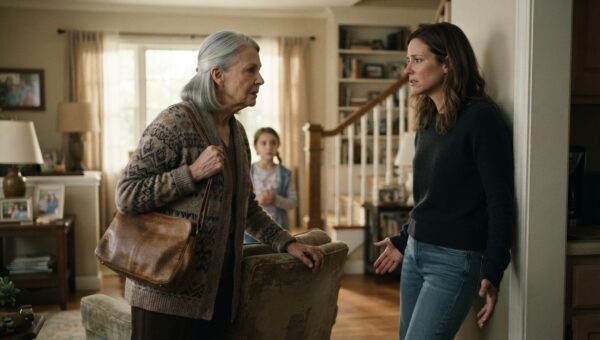
The front screen door banged shut at 5:15. Heavy footsteps on the braided rug in the entryway. Leo dropped his backpack on the floor by the coat rack, the heavy thud shaking the umbrella stand.
“Mom?” his voice called out, sounding a little rough around the edges from the damp air outside. “I’m home. Sorry I’m late, had to finish cleaning the grease traps behind the ovens.”
I didn’t answer right away. I stayed sitting on the edge of his bed, holding that blue notebook against my chest like it was something fragile that might break if I breathed too hard. I heard him walk into the kitchen, heard the refrigerator door open and close, heard the distinct sound of him looking for something on the counter where I had left the pharmacy receipts scattered out like a confession.
Footsteps padded softly down the hallway, stopping at the threshold of his bedroom.
Leo was standing in the doorway, his school jacket half-zipped over his gray sweatshirt, his hair damp from the mist outside. He looked so much younger than fifteen in that moment, his shoulders narrow under the fabric, his sneakers scuffed at the toes. He saw the notebook in my hands. He saw the white thermal receipts spread out on the quilt beside me.
His face didn’t go pale, and he didn’t try to shove his hands in his pockets to look tough. He just stood there for a long second, his jaw working slightly as he tried to figure out what to say.
“You shouldn’t have been going through my bag, Mom,” he whispered, and his voice cracked right on the middle of the sentence, the sudden vulnerability breaking through his careful teenage armor.
I looked up at him, my throat so tight I could barely force the air past my teeth. I wanted to tell him he was grounded for lying to me. I wanted to tell him that no child should ever have to worry about a parent’s heartbeat or a pharmacy bill. But all that came out was a ragged, wet breath.
“Why didn’t you tell me?” I asked, and the words barely made it across the small room.
Leo looked down at the scuffed toe of his sneaker, his throat moving as he swallowed hard. “Because you cried when the water bill came last November,” he said, and the plain, matter-of-fact way he said it hurt worse than if he had screamed at me. “And you said your chest hurt every time you walked to the laundry room. I didn’t want you to die, Mom. It’s just washing trays. It’s not that hard.”
He took two slow steps into the room and sat down on the wooden desk chair, his knees knocking against the drawers. He looked smaller than fifteen then, just a boy who had taken on a grown man’s terror and tried to solve it with dish soap and school vouchers.
“We aren’t doing this anymore, Leo,” I said, and I reached out across the space between us, grabbing his hand. His fingers were rough, the skin around his knuckles dry and chapped from the industrial bleach in the cafeteria sink. I squeezed his hand until my own fingers ached. “You hear me? You are done in that dish room. Starting tomorrow.”
Leo looked up, his eyes wide and panicked, ready to argue, ready to tell me about the pharmacy prices and the next refill date circled on his calendar. “But the prescription, “
“We are going to the clinic tomorrow morning,” I said, and my voice finally found its footing, steady and firm the way a mother’s voice is supposed to be. “I am going to talk to Dr. Evans about the assistance program. I am going to pick up a second part-time shift at the dry cleaners down on Broad Street. And you are going to go to your track practice after school, and you are going to let me be the adult in this house.”
Leo stared at me for a long, quiet moment, searching my face for any sign of the old, fragile weakness he had spent the last four months trying to patch together with his bare hands. Slowly, the tension left his shoulders, and he let out a long breath that sounded like a sigh of relief he had been holding since October.
“Okay,” he whispered. “Okay, Mom.”
We didn’t talk the whole way back down the hall to the kitchen. But he stayed right beside me, his shoulder brushing mine in the narrow doorway.
Later that evening, after we had eaten a quiet dinner of leftover soup and he had finally gone upstairs to tackle his algebra, I stood by the kitchen counter. I wiped the oilcloth clean with a damp sponge, clearing away the last of the dust and the memory of the receipts. In the center of the counter sat the white plastic pharmacy bottle, newly refilled and paid for through the clinic’s emergency hardship fund, sitting right next to a brand-new, bright red plastic lunchbox I had picked up at the dollar store after my talk with Dr. Evans. I packed two turkey sandwiches inside it, along with an apple and a small bag of chips, making sure the lid snapped shut with a sharp, secure click. Tomorrow morning, he would take that lunchbox to school like every other kid, and I would take my pill with a glass of tap water, and we would both start learning how to be exactly who we were supposed to be again.