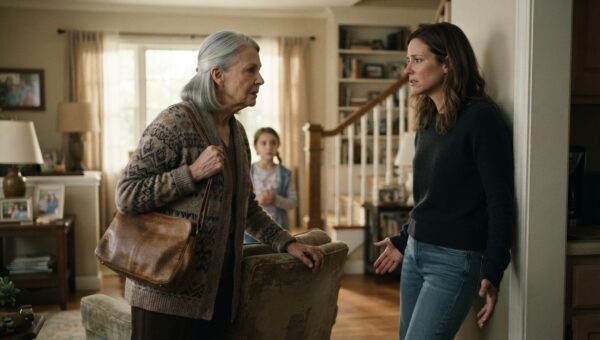
The notification light on my phone flashed three green times at 6:42 in the morning. It was a text from Mom, sent while Arthur was still downstairs grinding his coffee beans. She had left her heavy gold band taped under the bottom of theguest room dresser after her weekend visit, and my thumb had caught it while I was hunting for a stray lint roller.
My mother stopped wearing her wedding ring two months before my parents’ 50th anniversary. Dad noticed, but she told him her fingers were swollen from the humidity in Wichita. I believed her until I found the ring taped under a drawer in my guest room after one of her visits. I called and asked if she had forgotten it. She went quiet and said, “Please don’t tell your father yet.”
That word, yet, stayed with me. It sat in the back of my mind like a small pebble in a shoe, annoying and impossible to ignore. A mother who has worn the same band of yellow gold for forty-nine years does not simply misplace it in the dark underside of a guest bedroom furniture piece. She hides it.
A week later, Dad asked me to help scan old photos for their anniversary slideshow. Arthur loves his routines. He sat at the dining room table with his laptop open, the heavy plastic scanner humming like a small, tired cricket.
He had boxes of cardboard-framed snapshots from the late seventies, back when hair was long and polyester was king. We worked in comfortable silence for an hour, feeding pictures through the feeder, watching the digital ghosts of our family history blink onto his screen.
Inside a 1978 photo album with padded blue velvet covers, we found a marriage certificate folded behind a picture of Mom in a blue coat. Dad read it twice, then looked at the date. It was three years after I was born.
The room went entirely dead. The scanner finished its pass with a high, thin whine and then clicked off. Arthur didn’t move his hands from the edges of the paper. He just stared at the typed names, his thumb pressing down hard enough to wrinkle the bottom corner.
“Who is this?” he asked. His voice didn’t sound like him. It sounded like someone calling from the bottom of an empty well.
I walked around the table and looked over his shoulder. The groom’s name wasn’t Arthur. It was Julian Vance. The date on the court seal was October 14, 1978, in a county about two hours north of here, during a autumn when I was three years old and supposedly living in a quiet house with both of my parents.
“I don’t know,” I whispered. My stomach felt heavy, like I had swallowed a handful of lead pellets.
Arthur didn’t yell. He didn’t slam his fist against the wood. He just sat there with his shoulders curled inward, staring at the blue-coat photograph like it was a stranger’s face he was being asked to recognize. He traced the signature of Julian Vance with the tip of his finger.
“She told me she went to visit her aunt in Topeka that week,” Arthur said. He wasn’t talking to me anymore; he was talking to the empty room. “She was gone twelve days. Said the car had transmission trouble.”
“Dad,” I said, reaching out to touch his arm. “Stop.”
“Call her,” he said. He looked up at me then, and his eyes were completely dry, which somehow looked worse than tears. “Call her right now and tell her to bring the car back here.”
I didn’t argue. I pulled out my phone and dialed the number I had known since I was six years old. It rang twice before Mom picked up.
“Honey?” she said. Her voice sounded thin, tired, like she had been sitting by a window waiting for this exact ring.
“You need to come over,” I said. My hand was shaking so badly I had to grip the edge of the kitchen counter. “Now. Dad and I are looking at the 1978 album.”
There was a long silence on the line. I could hear the faint hum of her kitchen refrigerator in the background.
“I’ll be there in twenty minutes,” she said. And she hung up.
Those twenty minutes were the longest twenty minutes of my life. Arthur didn’t get up to make more coffee. He just sat at the table, staring at the folded piece of paper between his hands, occasionally turning the page of the album back and forth as if hoping the photograph would rearrange itself into something he understood. I stood by the window, watching the gray October wind shake the branches of the maple tree in the front yard.
When Mom’s Buick pulled into the driveway, she didn’t rush. She turned off the engine, sat behind the wheel for a full minute with her hands folded in her lap, and then got out. She walked up the front steps slowly, wearing a beige cardigan that looked too big for her.
When she opened the front door, she didn’t look at me. She walked straight into the dining room, her eyes fixed on Arthur’s bent head.
“You found it,” she said. It wasn’t a question.
Arthur looked up at her then. He didn’t raise his voice. “Fifty years, Claire. We’ve been planning a party for fifty years. People are flying in from Ohio.”
“I know,” she said, her voice barely louder than a whisper. She pulled out the chair across from him and sat down, her hands flat on the wood. “I know about the party, Arthur.”
“Explain it,” he said. “Explain how there’s a marriage certificate with another man’s name on it three years after our daughter was born, while we were living in the same house on Maple Street.”
Mom looked down at the certificate, her finger tracing the crease where it had been folded for decades. “It was 1978. You remember how bad things were that year with the mill closing and the bank threatening the mortgage. You walked out for three weeks in September. You stayed at your brother’s place in Missouri.”
Arthur flinched. I could see the memory hit him, sharp and ugly. “I came back.”
“I know you came back,” she said, looking up at him with eyes full of a heavy, exhausted sorrow. “You came back fourteen days later, and we never talked about those three weeks again. We just patched it together for the sake of the family. But while you were gone, I panicked. Julian was an old friend from art school. He was passing through, and he had some fool idea about moving out to the coast. He offered me a way out, a clean break, a paper marriage so I could get some property transfer sorted out before he left.”
“You married him,” Arthur said, his voice dropping into a harsh, grated register. “While you were still my wife, you married another man.”
“It wasn’t a real marriage, Arthur,” she said, and for the first time her voice cracked. “We never lived together. We never even went to a hotel. We signed the papers in a county clerk’s office because I was terrified that you weren’t coming back and I had a three-year-old child to feed with zero dollars in the bank. And then Julian left for Seattle two weeks later and vanished into thin air. He had federal trouble following him. I couldn’t divorce him because I didn’t know where he was, and I couldn’t tell you because I was so damn scared you would look at me and decide I wasn’t worth the trouble of keeping.”
She reached into her cardigan pocket and pulled out the unmounted wedding ring, placing it gently on the table next to the album.
“That’s why I took the ring off,” she said. “I found a probate lawyer in town two months ago. I’ve been trying to get the court to dissolve a ghost marriage from forty-five years ago so I wouldn’t have to walk into our golden anniversary with a lie sitting in the county records. I was going to tell you myself, Arthur. That’s why I said not yet.”
The room went quiet again. The grandfather clock in the hallway ticked away the seconds, loud and steady. Arthur didn’t touch the ring. He didn’t look at the certificate anymore. He looked at my mother, really looked at her, seeing the sixty-eight-year-old woman who had cooked every dinner, nursed him through his knee surgery, and sat beside him on the porch every summer evening since we were kids.
“You kept it a secret for half a century,” Arthur said. His voice was flat, drained of all anger, leaving only a vast, empty fatigue.
“I kept it because I was a terrified twenty-five-year-old who made a stupid mistake,” she said quietly. “And then the years went by, and every year it got harder to find the right time to tell you that I was technically a bigamist on a technicality. I was a coward, Arthur. I know that.”
I stood by the window, watching the wind push a dry leaf across the porch. Nobody yelled. There was no dramatic storming out, no grand cinematic exit. Just two old people sitting across a dining room table from a ghost that had finally caught up with them after fifty years.
Three weeks later, the anniversary party was officially canceled. We told the family that Mom had taken ill, which wasn’t entirely a lie; the stress of the past month had turned her gray and thin.
In the meantime, the legal work began. Mom’s attorney filed the emergency paperwork to clear the 1978 record once and for all, untangling the old paper knot that Julian Vance had tied and abandoned half a century ago. Arthur didn’t move back out. He stayed in the house, but he slept in the guest room for two weeks while they both figured out how to look at each other without the armor they had worn for a lifetime.
Yesterday afternoon, I stopped by their house to drop off some groceries. The front door was unlocked, as it always is. Inside, the kitchen was quiet except for the hum of the refrigerator.
On the center of the wooden table, right beside the open 1978 photo album and the old blue-coat picture, the heavy gold wedding ring sat alone, waiting for the paperwork to clear so it could finally go back where it belonged.