The linoleum in Ruth’s hallway always felt a little colder than the wood floors in my own house, probably because the insulation under those old ranch-style slabs in Bakersfield was thin to begin with. For six solid months, that cold floor meant the start of my day. At precisely 8:10 in the morning, right as I was waiting for my coffee maker to finish its sputtering whistle, three sharp raps would hit my front door.
It was always Ruth. She would stand there with her canvas grocery tote over her arm, wearing a faded blue cardigan that had seen better decades, asking if I needed anything from the market down on Ventura Street.
I figured she was just lonely. Her husband had passed away three years before I moved into the cul-de-sac, and her adult son, David, lived two hours away up toward Fresno and only visited on major holidays. I didn’t mind the interruption. Sometimes I would let her in for instant coffee, and she would sit at my laminate kitchen table, staring out my window toward the empty alleyway with a quiet, distracted sort of focus. She never talked much about her own past, only that she had worked forty years at the old community hospital downtown before the maternity ward got gutted and turned into outpatient physical therapy.
Then came a Monday in late October when 8:10 came and went without a sound.
The silence felt wrong right away. By 11:30, the unease in my stomach had grown heavy enough that I pulled on my sneakers, walked across the dry gravel driveway between our two properties, and rang her doorbell.
Nobody answered. I tried the brass knob, expecting it to be locked tight, but the latch clicked open with a loose, hollow rattle.
“Ruth?” I called out, stepping into the dim living room that smelled faintly of old peppermint and lemon oil.
I found her in the kitchen. She was sitting flat on the white vinyl floor tiles beside a shattered ceramic mug, her legs tucked awkwardly beneath her blue housecoat. A small puddle of lukewarm coffee had spread across the linoleum toward her slippers. When I dropped to my knees beside her, asking if she was hurt, she flinched and pulled her arms back like she was hiding something.
“I’m fine,” she whispered, her voice scratchy and trembling. “Just slipped on the tile. Don’t call an ambulance.”
I reached out to help her up, telling her we needed to get her to urgent care to check her hip, but she dug her palms into the floor and refused to budge.
That was when I looked up at the wall beside the refrigerator.
It was a standard paper calendar from the local plumbing supply, the kind with big square boxes for every day of the year. Every single date leading up to today was filled in with my first name, written in a cramped, shaky cursive, followed by a neat little red check mark. There were no notes, no reminders about birthdays or appointments, just my name, repeated three hundred and sixty-five times a year, checked off day after day like a ledger keeping score.
“Ruth, what is this?” I asked, my voice dropping an octave as the strange pieces of the last six months suddenly refused to fit together.
Ruth stopped trying to push herself up. Her shoulders slumped against the base of the kitchen cabinets, and she covered her face with both hands, starting to cry with a heavy, wet sound that scared me more than the fall.
“Call David,” she sobbed between her fingers. “Please, just call my son.”
I used my cell phone right there in her kitchen, punching in the number she had scribbled on a magnet by the landline months ago when she first offered to bring me milk. David answered on the third ring, sounding tired and immediately suspicious when I told him his mother had taken a spill. He didn’t ask how bad the fall was or whether she needed an ER. He just let out a long, exhausted sigh and said he would leave right now.
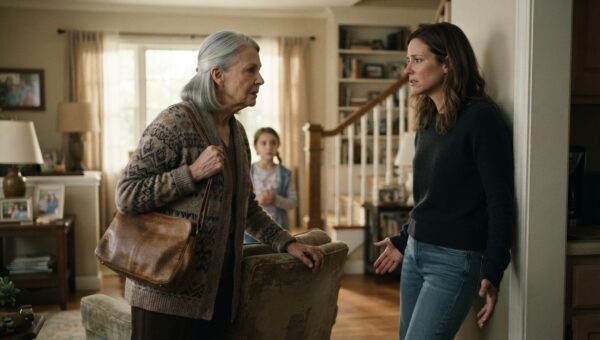
Two hours later, David’s sedan crunched up the gravel driveway. He walked through the front door without knocking, his face tight with the kind of defensive exhaustion that comes from dealing with aging parents from a distance. He bypassed the living room entirely, marched straight into the kitchen where Ruth was still sitting in a folding chair with a damp towel on her wrist, and looked up at the wall calendar.
He didn’t look surprised. He looked resigned, the way a man looks when a long-dreaded engine finally throws a rod on the highway.
David turned his gaze from the calendar to me, studying my face with an intense, unsettling scrutiny that made me step back toward the screen door. Then he asked a question that made no sense at all.
“Has my mother ever told you where she was on October 18, 1984?”
The kitchen went dead quiet except for the hum of the old refrigerator struggling against the afternoon heat. I stood there, shaking my head because the date meant nothing to me beyond being a random autumn day twenty years before I started renting this house.
“I don’t know,” I said, my voice tight. “That’s my birthday. Why?”
David looked down at his mother, who had her eyes squeezed shut, tears leaking from the corners of her wrinkled eyelids. He walked over to the kitchen counter, picked up a heavy metal lockbox that had been half-hidden behind a stack of grocery flyers, and set it down on the laminate table with a dull thud.
“Because she was standing five feet away from your mother in delivery room four at the old county hospital,” David said, his voice dropping into a flat, steady register. “And she spent the next thirty-six years wondering if she did the right thing by keeping her mouth shut.”
I sank into the spare wooden chair across from David, my hands resting on the cold table surface. The word nurse drifted through my thoughts, connecting fragments of things Ruth had mentioned months ago over instant coffee about the old maternity ward.
“What are you talking about?” I asked, looking between the two of them. “My parents adopted me when I was two weeks old. I grew up in Sacramento.”
Ruth finally lowered her hands, her face blotchy and red. “You weren’t adopted through an agency, honey,” she whispered, her voice cracking so badly I had to lean in to catch the words. “Not at first. Not legally, anyway. Not for the first ten days.”
David flipped open the latch on the metal lockbox. Inside sat a yellowed stack of hospital shift logs from October 1984, a laminated employee badge with Ruth’s younger face smiling beneath a nurse’s cap, and a bundle of unmailed, handwritten letters addressed to a name I had never heard before.
“My mother was the charge nurse on the night shift,” David explained, taking over when Ruth couldn’t find the breath. “October 18 was a bad day. A backlog of emergency admissions, short-staffed floors, and a young woman brought in from out of town who was completely overwhelmed. She was barely eighteen, terrified, and going through a severe postpartum breakdown.”
I stared at the metal box, my brain refusing to process how a file from three decades ago ended up in a kitchen in Bakersfield next to a box of saltines.
“She signed the initial temporary placement papers because she genuinely believed she couldn’t give you a safe home,” Ruth said, her voice dropping to a rough murmur as she looked directly at me for the first time. “She was crying so hard she couldn’t hold the pen. But five hours later, after she rested in room twelve, she changed her mind. She wanted you back. She walked down the hallway to the nursery asking for her baby.”
The kitchen seemed to narrow, the walls closing in as the pieces of David’s sentence clicked together with a sickening weight.
“Hospital protocol back then was ironclad,” Ruth continued, her hands trembling as she gripped the edge of the table. “If a mother signed the voluntary surrender form during a psychiatric hold, the administration treated it as final immediately to protect the prospective placement. The paperwork was already locked in the administrator’s safe before she changed her mind. I had the power to flag the file. I could have stalled the transfer for twenty-four hours to let her sort her head out. I knew the rule loopholes. But I was exhausted, terrified of losing my pension, and administration told us to stay out of family matters.”
She paused, swallowing hard as a fresh tear cut through the dust on her cheek.
“They discharged her out the side exit into the rain at four in the morning, and I watched her walk down the street alone,” Ruth whispered. “I never saw her again. And I spent every single day of my career wondering what happened to the baby I let walk out of my ward under a cloud.”
I sat frozen, the morning grocery knocks suddenly replaying in my mind with an entirely new, terrifying clarity. It wasn’t loneliness. It wasn’t neighborly kindness. It was decades of unhealed guilt looking for proof that the life it failed to protect had somehow turned out okay.
“When you rented the house next door six months ago,” David said gently, looking at me with a weary sort of grace, “she recognized your face the moment you walked out to check your mail. She saw the birth date on your DMV forwarding notice when you parked your car in the driveway. She started checking the calendar every morning just to make sure you were still here. To make sure you hadn’t vanished like her.”
Nobody said anything for a long time. The refrigerator compressor kicked off with a metallic shudder, leaving the house in an absolute, heavy stillness. I looked up at the wall calendar again, seeing those neat little red check marks not as a marker of a stalker or a threat, but as a monument of quiet penance kept by an old woman who couldn’t forgive herself for following the rules.
I didn’t yell. I didn’t demand they call the police or pack my bags to move away. The anger I thought I should feel just dissolved into a strange, hollow sort of pity as I looked at the woman who had watched over me from ten yards away without ever daring to cross the line.
“The calendar has to come down, Ruth,” I said quietly, my voice sounding distant even to my own ears.
Ruth nodded slowly, her chin quivering as she reached out and touched the corner of the metal lockbox. “I know,” she whispered. “I’m sorry. I just… I needed to know you were safe.”
We spent the next hour cleaning up the broken ceramic mug and putting the old hospital papers back into the tin box. David helped his mother onto the living room sofa, checking her wrist and making sure the fall hadn’t fractured anything serious, while I stayed in the kitchen wiping up the spilled coffee from the floor tiles.
The next morning at 8:10, there was no knock at my door.
I waited ten minutes, my coffee cooling in my favorite mug, before I walked across the gravel drive and let myself into Ruth’s house with the spare key David had left on my counter. Ruth was sitting at the kitchen table, looking tired but steady, staring at a brand-new, completely blank wall calendar hanging where the old one used to be.
She looked up as I walked in, her eyes wide with a quiet, hesitant question.
I didn’t say anything about the past. I just set two mugs of instant coffee on the table, pulled out the chair across from her, and sat down for a shared cup of tea as the morning sun hit the empty kitchen wall.