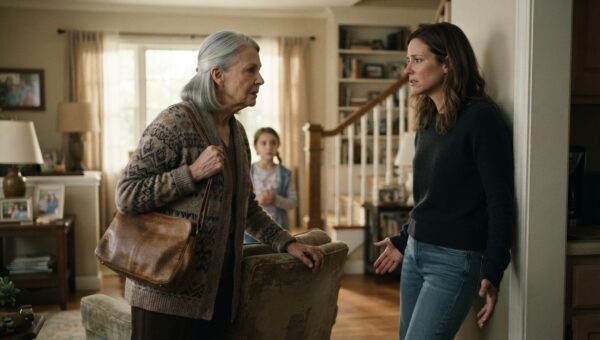
The cold off the lake always had this way of settling right into the floor joists of our house, making the old pine planks contract with a sharp, dry pop that sounded like footsteps in an empty hall. I heard that sound for thirty-two years with Arthur sleeping beside me, and after he passed, the silence filled those gaps instead.
I was sitting at the kitchen table with a mug of chicory coffee when the front gate rattled. Not tapped. Rattled with that sharp, aggressive iron-on-iron clatter that meant Eleanor was outside and she had brought Clara with her.
Twenty years. That was how long Eleanor, my mother-in-law, had maintained the comforting fiction that her son Arthur married up into wealth he was cheated out of, or conversely, that I had somehow trapped him in a cage of my own making. Arthur was a gifted mechanic who loved the grease under his fingernails, a man who could listen to an engine block cough twice and tell you which valve was sticking. When we married down by the county clerk’s office, he showed up in a pressed denim shirt with six hundred dollars in a battered leather billfold and a Kennedy-era toolbox in the back of a rusted Ford truck. I owned the duplex on Elm Street outright, the down payment saved from six years of clerking for a probate judge who paid in cash and strict lessons on compound interest.
I never corrected Eleanor. Arguing with a woman who measures human worth by the brand of tea service she inherited is like trying to nail jelly to a wall. You just end up sticky and tired.
The front screen door banged open without a knock. Eleanor walked in first, smelling faintly of lavender water and heavy disapproval, her wool coat sweeping the hardwood like a broom. Clara followed right behind her like a smaller, sharper echo, carrying a leather tote bag stuffed with rolls of bright yellow adhesive stickers, the kind they use at estate auctions to mark off inventory before the bidding starts.
“It is freezing in here, Clara,” Eleanor said, not bothering to take off her gloves. “Doesn’t she keep the thermostat at a civilized temperature? Arthur always did say the draft in this place went right through his bones.”
“The furnace is fine, Eleanor,” I said, not standing up from the table. My mug was warm against my palms.
“Well, we are here to make things orderly,” Eleanor announced, sweeping her gaze across the living room as if she were inspecting troop barracks. “A house with no man in it quickly turns into a landfill. Clara, start with the side table. We want to make sure the family pieces don’t vanish into the ether.”
Clara peeled a bright yellow rectangle off her roll and stepped toward the maple drop-leaf desk near the hallway. “Mother said we should be thorough before the paperwork gets complicated,” Clara murmured, her eyes darting toward me to see if I would bite.
I didn’t bite. I just took another sip of my chicory. The chicory was bitter, the way I liked it.
Ten years into our marriage, when Arthur outgrew the single-bay garage behind the hardware store and needed a proper commercial foundation for his repair shop, the banks laughed him out of the lobby.
Independent mechanics without land collateral were a risk they didn’t care to price. Arthur came home that evening with grease smeared across his forehead and a quiet, defeated slump in his shoulders that nearly broke me. He sat on the edge of the bed and stared at his calloused palms.
“They want three signatures I don’t have,” he had whispered into the dark. “My mother thinks I’m expanding too fast anyway. Says I should stay small where it’s safe.”
The next morning, I drove down to the county registry office during my lunch hour. I used the inheritance from my grandfather’s timber plot to buy the commercial lot on Fourth Street under my own separate estate, building the four-bay garage with office space above it. Arthur insisted on signing a formal commercial lease, paying a modest, nominal rent every month down to the penny because his pride required him to feel like the provider, even when the roof over his business belonged to the woman he kissed every night. I let him have that pride. It was a cheap price for a happy man.
“Put that one on the buffet,” Eleanor directed, pointing a gloved finger toward the dining room. “That cherry sideboard came straight from my mother’s dining room in Grand Rapids. Arthur had no business moving it into a place like this.”
“That sideboard was built by my uncle Walter in his basement shop on Maple Street,” I said, my voice level and quiet. “Arthur helped carry it up the steps because it weighed three hundred pounds.”
“Nonsense,” Eleanor sniffed, waving a hand as if she were brushing away a gnat. “Arthur told me himself it was a family heirloom from our side. He was always so generous about sharing our history with you.”
She moved toward the upright piano standing against the far wall. The wood was dark walnut, worn smooth on the fallboard where my small hands used to practice scales while my father sat in the wicker armchair keeping time with a rolled-up newspaper. That piano was the only thing I asked to bring when my parents’ estate was divided among cousins who didn’t know a Mozart sonata from a grocery list.
Eleanor reached into Clara’s tote, pulled off a bright yellow sticker with the number twelve scrawled in black marker, and leaned over the music rack to slap it squarely onto the polished wood.
“This one definitely goes to Clara’s girls,” Eleanor said, pressing the adhesive down with her thumb. “They’re actually taking lessons, unlike certain people who just let things collect dust.”
I stood up from the kitchen table. The chair legs scraped against the pine floor with a dry, protesting shriek.
I walked into the living room, my steps slow and deliberate, and reached out. My thumbnail caught the edge of the yellow paper. With a sharp, clean pull, I peeled the sticker off the walnut grain and balled it up in my fist.
Eleanor’s mouth tightened into a hard, white line. “Don’t get greedy now.”
That was when the doorbell rang. It wasn’t the polite, double-tap chime the postman used. It was Julian Vance, exactly fifteen minutes early for our two o’clock meeting, knocking with the crisp, double rap of a man who bills by the quarter-hour and expects the world to keep time with his pocket watch.
I walked past Eleanor and pulled the heavy oak door open. Julian stood on the porch in a charcoal overcoat, holding a worn leather portfolio tucked securely under his arm, his silver-rimmed glasses catching the gray afternoon light.
“Afternoon, Martha,” Julian said, stepping into the hallway and stamping the slush from his wingtips. “I hope I’m not cutting into family matters.”
“You’re right on time, Julian,” I said, taking his coat. “Come into the dining room. We have an audience.”
Eleanor turned around, her posture stiffening as she recognized the estate attorney who had handled Arthur’s final paperwork at the hospital. Her expression shifted from irritation to a practiced, social-register warmth meant for professionals she assumed would defer to her age and widow’s grief.
“Oh, Mr. Vance,” Eleanor said, smoothing the front of her wool cardigan. “I’m glad you’re here. We were just organizing the property distribution so things don’t get messy. Naturally, the family heirlooms need to be segregated from the general household estate before the probate gets complicated.”
Julian didn’t smile. He set his leather portfolio flat on the mahogany table, right where the yellow stickers were scattered like fallen leaves. He unlatched the brass clasps with two sharp clicks that echoed in the quiet room.
“Probate won’t be complicated at all, Mrs. Hayes,” Julian said, sliding a thick buff-colored folder out of the case. He didn’t look at Eleanor; he looked straight at me, then down at the papers. “Arthur left very clear instructions. Every asset, every account, and every square foot of real property was structured with absolute clarity long before he went into the hospital.”
Eleanor gave a short, dismissive laugh, stepping closer to the table. “Well, of course. Arthur always consulted me on major holdings. As his mother, I know what was brought into this family.”
Julian adjusted his glasses, pulling a certified deed out of the file with a crisp slide of parchment. He looked up at Eleanor, his expression entirely neutral.
“Did your son never tell you who owned the building his repair shop sits on?” Julian asked.
The room went completely still. Even the faint hum of the kitchen refrigerator seemed to drop an octave.
Eleanor blinked, her chin tilting up in that familiar, defensive arc. “Arthur owned his shop. Everyone in town knew it. He built that business with his own two hands and family support.”
Julian didn’t raise his voice. He laid a single document flat on the center of the table, right over the spot where Clara’s yellow sticker had been. “The commercial land at 414 Fourth Street was purchased in June of 2004 by Martha Hayes using separate pre-marital inheritance funds. Your son was the primary tenant under a standard commercial lease, paying monthly rent to the property owner, who happens to be standing right here.”
Eleanor looked at me for the first time all afternoon. Her eyes weren’t angry anymore; they looked small, like she was trying to read a sign written in a language she had never bothered to learn.
“That’s a lie,” Clara whispered, stepping up beside her mother and peering down at the embossed county seal at the bottom of the page. “Arthur never paid rent. He was a mechanic. He owned his tools.”
“He owned his tools,” Julian agreed calmly, flipping another page to reveal the residential deed for Elm Street. “And Mrs. Hayes owned the roof over his head from the day they walked out of the county clerk’s office with six hundred dollars in his pocket. The duplex, the commercial lot, and the secondary savings accounts were all secured by her credit and her separate estate before you ever set foot in this town, Mrs. Hayes.”
Eleanor reached out a gloved hand, her fingers trembling ever so slightly as they hovered over the corner of the paper, refusing to touch it. “Arthur told me… he told me the business was his inheritance.”
“Arthur loved you enough to let you believe whatever kept peace at Sunday dinner,” I said quietly. I stood by the piano, my hand resting on the cool walnut grain where the sticker had been. “He worked twelve-hour days because he wanted to earn his own living on land I provided, not because he needed your permission.”
Clara grabbed her mother’s arm, her face flushing a hot, mottled red. “Mother, let’s go. This is ridiculous.”
Eleanor didn’t move for a long moment. She stared at the signature line on the deed, where Arthur’s neat, looping handwriting appeared only as a secondary tenant acknowledging the lease terms, year after year, renewal after renewal, signed without a single complaint.
“You let me talk,” Eleanor whispered, her voice losing its edge, turning thin and papery. “You let me sit here for twenty years thinking…”
“Thinking you were protecting him from an opportunist,” I said. “I know. It must be very uncomfortable to realize he didn’t need protection from me at all.”
Julian quietly gathered the papers back into his leather portfolio, snapping the brass clasps shut with two sharp sounds that signaled the end of the conversation. He offered me a brief, respectful nod.
“I’ll leave the preliminary distribution copies on the sideboard, Martha. Call my office on Tuesday,” Julian said, letting himself out the front door without another word.
Clara was already pulling her mother toward the hallway, her tote bag swinging awkwardly against her hip as she scooped up her remaining rolls of yellow stickers with frantic, jerky motions. Eleanor let herself be led, her shoulders rounded under her heavy wool coat, looking smaller than she had when she marched through the front gate ten minutes earlier.
The front door clicked shut.
The house settled back into itself, the old pine floorboards giving one final, quiet creak as the heat kicked on through the vents.
I walked back into the living room and stood before the upright piano. The wood was dark and smooth, reflecting the gray winter light coming through the windowpane. There was no yellow paper left on the surface, no mark of anyone else’s claim, nothing except the grain my father had polished and the space Arthur and I had cleared together over thirty-two quiet years.
I sat down on the bench, lifted the fallboard, and pressed down a single C-major chord. The sound hung in the empty room, clean and true, before it slowly faded into the quiet corners of the house.