Why do some people spend decades tending to a grudge like it is a prize-winning tomato plant in the backyard? Evelyn had been watering her particular weed since the Saturday afternoon in May when David and I stood in front of a tired-looking justice of the peace in Benton County with two witnesses we borrowed from the county clerk office.
I never asked for her blessing, mostly because I knew I would not get it, and David had told me straight out that his mother’s opinion had about as much weight as a wet paper sack. But Evelyn had her own version of events, and she liked to air it out at every Thanksgiving table, every Easter ham, and every casual drop-in visit where she checked our baseboards for dust. According to her, I was just a clever girl from down near the river who had managed to sink her claws into a promising boy from a good family before he realized what hit him.
I let it slide for fourteen years. I let it slide because I figured a woman who lived in a house twice as big as she needed was mostly just lonely, and because David always squeezed my hand under the tablecloth whenever she started up about our modest beginnings.
We had lived on pinto beans, secondhand furniture from the Methodist church basement sale, and whatever overtime David could pull at the grain elevator down by the tracks. The funny part was, on the morning we signed the license, my savings account at the credit union had exactly $3,422.18 in it from three years of clerking at the hardware store, while David had four hundred dollars in a battered checking account and a rusted Ford Ranger that needed a new transmission. If anyone was trapping anyone for a fortune, we were both going to starve together.
The breaking point did not happen over a grand insult or a shouting match in her formal dining room. It happened over a bowl of butter beans in our own kitchen, with the late afternoon sun coming through the window and highlighting the grease spots on the wallpaper we never got around to replacing.
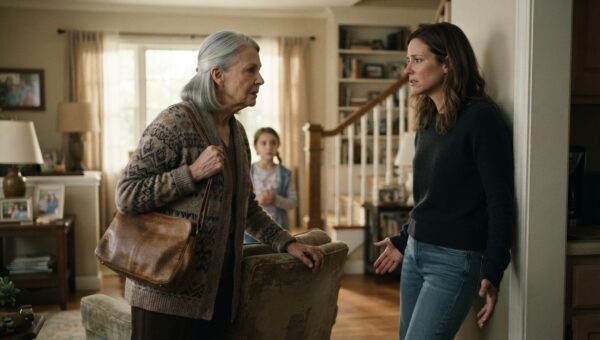
Chloe was fourteen then, sitting right across from us with her history textbook propped up against the salt shaker, trying to finish an essay about the Dust Bowl while we ate. Evelyn had dropped by unannounced, as she always did, carrying a tin of stale shortbread she must have found at the bottom of her pantry. She had watched Chloe reach for the butter, looked across the table at me with that little tight-lipped smile she wore like a Sunday hat, and dropped her favorite line right into the gravy.
“Well, I suppose we all make do with what we can catch, don’t we, Chloe honey?” Evelyn had said, patting my daughter’s hand with fingers heavy with gold rings that looked like they belonged on a pirate. “Some women come into a family with nothing in their pockets and spend forty years making sure they leave with everything.”
Chloe had stopped chewing. Her eyes went from her grandmother to me, sharp and sudden, the way a young girl’s eyes get when she realizes the adults around her are playing a game she is not supposed to understand.
I watched my daughter digest those words, her small jaw working the food slow and heavy, and that was when the years of biting my tongue tasted like copper in my mouth. I did not yell at Evelyn. I just stood up from the table so fast my chair leg scraped across the linoleum with a sound like a shovel hitting gravel, and I told Evelyn her ride was waiting in the driveway because David had already walked out to her Buick to save her the trouble of finding her own keys.
After the door clicked shut and the sound of her engine faded down the gravel lane, Chloe stayed right there at the table. She did not touch her history book. She looked at me with a steady, quiet look that felt far too old for a fourteen-year-old girl.
“Mom,” Chloe asked, her voice small and flat in the quiet kitchen. “Is it true what Grandma said about us? Did you marry Dad just because he had money?”
My chest tightened so hard I thought something in my ribs had cracked. I looked at my daughter, seeing the exact curve of David’s forehead and the stubborn set of my own jaw staring back at me, and I knew I could not just brush it off with a mother’s usual platitude. I walked over to the hall closet, reached past the winter coats and the spare vacuum hoses, and pulled down the heavy blue cardboard binder where I kept our old tax returns, the utility receipts from our first winter in the trailer, and the itemized list of every single nickel we spent on our ten-dollar wedding license and the diner pie that followed. I brought it back to the table, sat down right beside her, and started flipping through the plastic sleeves where our history was pressed flat between sheets of cheap copy paper.
“Look at this page right here, Chloe,” I said, my finger tapping against the lined paper where I had written down our weekly grocery budget in fading blue ink back in 2004. “That was our grocery list for the first month. Seven dollars and forty cents for flour, lard, and dry beans. If there was a fortune here, your grandfather forgot to leave the combination.”
We turned the pages together, going through the receipts for the secondhand crib we bought off a woman from church, the electric bills that made us sweat in August because we could not afford the window unit, and the record of David’s first promotion down at the elevator when he brought home an extra twenty-two dollars a week. It was an honest record of a hard, good life built from the ground up, nothing fancy, nothing hidden. But as I reached the back flap of the binder, where the wedding license from the courthouse was tucked into a paper pocket, my thumb caught on the edge of something thicker than standard receipt paper.
It was an envelope from the Mercantile Bank of Sedalia, yellowed around the edges and stamped with a date three days before we walked into the county clerk office. The logo at the top was old-fashioned, printed in dark blue ink that had started to flake off. My name wasn’t on it. It was addressed to David at his old apartment address on Elm Street, the one he had rented above the auto parts store before we moved into the two-room rental by the creek. I pulled the heavy cream paper out of the sleeve, sliding my thumb over the crease where it had been folded twice.
“What is that?” Chloe whispered, leaning in close.
I did not answer her because I could not find the air to do it. The letter was short, written on thick bank stationery with an executive signature at the bottom that I did not recognize, but the memo line at the bottom was written in Evelyn’s unmistakable, spiky cursive. It confirmed a wire transfer of forty thousand dollars deposited into David’s personal account from an account bearing his mother’s name, with one single sentence typed right above her signature in that familiar slanted hand. Only if he gets a prenup. Forty thousand dollars in the spring of 2004, back when forty thousand dollars could buy a small house or clear every debt a young man had in the county. And yet, I had walked down that courthouse aisle with a borrowed dress that smelled faintly of mothballs, and our entire bank balance between the two of us was less than four thousand dollars.
I stared at the paper until the numbers started to blur together into dark, jagged little ants crawling across the page. Evelyn had tried to buy her son’s compliance three days before our wedding, dangling a check large enough to change our lives just to make sure I signed away any claim to the family name or whatever scraps of land old man Miller had left behind. And David had never said a word about it. Not when we were counting out quarters for laundry, not when the transmission dropped out of the Ranger on Highway 65, not once in fourteen years of marriage.
The front door opened with that familiar heavy click, and David walked into the kitchen, carrying his canvas work jacket over his arm and smelling of diesel fuel and dry wheat chaff from his shift down at the terminal. He stopped dead when he saw the two of us sitting there at the table, the blue binder open between us like an open wound, and the bank letter lying flat right next to the salt shaker. I didn’t yell, and I didn’t throw anything across the room, which surprised me more than a little bit. I just slid the cream-colored paper across the laminate tabletop until it stopped right against his knuckles.
“You want to tell me why I am just seeing this letter now, David?” I asked. My voice sounded thin and quiet, like someone else was talking across the room.
David looked down at the paper, his face going still and tight the way it always did when something heavy hit him all at once. He didn’t reach for it, and he didn’t try to pull his hand away. He just stood there under the yellow light of the kitchen fixture, his shoulders dropping about two inches as if a heavy sack of seed had just been cut open on his back.
“Where did you find that?” he asked, his voice rough from the dust at the elevator.
“In the wedding binder,” I said. “Right where I put our marriage license fourteen years ago. Evelyn told Chloe today that I trapped you for your money. I wanted to show her our old budget to prove she was wrong. But I found this instead. Did your mother give you forty thousand dollars right before we got married, David?”
The kitchen was so quiet we could hear the old refrigerator compressor humming in the corner and the sound of gravel popping under a car tire out on the county road. David looked at Chloe, then back at me, his eyes dark and tired behind his wire-rimmed glasses. He pulled out the wooden chair across from us and sat down slow, rubbing the back of his neck with a large, calloused hand that had a small grease stain near the thumb.
“She did,” David said, and the words came out flat and hard like stones dropping into a dry well. “She called me into her kitchen three days before the wedding. She had the check sitting right there on the oilcloth table next to her teacup. She told me she knew what kind of girl you were, that you were just after the family name and whatever was coming to us when the farm was sold. She said the money was mine, every cent of it, to start my life right, but only if I had you sign those papers her lawyer drew up.”
My stomach felt hollowed out, but I didn’t look away from him. “And you didn’t sign them.”
“I didn’t even read them,” David said, his voice dropping down to a low murmur that barely carried across the oilcloth. “I picked up the check, I put it right back in her face, and I told her where she could put her lawyer and her money. Then I walked out to my truck, drove straight down to the Mercantile branch on the square, and wired every single dollar of that transfer right back to her personal account before the bank closed at four o’clock.”
I stared at him, the pieces of a puzzle I didn’t even know we were playing suddenly snapping together with a sharp, cold click. “If you sent it back, why is this letter here?”
“Because I never told you,” David whispered, looking down at his hands resting on the table. “I didn’t tell you because I knew how much it would hurt you to know what she thought of you. I figured if the money was gone and the paperwork was torn up, it didn’t matter. I thought I was protecting you by keeping her poison out of our house. But I was just hiding it. I let her keep running her mouth for fourteen years because I didn’t want the fight, and I let her make you feel like you owed us something when you didn’t owe us a damn thing.”
I sat there looking at my husband, seeing the man I had loved through lean years and dry harvests, and for the first time I understood the heavy cost of the quiet life he thought he was building for us. He had thought that keeping secrets was the same thing as keeping the peace, not realizing that every time he swallowed his mother’s insults and let her walk out our front door with her head held high, he was leaving me out here in the yard alone to take the weather. A secret built to protect someone is still just a wall built between them, and after fourteen years, that wall had grown tall enough to cast a shadow over everything we had made together.
Chloe reached across the table, her small fingers touching the corner of the bank letter where Evelyn’s cursive was printed in fading ink. She looked up at her father with a steady, clear gaze that didn’t have any room for doubt left in it.
“So she didn’t give us anything?” Chloe asked, her voice very quiet. “We did this all on our own?”
David reached out and took our daughter’s hand in his, his thumb brushing over her knuckles just like he used to do when she was small enough to sit on his knee during church. “Every single bit of it, honey,” David said, and his voice was steady now, clearing out the last of the dust. “Your mom and I started with nothing, and every roof we ever lived under and every meal we ever put on this table came from our own work. Not a red cent of it came from your grandmother.”
We sat there in the kitchen until the sun went down behind the ridge and the room turned the color of old pewter, talking through things we should have settled years ago when the paint on the walls was still fresh. We talked about Evelyn’s need to hold the purse strings like a leash, and we talked about David’s stubborn, foolish habit of carrying every load by himself instead of letting his wife help him lift the weight. It wasn’t a pretty conversation, and there were times when the silence between us felt heavy enough to sink a boat, but it was real. For the first time since we said our vows in that drafty little office by the courthouse, there were no hidden bank drafts, no unsaid words, and no ghosts sitting at our table.
The next morning, the sun came up sharp and bright over the bottomland, turning the dew on the pasture grass into a million little bits of broken glass. Evelyn called around ten o’clock, her voice sharp and brittle over the landline the way it always was when she wanted to check if her poison had taken root. She didn’t even say hello. She just started in about how she hoped we had thought over what she said about family responsibility and keeping things in order.
I didn’t hand the phone to David this time. I held the receiver tight against my ear, listening to the familiar rattle of her breath on the other end of the line, and I let every year of biting my tongue go out with my breath.
“Evelyn,” I said, and my voice didn’t shake at all. “You can keep your checkbook and you can keep your opinions. David sent your forty thousand dollars back fourteen years ago, and we have the bank receipt right here on the kitchen table to prove it. If you ever come into my house again and say one word to my daughter about how I got here, you won’t have to worry about finding your own keys, because you won’t be crossing this porch again.”
There was a long, sharp silence on the other end of the line, the kind of silence that happens when someone realizes the lever they have been leaning on for forty years has just snapped clean off in their hands. Then the line went dead with a hard, flat click.
I put the receiver back on the cradle, walked over to the hall closet, and pulled down the heavy blue cardboard binder that had held our secrets for more than a decade. I carried it out to the back porch where the metal trash can sat in the morning sun, waiting for the weekly pickup. I didn’t flip through the pages one last time, and I didn’t save the marriage license or the old grocery lists. I dropped the whole heavy thing right into the bottom of the bin, watching it land with a dull, hollow thud against the empty metal.
Later that afternoon, David brought home a clean, clear glass jar he had picked up from the hardware store down on the square, the kind with a tight wire bail and a rubber gasket around the lid to keep the air out. We put it right on the kitchen windowsill where the sun hits it every morning at eight o’clock. Inside it, we started dropping little folded slips of paper with the real dates and the real numbers written down in our own handwriting. The day we paid off the truck loan, the afternoon we finished shingling the north side of the roof ourselves, and the night Chloe made the honor roll at the high school. It isn’t much of an inheritance by Evelyn’s standards, but every single line in that jar belongs to us, and nobody had to buy it.