The kettle on the back burner had that small, dull rattle it made right before the water turned, a steady little click against the iron that usually meant the house was settling into its morning quiet. Arthur was already gone down to the shop, his boots leaving a faint trace of damp gray gravel near the back door where he always forgot to tap them clean.
I stood there with a dry dish towel in my hands, wiping down the enamel counter for the third time because stopping your hands from shaking meant keeping them busy with something stupid.
Twenty years of keeping my mouth shut leaves certain habits in the bones. When Arthur and I stood before the justice of the peace over in Coldwater two decades ago, he had six hundred and fifty dollars in a crumpled credit union envelope and a rusted Ford pickup with a leaky water pump. I had this duplex, the one my grandfather left clear and free, and the deed to the narrow gravel lot down by the railway spur where Arthur wanted to lift cars. Eleanor, his mother, spent the afternoon of our small luncheon telling anyone who would listen that I must have a secret bank account tucked away because nobody in their right mind marries a penniless mechanic unless there is an inheritance hiding behind the curtains.
I never corrected her. Arguing with Eleanor was like trying to shovel smoke. It just made her arms pump faster and her voice climb another octave until the neighbors started closing their double-hung windows. Arthur kissed my cheek that evening and whispered that his mother just had a hard time letting go of her only boy, so I let it be. If Eleanor needed to believe I was some clever little predator who snared her golden boy for his non-existent fortune, I figured it was a cheap enough price to pay for a quiet dinner on Sundays.
The silence lasted right up until the Tuesday after the funeral.
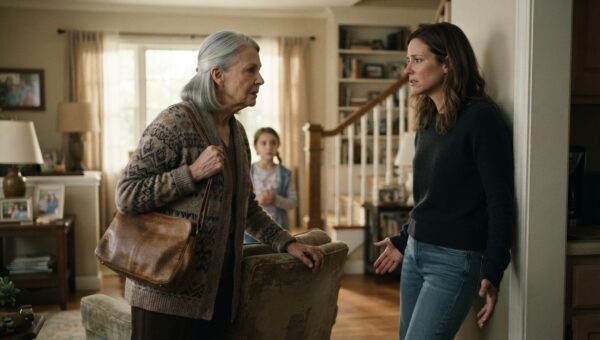
The front screen door banged open without the courtesy of a knock, which was Eleanor’s signature greeting since the Eisenhower administration. She came through the entryway like a squall off Lake Michigan, her gray hair pinned up so tight her eyebrows looked permanently surprised.
Behind her came Sarah, her youngest daughter, carrying a heavy plastic tote bag stuffed with rolls of neon yellow adhesive stickers that looked like they had been pried out of a clearance bin at the hardware store.
“We need to get ahead of the probate before the bank gets sticky,” Eleanor announced, not even bothering to take off her wool coat. Her eyes swept over the living room with the hungry look of a hawk spotting a field mouse in high stubble. “Mark was a provider, no matter how quiet he kept his accounts. Sarah, start with the sideboards and the silver chest. We’ll mark the heavy furniture first so nobody tries to slip a fast one in while we’re grieving.”
Sarah popped the plastic shrink wrap off a roll of yellow tape with her teeth, a sharp ripping sound that cut right through the stillness of the room. Neither of them looked at me, not once, as if my presence in the house I had paid the taxes on since 1994 was just a minor clerical error they were there to correct.
“Eleanor,” I said, my voice sounding quieter than I meant it to. “You don’t need the stickers. Sit down and let me pour you some tea.”
“Save your tea for the lawyers, Martha,” Eleanor snapped, already marching toward the corner where my drop-leaf desk sat. She peeled off a bright yellow square and slapped it right onto the brass keyhole with a firm, self-satisfied pat. “A man who works sixty hours a week doesn’t leave his widow empty-handed. My son built this life from the ground up, and I know damn well what he put into these walls.”
She didn’t know anything, of course. She didn’t know about the winter of 2002 when Arthur’s shop roof caved in under four feet of wet snow and we had to cash out my college savings bonds just to keep the insurance from canceling us. She didn’t know about the nights he sat at the kitchen table holding his head in his grease-stained hands, wondering if he should give up and go work for the county highway department. She just knew the version of Arthur she had invented in her head, the lone hero who supposedly rescued a lonely woman from her empty duplex.
They moved through the parlor like appraisers at a bankruptcy auction, slapping yellow tags on the mahogany end tables, the reading lamp Arthur bought at a church bazaar, and the small framed watercolor of the Mackinac Bridge my uncle painted. I watched them from the kitchen threshold, my fingers curled tight into the hem of my cardigan.
Then Eleanor stopped by the walnut upright piano against the north wall.
It was the only thing left in this house that still smelled like my father. He had bought it second-hand from a German family over in Cadillac when I was twelve, working three extra shifts at the foundry so I could take lessons from old Mrs. Gable down on Maple Street. Every key had a slight ivory yellowing on the middle C, and the left pedal squeaked if you didn’t press it just right.
Eleanor didn’t hesitate. She peeled a fresh yellow square off the roll, licked her thumb for extra grip, and slapped it right over the polished mahogany fallboard, square in the center where my fingers used to rest.
“This one goes to Sarah’s eldest for his music classes,” Eleanor said, smoothing down the corner with a blunt thumbnail. “It’s too heavy for you to move anyway, Martha. You wouldn’t even know how to tune it.”
Something in my chest gave a small, dry snap. It wasn’t loud. It just felt like a dry twig breaking under a boot heel in the woods.
I walked across the hardwood floor, my slippers making no sound at all, and reached out. My fingernail caught the edge of the bright yellow paper. With one steady pull, I peeled the sticker off the wood, rolled it into a small grey ball between my thumb and forefinger, and dropped it into the pocket of my skirt.
Eleanor froze, her hand still raised in the air like she was waiting for a gavel to fall. Her face mottled a dark, ugly red, the skin around her nose pinching tight.
“Don’t get greedy now, Martha,” she hissed, her voice dropping into that thin, venomous register she used whenever she thought her authority was being questioned. “You’ve lived off my boy’s sweat for twenty years. The least you can do is let his flesh and blood have a few keepsakes before the vultures show up.”
Before I could answer, the front doorbell gave two quick, professional chimes.
The brass handle turned before either of us could move, and Mr. Henderson stepped through the doorway. He was ten minutes early for our 2:00 PM appointment, carrying his heavy black leather briefcase by the handle with the careful posture of a man who spent his life carrying other people’s bad news. He wore his usual grey trench coat, smelling faintly of damp wool and winter air, and his silver-rimmed glasses slipped slightly down the bridge of his nose as he took in the scene.
He looked at Sarah holding the plastic tote. He looked at the yellow sticker still clinging crookedly to the side of the reading lamp. Then his eyes settled on Eleanor, who was still standing with her hand raised toward my father’s piano.
Mr. Henderson didn’t smile. He set his briefcase down on the dining room table with a dull thud that made the china rattle slightly in the cabinet.
“Am I interrupting an inventory?” he asked, his voice dry and flat as a prairie road.
“We’re just securing the estate before things get complicated,” Eleanor said, lifting her chin with the practiced dignity of a woman who assumed every man in town was on her side. “My son’s property. My grandchildren have a right to see that everything is accounted for.”
Mr. Henderson opened the brass latches of his briefcase with two sharp clicks. He didn’t pull out the will or the death certificates. Instead, he pulled out a thick, blue-backed leather folder with the embossed seal of the county recorder’s office, opened it to the middle page, and adjusted his glasses.
He looked up at Eleanor over the rim of his frames, his expression completely blank.
“Did your son never tell you who owned the building his repair shop sits in?” he asked.
The room went so quiet you could hear the refrigerator compressor humming down the hall.
Eleanor didn’t move. Her hand stayed suspended half an inch from the piano wood, her fingers curling slightly like she had touched something hot. For the first time all afternoon, she turned her head and looked directly at me, her eyes darting across my face as if she were trying to read a language she had never bothered to learn.
“What are you talking about?” Eleanor muttered, her voice losing its sharp edge, turning thin and papery. “Mark owned the bays. Everyone in the county knew Mark’s Garage.”
“Mark operated the business, Mrs. Vance,” Mr. Henderson said evenly, his fingers tapping once against the edge of the blue folder. “He leased the commercial parcel from the primary property holder. For twenty-two years, the ground lease, the building title, and this very duplex have been held in a single name.” He turned the document toward her just enough so she could see the signature line at the bottom, signed in my grandfather’s bold, shaky cursive and renewed in my own hand back in the spring of 2004. “Your son was a fine mechanic, Eleanor. But he didn’t own the dirt he stood on. His wife did.”
Sarah dropped the plastic tote bag. It hit the floor with a hollow plastic rattle, spilling three rolls of yellow stickers across the braided rug like scattered corn.
Eleanor didn’t look at the stickers. She didn’t look at Sarah. She just stood there by the piano, her mouth opening slightly and then closing again, her eyes fixed on the small spot where I had just peeled her yellow paper off the polished wood.
The afternoon light drifted through the front window, cutting a pale yellow line across the floorboards between us, hitting the smooth grain of the piano where no paper remained. Mr. Henderson picked up his pen, unscrewed the cap with a tiny metallic click, and waited for someone to speak.