PART 1
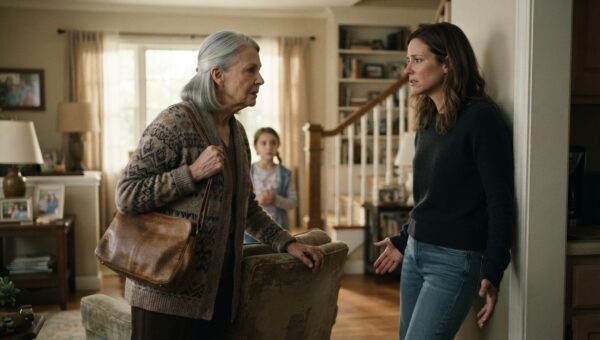
My oldest son called on a Tuesday evening while I was wiping down the kitchen counter. He didn’t ask how my week was going or whether my knee was still bothering me. He got right to the point with that flat, reasonable tone he uses when he has already decided what is best for everyone else.
“You’re alone in that big house, Mom,” he said. “We worry about you rattling around out there.
Brenda found some wonderful senior apartments just twenty minutes from us. You’re going to love them.”
I paused with the dish towel in my hand, staring out the window at the overgrown hydrangea bush by the back fence. The house is forty years old. Your hands remember every corner of it, every squeak in the floorboards, every mark pencil-measured on the inside of the pantry door where the kids grew. I didn’t want an apartment with shared hallways and an elevator that always smelled like wet carpet.
“I’m fine here, Arthur,” I said.
“You only think you’re fine,” he replied, and I could hear his wife, Brenda, in the background, murmuring something about square footage and maintenance fees. “It’s too much property for one person. Let us help you list it. We can handle the staging, the paperwork, the whole thing. It will take a weight off your shoulders.”
By Friday, Brenda sent me an email with four different links to apartment complexes.
She had helpfully underlined the cheapest one in yellow highlighter. At the bottom of the email, she added a casual sentence asking what I thought my house might sell for in the current market, as if she were budgeting a vacation for me. That was the first pebble that didn’t settle right. Arthur and Brenda have never shown an active interest in my finances unless they needed a co-signer or a short-term loan for their truck repair, and here they were suddenly calculating my property value down to the last square foot.
I sat at the kitchen table with my cold coffee and looked at the tax assessment letter from last year. Then I looked at Brenda’s email again. I didn’t call Arthur back that night. I told myself I was just tired, but by Saturday morning, a strange sort of static had settled in the back of my mind.
I called Linda, who lives three doors down and has kept an eye on my driveway since my husband passed away five years ago.
“Linda,” I said, keeping my voice level. “Did you see anyone walking around my yard yesterday?”
“Actually, yes,” Linda said immediately. “A young man with a clipboard. He took a lot of photos of the side porch and the roof. I thought he was with your son since Arthur’s car was parked down at the corner for twenty minutes.”
My blood didn’t run cold or any of those dramatic things you read in books. It just felt like someone had dropped a heavy stone onto my chest. Arthur doesn’t own a car that color anymore, and he certainly hadn’t mentioned coming by.
I told Linda I had asked someone to look at the gutters, which was a lie, and hung up the phone. I didn’t go to the grocery store like I had planned.
Instead, I sat in the armchair by the front window and waited.
It was nearly four o’clock when a silver sedan pulled slowly into my driveway. A man in a blue button-down shirt got out, walked straight to my front door, and jammed a thick white envelope behind the brass handle. I watched him from behind the lace curtain, my breath catching in my throat as he turned and walked back to his car.
I waited two full minutes after he drove away before I opened the door. I pulled the envelope out. Inside was a heavy cardstock business card for a commercial property investment firm downtown, along with a handwritten note scrawled in black ink.
“Great meeting you today, Margaret,” the note said. “Deal looks solid. Glad we could lock in the cash price so fast. Call me if you need the deposit confirmation early.”
I stood on the porch with the card in my hand while the afternoon sun beat down on the empty driveway. My house wasn’t on the market. I hadn’t signed a single paper. And yet, according to a stranger with a clipboard, I had apparently just sold my home.
PART 2
The phone number on the business card went straight to an office downtown. A woman with a brisk, efficient voice answered on the second ring, asking if I was calling about the closing paperwork for the Elm Street property.
“This is Margaret Vance,” I said, my voice shaking slightly despite myself. “I own the house on Elm Street. I never agreed to sell it to anyone.”
There was a short pause on the line, the sound of a mouse clicking, and then a paper shuffling. “Oh. One moment, Mrs. Vance. Let me check the file. We have a signed purchase agreement executed through your designated family representative, Arthur Vance. The earnest money deposit was wired to the account on file this morning.”
“Arthur doesn’t represent me,” I said, my grip tightening on the receiver. “Send me that agreement right now.”
Within three minutes, my email chime pinged. I opened the PDF while still holding the phone to my ear. There was my signature at the bottom of a standard standard residential purchase contract, scrawled in blue ink. Except it wasn’t my handwriting. It was a clumsy imitation of the loops I use when I sign birthday cards, the letters too cramped and the final ‘e’ trailing off in a way I never write.
Beneath the signature was the instruction for the wire transfer of the earnest money deposit. The routing number listed for my payout matched an account at the credit union across town. I knew that account number by heart because I had helped Arthur open it six years ago when he was trying to rebuild his credit after his second business failed.
I didn’t call the police right away. I didn’t even call Arthur. I got my coat, locked the front door behind me, and drove straight to the credit union.
The teller at the counter was a young woman named Sarah who went to church with my sister. She looked up when I stepped to the glass, her smile dropping when she saw my face.
“Mrs. Vance? Is everything okay?”
“Sarah, I need to look at the recent activity on an account,” I said, sliding my ID across the counter. I gave her the number from the purchase contract. “My son is listed on this, but I need to see what came in today.”
Sarah hesitated, her fingers hovering over the keyboard. Bank rules are strict, and she knew it. But she also knew me, and she knew Arthur. She looked at my hands, which were gripping the edge of the counter, and then she looked down the empty hallway toward the manager’s desk.
“Just looking, Mrs. Vance,” she whispered, turning her monitor slightly so I could see the green-and-white ledger. “Just looking.”
There it was. A wire transfer for twelve thousand dollars, marked as an earnest money deposit for residential property sale. And right below it, an outgoing transfer of ten thousand dollars made less than an hour later, sent straight to an auto finance company in another county. Arthur hadn’t just listed my house. He had already spent the deposit on his truck loan.
PART 3
I waited until Sunday afternoon to go to Arthur’s house. I didn’t call ahead. I wanted to catch them before they had time to get their story straight or hide behind Brenda’s endless spreadsheets.
When Brenda opened the front door, her smile vanished so fast it looked like someone had pulled a string. She was holding a spatula, and the smell of roast beef drifted out from the kitchen.
“Margaret,” she said, smoothing the front of her blouse. “We weren’t expecting you. Arthur is out in the garage.”
“Tell him to come inside,” I said, stepping past her without waiting for an invitation. I didn’t take off my shoes. I walked straight into the living room and stood by their glass-topped coffee table, laying the printed purchase agreement and the bank printout side by side on the glass.
Arthur came in through the kitchen door a minute later, wiping his hands on a greasy rag. He looked at the papers on the table, and the color drained right out of his face, leaving him looking remarkably like his father when he got caught speeding in high school.
“Mom,” he muttered, tossing the rag onto the counter. “You shouldn’t be snooping around at the bank.”
“You forged my signature, Arthur,” I said. My voice didn’t shake anymore. It felt cold and hollow, like winter air in an empty room. “You had someone come measure my yard, you signed my name to a contract, and you took twelve thousand dollars of earnest money for a house that belongs to me.”
Brenda crossed her arms, her chin coming up in that defensive way she always has when she’s cornered. “We were trying to help you, Margaret! You’re getting older, and that house is falling apart around you. If we didn’t move fast, the market was going to dip. We found a buyer who was willing to pay cash, and we were going to use part of it to put down on a nice two-bedroom right near us where we can keep an eye on you.”
“You used ten thousand dollars of it to pay off your truck loan this morning,” I said, looking right at my son. “Does that help me, Arthur? Or does that help your payment schedule?”
Arthur looked at the floor, his jaw working. “The business has been bad, Mom. You know that. One big contract fell through, and the bank was threatening to repossess the truck. I was going to pay it back as soon as the final sale went through. It was just a bridge.”
“A bridge,” I repeated.
I didn’t yell. I didn’t cry. I stood there in their clean, expensive living room with its gray walls and matching throw pillows, and I realized my son looked at me not as a mother, but as a resource. An asset to be liquidated when things got tight.
“The contract is canceled,” I said quietly. “I called the investment firm an hour ago and sent them a copy of my real ID and a statement from the handwriting expert at the bank. If you don’t call them yourself and back out by five o’clock, I’ll let the police handle the forgery charge. I don’t care about your truck, Arthur. And I don’t care about your real estate plans.”
Brenda opened her mouth to say something sharp, but Arthur put a hand on her arm. He looked at me, really looked at me, perhaps seeing for the first time that I wasn’t going to fold just to keep the peace at Sunday dinner.
“You’re going to press charges?” he asked, his voice small.
“I’m going home,” I said. “And if either of you comes within a mile of my property again, I won’t call you first.”
ENDING
I drove home with the windows rolled down, letting the cool September air blow across my face. The sun was dipping low behind the hills, turning the sky the color of old copper.
When I pulled into my driveway, the house looked smaller in the dusk, but it was mine. The lights from the kitchen cast a warm yellow square across the grass where the stranger had stood with his clipboard two days before.
I unlocked the front door and walked into the quiet hallway. I hung my coat on the brass hook by the door, the same hook my husband put up thirty years ago. On the kitchen table, the tax assessment letter was still sitting where I left it.
I picked up the black ink pen, the one that actually writes like my hand, and signed my name across the bottom of a blank piece of paper just to watch the loops fall the way they are supposed to. Then I put the paper in the drawer, closed it, and turned off the kitchen light.