PART 1
The phone began buzzing on the nightstand at six twelve in the morning. My husband, Arthur, was breathing heavily beside me, his arm draped across my waist in that familiar, heavy way it always was after a long week. I rolled over, blinking against the sharp gray light leaking through the cheap linen curtains, and saw the caller ID flashing. It was Martha.
Martha was his ex-wife of twelve years. We did not speak. We had an unspoken agreement to pretend the other person did not exist on this earth, surviving the occasional awkward holiday crossover through sheer distance and cold politeness.
I slid my thumb across the screen, my chest tightening with a sudden, ugly spike of adrenaline.
“Arthur?” she asked before I could even say hello. Her voice was thin, almost shaking, stripped of the usual sharp edge she used when we ran into each other at the hardware store or the pharmacy. “Is Arthur there?”
“Yes,” I said, my throat dry. “He’s right here. He’s asleep beside me.”
The line went completely dead for a few seconds. I could hear the faint, hollow hum of her connection, like wind blowing across an open microphone. Then she let out a breath that sounded like a sob or a dry laugh.
“Then who just used his key at my back door?” she asked.
My stomach dropped into a cold pit. I sat straight up in bed, the sheets tangling around my legs. Arthur stirred beside me, muttering something incoherent, his face buried deep in the pillow.
“Martha, what are you talking about?” I whispered, my voice shaking. “Arthur hasn’t been to your house in twenty years. Not since the divorce.”
“I heard the deadbolt turn,” she whispered back, her terror real enough that I could feel it crawling through the phone speaker. “I heard the squeak of the screen door. Someone just walked into my kitchen. I’m locked in the guest bathroom right now, looking under the door. I see shoes, Martha. I see men’s work boots standing by my refrigerator.”
“Stay where you are,” I said, my heart hammering against my ribs like a trapped bird. “Don’t open the door. We’re coming right now.”
I shook Arthur hard by the shoulder. He groaned, rolling onto his back, his eyes blinking open with irritation. “What? What is it, Sarah?”
“Get up,” I snapped, pulling the blanket off him. “Get your clothes on. Martha just called.”
He sat up, rubbing his face with his calloused palms. “Martha? Why would Martha be calling us at this hour?”
“She said someone just used his key at her back door,” I said, already pulling my jeans on over my pajamas. “She’s locked in her bathroom. She heard someone walking in her kitchen.”
Arthur froze, his hands dropping to his knees. The color drained from his face so fast he looked almost gray in the morning light. “Her key? Nobody has that key except her. And me. And…” He stopped, his mouth hanging half open.
“And who, Arthur?” I demanded, leaning over him.
“Nobody,” he muttered, shaking his head as he scrambled out of bed. “Nobody. Let’s just go.”
We didn’t wait to brush our teeth or make coffee. We piled into his truck in the damp chill of the early morning, the engine roaring to life with a rattle that usually annoyed me but today felt too slow. The drive across town took twelve agonizing minutes through quiet suburban streets where sprinklers were just starting to click on across manicured lawns.
When we pulled up to Martha’s small brick ranch house, her car was parked in the driveway exactly where it always sat. The house was dark except for the kitchen light burning a sickly yellow through the sheer curtains. There were no broken windows. The screen door was latched shut.
Arthur killed the engine, and we sat there for a second, staring at the front porch.
“Martha?” Arthur called out, pushing his way through the front door, which he unlocked with his own spare key that he kept tucked in the console—a detail he had never mentioned to me before.
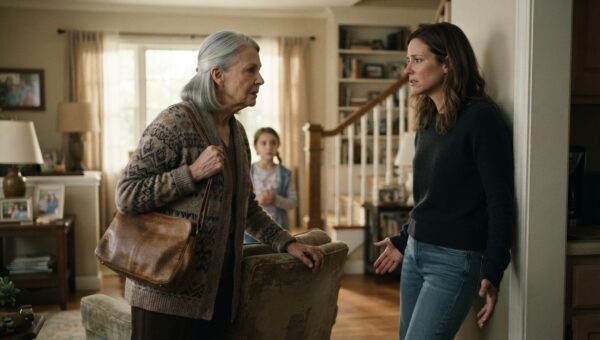
I followed right behind him, my hand clenched into a fist in my pocket. The house smelled faintly of old coffee and floor wax. Martha came walking out of the hallway, wrapped in a faded floral bathrobe, her hair messy and her face pale. She looked at Arthur, then at me, and her lower lip trembled.
“I heard it,” she whispered, pointing toward the kitchen. “I swear to God, Arthur, I heard the deadbolt. The lock sticks on the left side. You remember how it sticks.”
Arthur didn’t answer. He walked past her into the kitchen, his boots clicking hard against the linoleum. I walked with him, scanning the room.
Nothing was out of place. The toaster was in the corner. The dishtowels hung neatly over the oven handle. But sitting right in the center of the butcher-block table was a ceramic mug filled with black coffee, still giving off a faint, rising wisp of steam. Beside it sat an old, heavy wooden frame holding a faded photograph from Arthur and Martha’s wedding day back in nineteen ninety-four.
Martha stared at the photo, her hand flying to her mouth. “That was in the attic. In the cardboard box behind the Christmas tree. I haven’t looked at that picture in fifteen years.”
Arthur stepped closer to the table. He reached out a trembling finger and touched the corner of the wooden frame, where a small notch had been carved into the oak. He stared at it for a long moment, his breathing shallow.
“This was taken by my brother,” Arthur whispered.
I stopped breathing. “Your brother? Arthur, you don’t have a brother. You told me you were an only child.”
Arthur didn’t look at me. His eyes stayed glued to the notch in the wood. “His name was David. He disappeared nineteen years ago. Right before the divorce.”
PART 2
The silence in that small kitchen felt heavier than the house itself. I looked from Arthur’s rigid back to Martha, whose eyes were wide and hollow in the morning light.
“What are you talking about, Arthur?” I demanded, my voice cutting through the quiet. “You told me your parents died when you were young. You told me you didn’t have any siblings. Not once in twelve years have you ever mentioned a brother.”
Arthur turned around slowly, his face flushed with a strange mix of shame and panic. “It wasn’t something I liked to talk about, Sarah. David left. He just packed up his truck one night and drove away. We thought he went out west. We thought he wanted nothing to do with any of us.”
“People don’t just disappear and leave hot coffee on an ex-wife’s kitchen table twenty years later,” Martha said, her voice shaking as she crossed her arms tightly over her chest. “Someone was here. Someone who knew about that lock. Someone who knew where that photograph was hidden.”
“David built this house with me,” Arthur muttered, staring down at his boots. “Before we got married, David and I did the finish carpentry. He put that lock in. He knew the trick to it.”
“If your brother is alive,” I said, stepping right up into Arthur’s space until he had to look at me, “why is he hiding in our town? And why is he breaking into your ex-wife’s house to leave wedding pictures and coffee?”
Arthur didn’t have an answer. He walked over to the kitchen window and looked out into the overgrown backyard, where the old oak tree dropped acorns onto the grass. “I don’t know,” he lied. I could hear it in the flatness of his voice. He knew something, or at least he suspected something that he was too terrified to say out loud.
We spent the next two hours searching the house from top to bottom. We checked the attic hatch, which was pulled down slightly, leaving a dark gap in the ceiling drywall. We checked the closets and the utility room. Nothing was missing from Martha’s home. No silver, no cash, no jewelry. The only things left behind were the warm mug of coffee and the wedding photograph.
By nine o’clock, Martha insisted we leave. The shock had turned into a hard, defensive anger in her eyes, and I couldn’t blame her. I told Arthur to drive us home, but instead of going back to our house, I made him pull over at the small diner down on Main Street. We needed space that wasn’t filled with Martha’s fear or Arthur’s obvious secrets.
Over a cup of lukewarm diner coffee, I pressed him until he finally cracked.
“It was about the land, Sarah,” Arthur whispered, staring into the dark amber liquid in his mug. “When my father died, he didn’t leave a will. Just the family acreage up by the county line. David and I were supposed to split it. But right before David vanished, there was a big fight. A bad one about money and the title deed.”
“And you kept the land,” I said flatly.
“I didn’t steal it,” he protested, his voice rising a fraction before he caught himself and dropped his gaze. “David signed a quitclaim deed. He signed it over to me for five thousand dollars so he could clear out of state. I have the papers at home in the safe.”
“For five thousand dollars,” I repeated, the numbers clicking together in my head with a sickening thud. “An acreage that’s worth three hundred thousand today. And he just signed it away willingly?”
Arthur didn’t answer. He just stared at the chipped formica table.
We drove back to our house in complete silence. The tension inside the truck was thick enough to cut with a knife. When we pulled into the gravel driveway, I noticed something immediately that made my blood run cold.
The small wooden cellar doors set into the side of our foundation—doors that we hadn’t opened in years because they were rusted shut from the outside—were standing wide open. A heavy iron padlock that always hung on the latch was lying smashed in the dirt, its shackle snapped clean through.
PART 3
I stopped by the side of the truck, my hand gripping the door handle. “Arthur. Look at the cellar.”
He killed the engine and climbed out slowly, his movements heavy and reluctant. He walked around the hood of the truck, picking up the broken padlock from the dirt. He turned the heavy iron piece over in his palm, his jaw working tight.
“Someone didn’t pick this,” Arthur muttered. “Someone hit it with a sledgehammer.”
“Go get the flashlight from the garage,” I said, my voice dropping into a tone that left no room for argument.
“Sarah, maybe we should call the sheriff—”
“Get the flashlight, Arthur.”
He brought it over, his hand shaking as he clicked the switch. The beam cut a bright, shaky circle through the dark opening of the cellar stairs. The damp smell of old earth and damp concrete drifted up into the afternoon air.
“David?” Arthur called out, his voice cracking slightly. “David, are you down there?”
There was no answer from the dark. Just the faint drip of a leaky pipe somewhere in the shadows.
“I’m going down,” I said, pushing past him before he could grab my arm.
The concrete steps were cold and slick with moss. I kept my hand on the rough stone wall as I descended, the beam of Arthur’s flashlight bouncing off old cardboard boxes, broken lawn chairs, and winter tires stacked against the back wall.
Then I saw the corner.
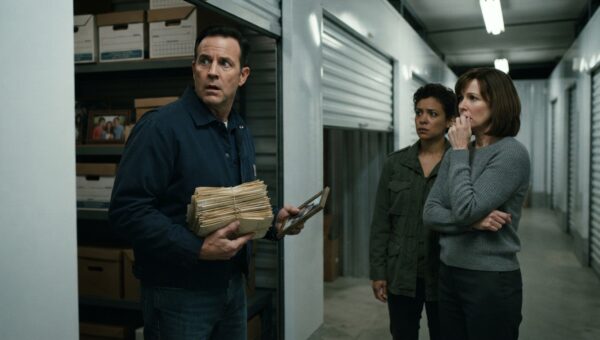
Behind the old coal chute, someone had dragged an old canvas cot from the shed. There was a rolled-up wool blanket, a half-empty gallon jug of water, and a small stack of paperback books. Sitting right on top of the books was a leather-bound journal with the initials D.H. embossed in gold on the cover.
“Arthur,” I called up the stairs. “Bring your light down here. Now.”
He hurried down the steps behind me, his boots clattering against the concrete. When the light hit the cot, he stopped dead in his tracks. He didn’t look surprised. He looked like a man who had been waiting for a bomb to go off for twenty years.
“He’s been living under our house,” I whispered, shining the beam around the dark corner. I saw the empty soup cans, the plastic spoons, the small battery-powered lantern. “For how long, Arthur? How long has he been down here?”
“I don’t know,” Arthur said, though his voice sounded small and hollow.
“Don’t lie to me anymore,” I snapped, turning on him with a fury that had been building since six o’clock that morning. “You knew he was here. That’s why you weren’t shocked when Martha called. You knew he was back in town.”
Arthur dropped the flashlight. It rolled across the concrete floor, its beam pointing uselessly up at the ceiling joists, leaving us in a dim, gray gloom filtered through the open cellar doors.
“He came to the back door three weeks ago,” Arthur confessed, his voice breaking as he slumped against the stone foundation. “He looked old, Sarah. He looked like a ghost. He said he never signed those papers. He said I forged his signature on the quitclaim deed back in ninety-four when he skipped town.”
I stared at him through the dim light, the room spinning slightly. “You forged his signature? You stole the land?”
“We were broke,” Arthur said, his voice pleading now. “My father left us nothing but debt and that patch of dirt. I needed a loan to keep the farm afloat, and the bank wouldn’t look at me unless I owned the title outright. David had already left town. I thought… I thought it didn’t matter. I thought he was never coming back.”
“And instead of coming to terms with it,” I said, my voice shaking with cold disbelief, “he’s been living in our basement like an animal, breaking into his ex-wife’s house just to prove he exists?”
“He’s my brother,” Arthur wept, covering his face with his hands. “What was I supposed to do? Turn him in?”
“You’re going to call the sheriff right now,” I said, my voice hard as iron. “And then you’re going to call a lawyer. Because that land is going back into his name before the sun goes down, or I am walking out of this house and never coming back.”
Arthur didn’t argue. He just sat there on the cold concrete cellar floor, his shoulders shaking, while I climbed back up the stairs into the bright afternoon sunlight.
ENDING
The sheriff’s deputies came out within the hour, followed by an ambulance that took David to the county hospital for a checkup he desperately needed. He looked like an old photograph left out in the sun, frail and gray, wrapped in a faded plaid blanket as they wheeled him out through the side yard. He didn’t look at Arthur once.
By Tuesday, the paperwork was underway. The county recorder’s office pulled the old ninety-four files, and the forged quitclaim deed was dissolved with a stroke of a pen and a quiet, formal apology from a local judge who had known Arthur’s father. The land went back to David, along with a settlement from the equity Arthur had pulled from it over the decades.
Arthur moved his clothes out of the bedroom on Thursday night, carrying two heavy duffel bags down the stairs without a word. I didn’t help him pack, and I didn’t try to stop him. He went to stay at the small motel off the highway until he could figure out what to do next.
The house was terribly quiet that evening. I walked down the basement stairs alone with a trash bag and a broom, cleaning out the empty cans and the old wool blanket from the corner behind the coal chute.
On the small wooden crate where David had kept his things, he had left one item behind. It was an old tin tobacco box with a latch that didn’t quite close all the way. Inside was a single, faded photograph of Arthur and David standing side by side in front of their father’s old tractor, both of them young and smiling, before the land and the money and the lies tore everything apart.
I set the tin box on the kitchen counter, turned off the overhead light, and walked out the back door to lock the cellar from the outside.