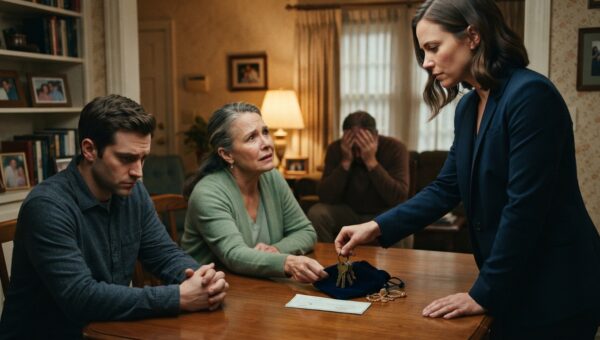
The ice in my water glass had melted down to a clear little nub that floated against the rim when Evelyn raised her fork to tap against the crystal.
“Before we cut the cake,” she said, her voice carrying across the private dining room at the country club with that crisp, polished edge she used whenever she wanted forty people to stop breathing at once, “I just want to thank everyone for coming to celebrate seventy years of a very well-ordered life.
Clara, darling, thank you for organizing this. And Matthew… well, Matthew is here too, doing his quiet best as always.”
She let out a small, dry laugh that nobody else joined, though a few aunts down the table smiled out of pure habit.
That was always my place at these dinners. I was the quiet backdrop, the husband Clara brought along like an umbrella she kept in the trunk just in case the sky looked uncertain. Evelyn never missed a chance to remind the room that I had been found in a bassinet at a county intake office in central Wisconsin before I ended up in the foster system with three different sets of last names by the time I hit high school. She liked to sip her chardonnay and tell her bridge friends that Clara had married without knowing the family behind the man, as if I were a used truck with a painted-over dent on the quarter panel.
I had stopped going to half of these things over the last ten years, but tonight was her seventieth, and Clara had asked me to be there as a peace offering to keep the family waters smooth.
“Roots matter,” Evelyn said, sliding her gaze down the long table until it landed right between my salt shaker and my bread plate. “Some people spend their whole lives trying to grow in soil that doesn’t belong to them. It never really takes.”
The silence in the room had that heavy, upholstered feel of a place where nobody ever disagreed with the hostess.
Before I could find something dull and polite to say about the roast beef, an elderly man sitting three seats down on the opposite side of the table set his napkin beside his water glass with a sharp little scrape. His name was Arthur, a distant cousin of Evelyn’s late husband whom she only invited every five years to prove she kept track of the old branches of the tree.
“What did you just call yourself?” Arthur asked. His voice was cracked like dry pine, but it cut through the room like a cold draft.
I blinked at him. “Matthew. Matthew Vance.”
Arthur didn’t blink back. He leaned his upper body across the white tablecloth, knocking a spoon against a water pitcher, and stared at my face with a terrifying kind of intensity. His eyes were pale blue, watery at the corners, but locked onto my forehead and jawline like he was checking a map he had memorized forty years ago.
“Vance,” he whispered, mostly to himself. Then louder, his hands trembling slightly as he reached into the breast pocket of his wool jacket. “Where were you born? What county?”
“Portage County,” I said, my chest tightening up. “Nineteen-eighty-four.”
Evelyn dropped her fork. The metal hit the porcelain plate with a crack that made the woman beside her jump. “Arthur, don’t be absurd. This is a family dinner, not a parish archive.”
Arthur ignored her completely. He pulled out a worn brown leather billfold, flipped open the plastic sleeve that usually held old driver’s licenses, and slid out a photograph so faded the edges were soft and gray. He laid it flat on the white linen between us, right over the spot where Evelyn had been looking down her nose five seconds earlier.
“Look at that,” Arthur said, his finger tapping the corner of the small square. “Look at the left-hand side.”
I leaned forward. Two young men stood outside a red-brick dairy barn in the middle of a Portage County winter, their breath pluming white in the freezing air, both of them wearing heavy wool jackets with the collars turned up. The one on the right had Arthur’s nose and chin, older now in the picture than Arthur was when I first met him at a family reunion a decade ago.
The one on the left had my face. Not sort of like me. It was me, down to the way the left earlobe curved and the crooked scar across the bridge of the nose where I took a baseball bat to the face when I was nine.
“That was my brother, Thomas,” Arthur said, his voice dropping so low the table leaned in to catch it. “He disappeared forty-seven years ago after the family blew apart over land and blood and things people were too proud to fix. I’ve been looking for his kids for four decades. Everyone told me the line was dead.”
I looked from the photograph to Evelyn. Her face had lost every trace of color, turning the gray shade of wet limestone.
“Evelyn,” Arthur said, turning his head slowly toward the head of the table. “You knew Thomas. Before you married into this money, you were promised to him for two whole summers. You knew every Vance in the valley.”
Evelyn didn’t move. Her hands were clamped over the edge of the tablecloth so hard her knuckles looked like peeled knobs of ginger.
“Arthur, you are an old man losing his mind,” she whispered. Her voice wasn’t loud, but it shook with a raw, ugly panic that didn’t belong at a seventieth birthday party. “Take your wallet and sit back down before you ruin this evening.”
“He’s not losing his mind,” I said. My own voice sounded stranger to me than Arthur’s did. “Because I’ve seen that exact scar in the mirror every morning of my life.”
Clara reached out across the table and put her hand over mine. Her fingers were ice-cold. She looked at her mother, then down at the photograph, and I could see the exact moment the geometry of her entire life shifted on its axis.
“Mom?” Clara asked, and for the first time in our marriage, there was no deference in her tone at all. “What is he talking about?”
We didn’t stay for the cake.
The drive back to our house on the edge of town was the quietest forty minutes of my life. Clara didn’t turn on the radio. She kept the worn-down family photograph tucked inside her leather purse like it might turn to dust if she held it too loose.
“She knew,” Clara said finally as I cut the engine in our gravel driveway. She didn’t look at me; she stared straight ahead at the porch light buzzing in the damp night air. “My whole life, she talked about your background like you crawled out from under a rock. She made those jokes at every single holiday. And she knew who your father was.”
“She didn’t just know,” I said, feeling a cold weight settle behind my ribs. “She was there when the family broke apart. That’s why she hated my name before she even met me.”
The next morning at 9:00 a.m., Arthur was sitting in our worn-out kitchen armchair with a cardboard box full of old church bulletins, tax ledgers, and leather-bound address books that smelled like a damp basement in January.
“She didn’t just forget you,” Arthur told us, spreading a yellowed hospital receipt across our formica table. “When Thomas left after the fight with our father, Evelyn was already looking for a way out of the valley. She dropped him the minute Robert Vance started building that brick-laying business down in Madison. She married up, Clara. She married money and respectability, and she buried every connection to the people she grew up with.”
He tapped a finger on a small, neat column of cursive handwriting from 1984.
“When your mother died in that car wreck up near Wausau, and you ended up in the county system, Evelyn was on the board of the regional charity fund,” Arthur said, looking straight into my eyes. “She saw the intake name. She saw the Vance middle name on your birth card. She had the connections to pull the file, and she let you go into the foster system anyway because having a Vance relative pop up in her new high-society life would have ruined the story she told her husband about where she came from.”
The kitchen was so quiet I could hear the refrigerator compressor clicking on through the wall.
“She weaponized my lack of roots,” I said, the words tasting like copper in my mouth. “She used it to keep me small so I’d never look too close.”
“Let’s go,” Clara said. She stood up from the kitchen table so fast her chair scraped against the linoleum. She wasn’t crying. Her face had the hard, set look of someone who had just found out their entire childhood was built on cardboard. “Let’s go right now.”
Evelyn’s house smelled like lemon polish and old lavender, just like it always did.
She answered the door herself, her gray hair pinned into its usual stiff silver roll, wearing a beige cardigan that cost more than my first car. When she saw Clara standing there behind me, her expression flickered with that old, practiced authority, the look she used to make repairmen lower their prices or waiters find a better table.
“Clara,” she said, smoothing the front of her skirt. “I expected you to have more sense than to drag this… this nonsense back to my front door.”
“We’re not here to argue, Evelyn,” I said, stepping past her into the front hallway without waiting for an invitation.
“You don’t have the right to walk into my house,” she hissed, her voice dropping into that sharp register she reserved for people she considered help.
“I have every right,” I said, pulling the photocopied intake record Arthur had given us out of my jacket pocket and laying it right on the mahogany entry table beside her silver key bowl. “Forty-seven years ago, you walked away from Thomas Vance because he wasn’t rich enough. And when I showed up thirty years later bearing his name in a county file, you kept your mouth shut so your country club friends wouldn’t ask questions about your past.”
Evelyn’s hand went to her throat, her fingers clutching the pearls she wore like armor. “That is a vicious lie. I was a young woman. Families fracture. People move on.”
“You didn’t just move on,” Clara said, her voice shaking with a quiet, terrifying fury as she stepped into the hallway beside me. “You watched him struggle through foster homes. You watched him come to your table for ten years and feel like a ghost in his own life. And every single time you made a joke about his roots, you knew damn well those roots were the ones you tried to rip out yourself.”
Evelyn backed up until the back of her knees hit the small antique bench by the hall closet. The formidable, unassailable matriarch of Portage County looked small suddenly, her shoulders rounding under the heavy wool of her cardigan as the walls she built around herself finally cracked from top to bottom.
“I protected this family,” she whispered, her voice cracking for the first time. “I built something respectable. You don’t know what it was like back then. If anyone had known, “
“You protected yourself,” I said.
I didn’t yell. There was no point in yelling anymore. The anger that had sat in my chest like a hot coal for thirty-five years had burned down to something cold and clear.
“You spent my whole life making sure I felt like I came from nothing,” I told her, looking down at her from three inches taller than she stood. “You thought if you kept me in the dark, you’d never have to look at what you left behind. But you were wrong.”
Clara reached out and took my hand, her fingers warm and steady against my palm.
“We’re leaving, Mother,” Clara said, her voice as cold as winter glass. “And don’t bother calling us. Don’t send gifts for the holidays, and don’t ever mention my husband’s name at your bridge club again. You wanted a clean break from your past. You finally got it.”
We didn’t look back as we walked out the front door and down the brick path to the car.
Two days later, Arthur invited us over to his small house down by the river road.
The kitchen smelled like strong coffee and old paper. Arthur didn’t say much about Evelyn, and we didn’t ask. Instead, he cleared a space on his worn maple dining table, pushing aside a stack of seed catalogs and an old tin of mints, and laid out two items side by side.
On the left was the faded, graying photograph of Thomas Vance standing outside the dairy barn in the winter of 1978. On the right was a brand-new color print Arthur had made at the pharmacy down on Main Street, showing the three of us, Arthur, Clara, and me, standing out on our own front porch with the late afternoon sun hitting the cedar siding behind us.
“Family isn’t something you inherit by accident,” Arthur said softly, sliding the two pictures together until the corners touched. “It’s just the stuff you decide to keep when the rest of it burns down.”
I looked down at the two faces separated by forty-seven years of silence, and for the first time in my life, I didn’t feel like a question mark at all.