FULL STORY — PART 2
When I got home, I spread the yellow citation out on my dining room table and made myself a cup of chamomile tea. Looking at the ticket, I couldn’t help but laugh out loud in my empty kitchen.
The young officer was half-right. U-turns at Third and Maple had indeed been prohibited in 2011 because the old lane configuration made the turning radius far too dangerous. However, he was missing a rather massive, crucial piece of updated information.
In 2018, the city spent two million dollars widening that exact road and redesigning the lanes. Because of the new traffic flow, the city council officially voted to lift the U-turn restriction, making it perfectly legal. And the only reason I knew the exact timeline of that legislative change wasn’t just because I lived in the area.
It was because I was the lead consultant who helped write the updated DMV curriculum and traffic safety manual for our entire region following that redesign.
I walked into my home office and booted up my computer. If this young officer was confidently pulling me over for a rule that had been abolished five years ago, it meant he was operating on severely outdated training. And worse, it meant I wasn’t the only one. He, and likely other officers in his precinct, had probably been writing bogus tickets to hundreds of innocent drivers for years, raking in thousands of dollars in unlawful fines for the city.
I wasn’t just going to pay the fine and move on. I was going to dismantle the entire operation.
I spent the weekend organizing my payload. I didn’t just want to tell the judge I was innocent; I wanted to bury the court in irrefutable, undeniable proof.
First, I printed the official 2018 city council meeting minutes, highlighting the exact motion where the Third and Maple U-turn ban was repealed. Next, I pulled the revised civil engineering traffic diagrams from the city planner’s public database, which clearly showed the legal turning radius.
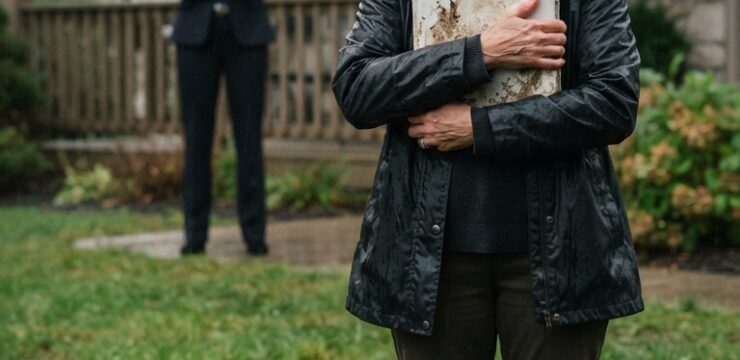
Finally, I went to my bookshelf and pulled down a pristine, thick, spiral-bound copy of the official State Department of Motor Vehicles Driver’s Manual. I flipped to the chapter on intersection right-of-ways, marked the page detailing the legality of U-turns at redesigned junctions like Third and Maple, and placed a sticky note on the acknowledgments page at the very front of the book.
I put all the documents into a sleek black leather binder. The officer thought he had caught a clueless old woman making a careless mistake. He had no idea he had just ticketed the very woman who wrote the rulebook.
FULL STORY — PART 3
My court hearing was scheduled for Thursday morning at 9:00 AM.
I dressed in a sharp navy blazer and sensible slacks, carrying my heavy black binder under my arm. When I walked into the crowded traffic court, I immediately spotted the young officer who had pulled me over. He was sitting in the front row with a stack of citations on his lap, looking incredibly bored as he waited to rubber-stamp a morning’s worth of easy guilty pleas.
He didn’t even recognize me when I sat down two rows behind him.
After about an hour of watching tired commuters plead guilty and accept payment plans, the bailiff finally called my case. “State versus Barbara Hayes. Citation for an illegal U-turn.”
I stood up and walked confidently to the defendant’s podium. The young officer stepped up to the prosecution’s table, glancing at me briefly before looking down at his notes.
The presiding judge, a no-nonsense woman in her late fifties named Judge Davis, peered down at me over her reading glasses. “Mrs. Hayes,” she said, her voice echoing in the quiet courtroom. “You are charged with a moving violation at the intersection of Third and Maple. How do you plead?”
“Not guilty, Your Honor,” I said clearly.
The officer sighed heavily, stepping up to the microphone. “Your Honor, the defendant was observed making a prohibited U-turn at Third and Maple. Per city ordinance, that intersection has been a no-U-turn zone since 2011. The violation is clear.”
Judge Davis looked back at me. “Mrs. Hayes, do you have a defense?”
“I do, Your Honor,” I replied, opening my black binder. “May I approach the bench with my evidence?”
The judge nodded. I walked forward and handed her the stack of organized documents. “Your Honor, the officer is citing an ordinance that was officially repealed in October of 2018. If you look at Exhibit A, you’ll see the city council minutes proving the ban was lifted. Exhibit B contains the updated engineering diagrams from the Department of Transportation, explicitly allowing U-turns in those widened lanes.”
The officer’s bored expression instantly vanished. He stood up a little straighter, frowning in confusion.
Judge Davis adjusted her glasses, reading through the highlighted pages. Her eyebrows slowly rose toward her hairline.
“And finally, Your Honor,” I said, my voice carrying perfectly through the silent room, “I have included the current, official state DMV manual, which I helped author and edit. If you turn to the acknowledgments page, you will see my name listed as the lead curriculum consultant. The maneuver I made was completely legal, and this officer is enforcing a law that hasn’t existed for half a decade.”
ENDING
The silence in the courtroom was absolute. You could have heard a pin drop on the carpeted floor.
Judge Davis looked from the thick DMV manual in her hands, down to my name printed in the front cover, and then slowly turned her furious gaze toward the young police officer. All the color had completely drained from his face. He looked like a deer caught in the headlights of an oncoming semi-truck.
“Officer,” Judge Davis said, her voice dangerously quiet. “Are you and your precinct currently enforcing an obsolete traffic law?”
“I… I was trained that it was a restricted zone, Your Honor,” he stammered, gripping the edges of his table.
Judge Davis slammed her gavel down with a sharp, echoing crack. “Case dismissed,” she announced firmly. “But we are not done here. Clerk, I want a full audit of every single moving violation issued at the intersection of Third and Maple since October 2018. I am issuing an immediate injunction on those fines. This court is not in the business of robbing citizens because the police department failed to update its training manuals.”
She looked back down at me, the sternness leaving her face, replaced by a subtle, respectful smile. “Thank you for your thoroughness, Mrs. Hayes. You are free to go.”
I gathered my binder, turned around, and walked out of the courtroom, my head held high. The young officer didn’t dare make eye contact with me as I passed his table.
A few weeks later, the local news ran a story about the “Third and Maple Audit.” Because of my single court appearance, the city was forced to refund nearly four hundred wrongfully issued traffic tickets, putting thousands of dollars back into the pockets of innocent drivers. The police precinct had to undergo a mandatory retraining seminar on updated traffic codes—a seminar I took great personal pleasure in declining an invitation to teach.
Sometimes, the universe puts you in the exact right place at the exact right time. That young officer thought he was just handing a ticket to a clueless older woman. Instead, he handed me the opportunity to fix a broken system, and reminded me that knowing your rights is the most powerful vehicle you can ever drive.