FULL STORY — PART 2
I am seventy-eight years old now. My world has shrunk to the size of my garden and my living room.
Last month, I was at the local hardware store buying potting soil when I ran into Martha, a former neighbor whose children used to run through the sprinklers with Clara in the summers. Martha and I hadn’t spoken in years, but she recognized me immediately. After some polite small talk about my health, she hesitated, clutching her purse, looking at me with a mixture of caution and warmth.
“William,” Martha said gently. “I don’t know where things stand with you and Clara… but my granddaughter goes to a special school up in the city. I was at her winter recital last week, and I saw her.”
My breath caught in my dry throat. “You saw Clara?”
Martha nodded, pulling her smartphone from her purse. “She goes by her married name now, but I knew those eyes anywhere. I wanted to show you.”
She tapped the screen and handed the phone to me. I put on my reading glasses, my hands beginning to tremble.
The woman in the photograph was fifty-seven years old. Her hair was heavily streaked with silver, and there were deep laugh lines around her eyes, but it was unmistakably my Clara. She was sitting in a circle of children—some in wheelchairs, some with Down syndrome, some who looked as though the world had been incredibly unkind to them. Clara was holding an acoustic guitar, her head thrown back in a joyous, radiant laugh, while a little boy with a hearing aid rested his hand against the wood of the guitar to feel the vibrations of the strings.
“She teaches music therapy, William,” Martha whispered, her voice thick with emotion. “To the children nobody else will take. The kids who have been abused, the ones with severe disabilities. She uses music to help them speak, to help them heal. My granddaughter has autism, and Clara is the only teacher who has ever reached her. Those children absolutely adore her.”
I stared at the glowing screen in the aisle of the hardware store, the walls of the building seeming to blur and spin around me.
*Chasing music will leave you with nothing.*
My cruel, ignorant words echoed in my ears. I had been so utterly, terribly wrong. She hadn’t wasted herself on a guitar. She had used it to become a lifeline for broken children. She had taken the music I despised and used it to give herself away, beautifully and completely, to a world that desperately needed her.
FULL STORY — PART 3
I drove home in a daze, the tears I had suppressed for forty years finally falling freely down my weathered cheeks, soaking the collar of my flannel shirt.
When I walked into the empty house, the silence felt heavier, yet somehow more fragile than before. I didn’t turn on the television. I didn’t make tea. I walked straight down the hallway and into my small, dusty study.
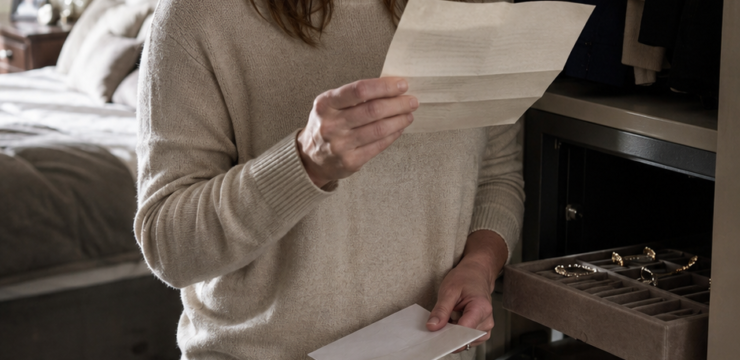
I sat down at the heavy oak desk. My heart was pounding with a frantic, terrifying urgency. I opened the top drawer and pulled out a stack of the heavy, ivory stationery Eleanor had bought for me years ago. Then, I reached into the velvet box beside the lamp and picked up the heavy silver fountain pen her mother had given me for our twenty-fifth wedding anniversary. Eleanor had always told me that pen was meant for writing something important. It had sat unused for a decade.
I uncapped the pen. I stared at the blank, cream-colored paper.
How do you summarize forty years of foolishness? How do you compress decades of missed birthdays, unanswered letters, and agonizing regret into ink? I thought about the little boy resting his hand on Clara’s guitar. I thought about the joy in my daughter’s silver-haired portrait.
My hand shook so violently that I had to press my left palm over my right wrist just to steady the pen against the paper. The nib scratched against the thick grain. I tried to say in ink what I had been too much of a coward to say out loud when she was seventeen.
I didn’t offer excuses. I didn’t talk about my own grief or try to justify my fear. I just told the absolute, devastating truth.
The first line I finally set down read: *I have been a deaf, foolish old man for forty years, but today, I finally heard your music.*
I wrote for two hours. I told her about running into Martha. I told her how intensely proud I was of the woman she had become, and how deeply ashamed I was of the father I had been. I told her that Eleanor had loved her every single day, and that I had kept her only letter in my desk, a monument to my own failure. I ended it by telling her she owed me absolutely nothing, but that I loved her, and I was so deeply, profoundly sorry.
ENDING
I mailed the letter that afternoon. For three agonizing weeks, the mailbox remained empty. I prepared myself for the reality that some wounds are simply too old, and too deep, to be healed with a single apology. I accepted that I had forfeited my right to her forgiveness.
But on a rainy Sunday morning, I heard the crunch of tires on the gravel driveway.
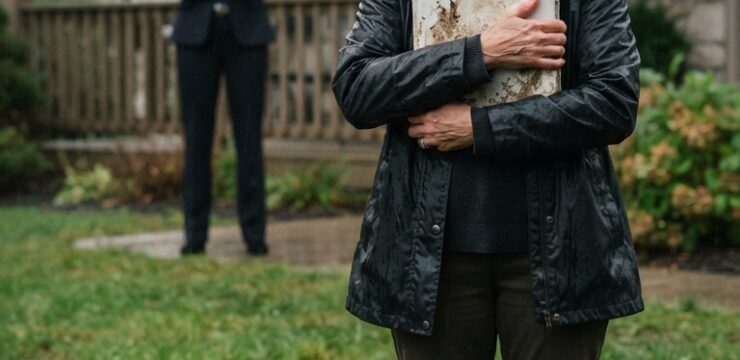
I walked to the front window and pulled back the curtain. A sensible blue sedan was parked near the porch. A woman with silver-streaked hair stepped out into the drizzle. She was holding an umbrella in one hand, and a battered acoustic guitar case in the other.
I opened the front door before she even reached the steps. My legs felt incredibly weak.
Clara stopped at the bottom of the porch stairs. We looked at each other across the rain, forty years of silence standing between us. The anger I expected to see in her eyes wasn’t there. Instead, there was a cautious, fragile grace.
“Hello, Dad,” she said softly.
“Clara,” I choked out, the word tearing from my throat as I gripped the doorframe to keep from collapsing. “You came.”
“I did,” she replied, stepping up onto the porch and lowering her umbrella. She looked at me, taking in my gray hair and my frail posture. “Mom’s pen writes beautifully.”
I stepped back, opening the door wide, tears freely tracking down my face. I didn’t ask her for forgiveness right then. I knew I had to earn my way back into her life, one quiet, steady day at a time. But as Clara walked into the house and set her guitar case down gently on the living room rug, the crushing stone I had carried in my chest for four decades finally dissolved. It is never too late to admit you were wrong, and it is never too late to finally sit down and listen to the music.