PART 2
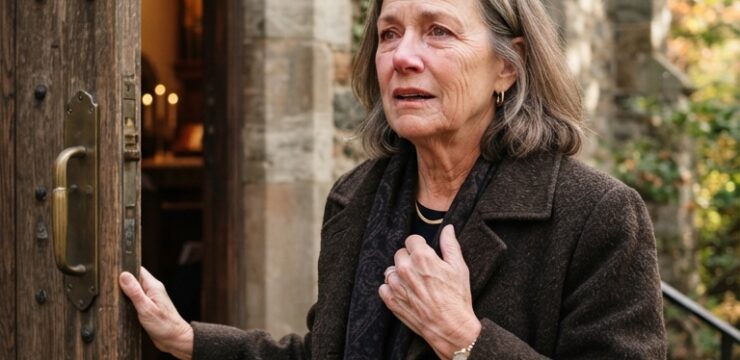
Having Martha and Joyce watching didn’t make me feel righteous; it only made the tension in my chest tighter. It only took two weeks for Martha to call me on a Thursday morning, her voice trembling.
“You were right, Eleanor,” she said, practically whispering into the receiver. “I saw him hand it to her last night near the nursery. He touched her shoulder. She looked like she was about to cry, and then she hurried out the back door.”
That was the breaking point for me. I felt a surge of indignation hot enough to burn away any of my lingering hesitation. This was my church. I had dedicated over a decade of my life to keeping its affairs honest and transparent. I had watched babies be baptized here, including my own grandchildren. I wasn’t going to let a scandal destroy our congregation, and I certainly wasn’t going to let a man misuse his authority over a vulnerable widow.
I spent the next six days preparing. I ran the financial reports one last time, printing out the benevolence fund balance—$900, plain as day. I rehearsed what I was going to say. I didn’t want to destroy Pastor Maddox; I just wanted the truth, and I wanted the inappropriate behavior to stop before it became public and shattered the community.
Last Wednesday, the autumn air was already biting cold. The fellowship hall smelled of percolating coffee and damp wool coats. I kept my eyes fixed on the pastor. As usual, as the crowd began to thin, he made his way toward the back hallway. Tessa was there, wrestling her three-year-old into a winter coat.
I saw his hand go to his jacket pocket. I saw the white edge of the envelope.
My heart hammered against my ribs like a trapped bird. I didn’t wait for him to approach her. I stepped out from behind the coffee urn and intercepted him just as he turned down the narrow corridor leading to the coat room.
“Pastor,” I said, my voice sharper than I intended. “Could I speak with you in private? Now.”
He looked surprised but nodded, gesturing toward the small, windowless coat room. I walked in first, waiting for him to step inside before I firmly shut the solid oak door behind us. The muffled sounds of the congregation faded, leaving us in a heavy, suffocating silence surrounded by the smell of wet umbrellas and heavy winter coats.
I turned to face him, clutching the printed financial reports in my trembling hands. I didn’t give him a chance to ask what was wrong.
“I know about the envelopes,” I said, looking him dead in the eye.
PART 3
I expected him to pale. I expected him to stutter, to deny it, or to instantly launch into a defensive explanation about pastoral care.
He didn’t flinch. He didn’t even look angry. Instead, a deep, heavy sadness seemed to settle over his features.
“Eleanor,” he said softly, his voice echoing slightly in the cramped room. “I know you’ve been watching. I know you had Martha and Joyce watching, too.”
The air rushed out of my lungs. He knew.
“Then you know how this looks,” I fired back, my protective anger flaring to cover my embarrassment. “The benevolence fund is practically empty. There is no church record of financial support for Tessa Hardy. So either you are embezzling funds off the books, or you are paying her for something else. Which is it? Because I won’t let you drag this church into the mud.”
Pastor Maddox reached into the breast pocket of his jacket. But he didn’t pull out the white envelope. He pulled out a folded piece of paper and laid it quietly on the small wooden table between us.
It was a bank document. I leaned in, my eyes scanning the numbers. It was his personal pay stub.
“That’s my money, Eleanor,” he said, his voice completely steady. “Not the church’s. Every cent of it comes from my own salary. I give her what I can spare every week.”
I stared at the paper, my mind struggling to pivot. “But why?” I demanded, pointing a shaking finger at the stub. “Why all the secrecy? Why are you personally supporting a twenty-six-year-old woman in the shadows?”
The room seemed to tilt beneath my feet as he looked at me, his eyes shining with unshed tears.
“Because she has too much pride to take charity, and the church doesn’t have enough to keep her lights on,” he said softly. “And because I owe her husband a debt I can never repay. We all do. Especially you, Eleanor.”
I froze. “What are you talking about? Her husband, David, just died of a heart defect a few months ago. I barely knew him.”
“David was older than Tessa,” the pastor said gently. “They married just five years ago. But before he was a husband and a father, he was a young volunteer fireman for the county.”
He took a step closer, his voice dropping to a whisper. “Twelve years back, Eleanor. The night the electrical fire took your old house on Elm Street. Do you remember the young man with the soot-stained face who ran into that collapsing structure and carried out your daughter, Emily, right before the roof caved in?”
My breath hitched. The clipboards and financial reports slipped from my hands, scattering across the linoleum floor.
ENDING
“David,” I whispered, the name catching on a sob as the memory of that terrifying night came rushing back. The young fireman sitting on the bumper of the ambulance, coughing violently while I held my weeping, terrified little girl. I had sent a thank-you card to the station, but in the chaos of losing our home, I had never properly learned his last name.
“He never wanted recognition,” Pastor Maddox explained quietly, picking up the scattered papers for me. “When he died in February, he left Tessa with a mountain of medical debt and no life insurance. She was going to lose her apartment last month. I couldn’t let the family of the man who saved so many in this town end up on the street. I kept it quiet because she was humiliated to need the help.”
I sank onto a folding chair in the coat room, burying my face in my hands. The tears came hot and fast—tears of overwhelming gratitude for a man who had saved my greatest treasure, and tears of bitter, agonizing shame for the ugly assumptions I had harbored in my own self-righteous heart. I had weaponized my duty to the church against the very family that had kept my own intact.
When I finally composed myself, I walked out of that coat room a profoundly changed woman. I didn’t just apologize to Pastor Maddox; I went straight to Tessa. I held her hands, told her the story of the young fireman who had given me my daughter’s future, and wept with her.
I called Martha and Joyce that same night. I didn’t just correct the gossip; I dismantled it. The next Sunday, I stood before the congregation during the announcements. I didn’t betray Tessa’s privacy, but I spoke about grace, about unseen sacrifices, and about a hero whose family now needed us.
By the end of the month, the benevolence fund didn’t just recover—it overflowed. We paid off Tessa’s medical debt in full. I still keep the church books, and I still watch every penny. But I no longer look at the people in our pews searching for their sins. I look at them knowing that behind every tired face, there might be a story of quiet heroism or private grief, simply waiting for a little bit of grace.