PART 2:
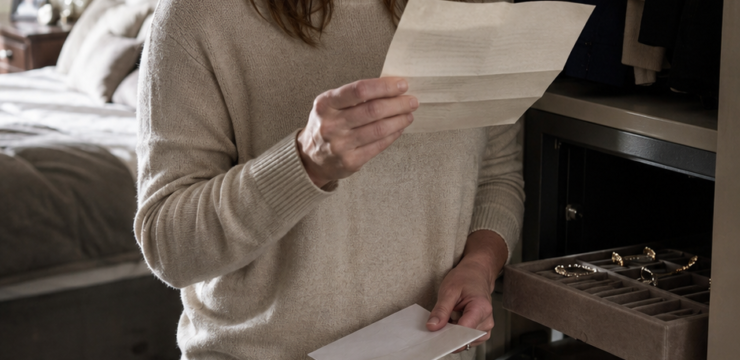
I turned the envelope over again, my thumb tracing the faded return address stamped in the upper left corner—a small town two hours north, nestled deep in the rolling hills near the Pennsylvania border. For three days, the unopened envelope sat on the kitchen counter like a ticking clock. I tried to convince myself it was a morbid coping mechanism, a grieving mother’s strange way of dealing with infant loss. But mothers don’t mail birthday cards to cemeteries, and they certainly don’t write *To my son* for a child they supposedly buried seven years prior.
On the fourth morning, fueled by a restless, gnawing curiosity that would not let me sleep, I locked up the farmhouse, got into my sedan, and pointed the hood north up Route 21. The drive took a little over two hours, the flat farmland gradually giving way to steeper wooded ridges and small, forgotten mill towns where the paint was peeling off the storefronts. The address on the envelope pointed to a modest, white-sided bungalow on Elm Street, a quiet neighborhood where the lawns were neat and autumn leaves drifted across cracked concrete sidewalks.
My hands were shaking slightly as I cut the engine in front of the house. It was a well-kept place, with a faded American flag hanging from the porch rail and a rusty pickup truck parked in the gravel driveway. I sat in my car for ten minutes, rehearsing what I would say. *Hello, I’m Clara. I’m looking for a boy who shouldn’t exist.* It sounded insane even in my own head.
Finally, I forced myself out of the car, walked up the three wooden steps to the front porch, and pressed the doorbell. From inside, I heard the faint chime of a mechanical bell, followed by the heavy, measured sound of footsteps shuffling across a linoleum floor. The front door swung open. A man stood in the doorway, wearing a faded plaid flannel shirt and holding a pair of reading glasses in his hand. He was in his early seventies, tall and broad-shouldered, with thinning gray hair and deep lines around his eyes. But it wasn’t his face that made the breath rush out of my lungs—it was the way he moved his left shoulder as he leaned against the doorframe, a distinct, habitual slouch that my father had carried every single day of his life.
He looked down at me with mild, polite curiosity, his blue eyes searching my face. “Can I help you, ma’am?” he asked, his voice deep and slightly raspy.
I couldn’t speak. My throat had tightened into a hard knot, the unopened birthday card burning a hole in the pocket of my coat.
PART 3:
“Ma’am?” the man repeated, a flicker of concern crossing his weathered features as he noticed the trembling in my hands. “Are you alright? Do you need to sit down?”
“I… I’m looking for Thomas,” I managed to whisper, using the name I had found written lightly in pencil on the back of an old, torn photograph hidden inside Mama’s recipe box years ago—a name Mama had never spoken aloud in our home.
The man’s posture shifted instantly. The polite confusion in his eyes vanished, replaced by a sudden, sharp wariness. He gripped the edge of the screen door tighter, his knuckles whitening. “Who are you?” he asked, his voice dropping an octave.
I reached slowly into my coat pocket and pulled out the faded envelope, holding it out between us like an olive branch. “My name is Clara. I’m Arthur and Eleanor’s daughter. I found this in Mama’s house after she passed away in January.”
He stared at the envelope. He didn’t take it from my hand, but I saw his chest rise and fall in a long, shuddering breath. He looked past me at my car parked on the street, then back down at my face, tracing the shape of my nose and the set of my jaw with an intensity that felt heavy with decades of unspent grief.
“She never opened it,” he said softly, more to himself than to me. He pushed the screen door open wider and stepped back into the hallway. “You’d better come inside, Clara. It’s a long story, and you’ve been carrying a lie for a very, very long time.”
We sat at a small laminate kitchen table while he poured coffee from a chipped ceramic pot. His name wasn’t Thomas; it was David. And the story he told me in the quiet afternoon light shattered every foundation I had built my life upon. In the winter of 1958, my parents had fallen into desperate financial ruin during the local factory layoffs. Relatives from my mother’s side—wealthy, strict, and deeply religious—had offered to take my three-year-old brother in and raise him legally under their name in a neighboring county, promising a stable life my parents couldn’t provide. But the arrangement came with a cruel, ironclad condition: my mother had to sign away all parental rights and agree never to contact him, never to tell him he had a sister, and to pretend to the world that he had died so the scandal of giving up a child wouldn’t taint the family name.
“Mama didn’t die of a broken heart when I was a baby,” I whispered, tears finally spilling over my cheeks as the pieces locked into place. “She spent fifty years wondering where you were, mailing letters that always came back, too terrified of her own family to ever come look for you.”
David reached across the table, his large, calloused hand covering mine. His skin felt warm, steady, and entirely familiar. “She tried, Clara,” he said gently. “I remember the social worker telling me when I turned eighteen that my birth mother had never stopped writing. But by then, I had my life here. And she had her life down there.”
ENDING:
The sun was dipping low behind the Pennsylvania hills by the time I finally stood up to leave David’s porch, the lingering chill of winter replaced by the quiet, overwhelming warmth of a connection I never knew I had. We spent the rest of that weekend sitting at his kitchen table trading photographs, piecing together the missing decades of our family history like a puzzle that had been scattered to the wind fifty-eight years ago.
When I drove back down Route 21 toward the farmhouse in Ohio, the empty rooms didn’t feel quite so lonely anymore. The secret that had weighed down my mother’s life and been buried in a rusted coffee can was finally out in the open, breathing under the light of day. We couldn’t reclaim the lost years, and we couldn’t rewrite the harsh choices made by a frightened young mother in the winter of 1958, but as David and I planned our first Thanksgiving together with my daughters in Columbus, I realized that family isn’t just defined by who stays in the house—sometimes, it’s found waiting quietly on a porch two hours north, just hoping someone will finally knock on the door.