PART 1
I was seven months pregnant when the doctor called me into his private consultation room alone. My husband, Brian, had dropped me off at the medical building on his lunch break and rushed back to the machine shop where he worked the second shift. I thought Dr. Mercer just wanted to discuss my iron levels or scheduled ultrasound dates.
Instead, he shut the heavy wooden door, sat down behind his wide laminate desk, and folded his hands over my chart.
“Mrs. Davis,” he said, keeping his voice quiet and level. “The baby’s routine blood work came back from the regional lab yesterday. The baby is healthy, but there is a clear genetic discrepancy. The blood type does not match the parental records we have on file.”
I looked at him, confused. “What does that mean?”
“Your prenatal panel lists your husband as type O negative,” Dr. Mercer said. “Your own records show you as type A positive. A child conceived by a type O parent and a type A parent can only inherit type O or type A. But the cordocentesis and maternal fetal blood draw show your baby is AB positive.”
He looked at me with that guarded, uncomfortable neutrality doctors use when they suspect marital infidelity.
“Biologically,” he added, “a child with AB positive blood cannot be fathered by a man with type O blood.
Unless there is another biological contributor you have not mentioned, we need to consider rare genetic anomalies.”
I sat in that vinyl chair with my palms pressed against my swollen belly. I had been married to Brian for eleven years. We had met when I was twenty-one, bought a small house near the water tower, and spent five difficult years trying to conceive. I had never cheated on him. Not once. Not in eleven years, and not in the dark months when we thought we would never have a family of our own.
“There is no one else, Dr. Mercer,” I said. My voice did not waver. “Brian is the only man I have ever been with.”
Dr. Mercer sighed softly. “Then we need to confirm the laboratory parameters. Sometimes sample contamination occurs, or there is an extremely rare chimerism or cis-AB allele mutation. I am referring you directly to the maternal genetics division at St. Vincent’s for comprehensive sequencing.”
The specialist at St. Vincent’s ran $8,400 in specialized genetic assays and extended antibody panels to rule out lab error. Our insurance required a forty percent copay because it was categorized as non-standard diagnostic testing, but I signed the financial responsibility forms without hesitation. I needed the truth in black and white.
Ten days later, the certified laboratory report arrived by courier. All the previous findings were confirmed. The baby was definitively AB positive. Brian’s blood sample, which he had provided without question thinking it was routine RH factor screening, was confirmed O negative.
My husband could not possibly be the biological father of an AB child unless my own genetic typing was completely impossible.
I drove home from the lab with my hands shaking on the steering wheel. I parked in my driveway, left the engine idling, and called my mother on her landline.
“Mom,” I said as soon as she picked up. “The baby is AB positive.
Brian is O. The geneticist says the only way that is possible is if one of my parents carried type B blood. Dad’s army discharge papers say he was type O positive. What do you know about this?”
There was a dead silence on the line. I could hear the rhythmic ticking of the antique clock in her front parlor.
“Mom?” I pressed.
My mother’s voice came through the receiver, sounding paper-thin and brittle. “Some things are better left alone, Clara.”
Before I could say another word, she hung up the phone.
I put my car in reverse, backed out of the driveway, and drove forty-five minutes north on the two-lane state highway to her brick ranch outside Mansfield.
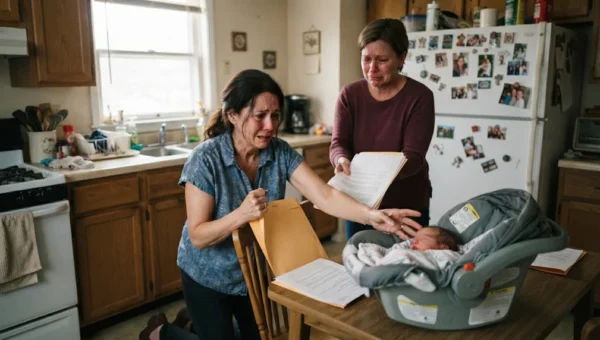
When I pushed through her unlocked screen door, she was sitting alone at the kitchen table in the dim afternoon light. Her hands were folded on the yellow floral tablecloth, and her face was wet with quiet tears.
Without looking up at me, she slid a faded yellow legal envelope across the wood.
I picked it up and pulled out the single folded sheet inside. It was an official state certificate of live birth, embossed with a raised blue seal. It was not the certificate tucked into the satin pocket of my baby book with the pastel stork on the cover.
It was issued by a municipal hospital in Marion, Ohio, a town ninety miles away from where I was raised, and the date of birth was five days earlier than the birthday I had celebrated for thirty-two years.
I looked down at the typed line beneath the hospital header.
The mother’s name on the certificate was not Evelyn Davis. It was Margaret Rose Vance.
PART 2
The paper felt stiff and cold between my thumb and forefinger.
I pulled out the kitchen chair across from my mother and sat down heavily, resting my forearms against the table to steady myself. The refrigerator hummed in the quiet room. On the counter stood the blue ceramic sugar bowl my father had bought at the county fair thirty years ago, an ordinary object in a room that had suddenly ceased to be my real home.
“Who is Margaret Vance?” I asked, my voice barely above a whisper.
My mother wiped her eyes with the corner of a paper napkin. She was seventy-one years old, her shoulders slightly rounded from decades of clerical work at the township water board, but she looked smaller right then than I had ever seen her.
“She was your father’s younger sister,” Mom said. Her voice was cracked and uneven. “Margaret died in 1994, Clara. You were only four years old.”
My mind spun, trying to anchor itself to childhood memories. I remembered Aunt Margaret as a quiet woman who lived in an assisted-care cottage near Columbus, someone we visited once a year around Thanksgiving. She had thick brown hair, walked with a slight limp from childhood polio, and always gave me small brass animal figurines that she kept wrapped in tissue paper. I had been told she suffered from heart complications after a bad winter flu.
“Margaret had type B blood,” Mom continued, staring down at her worn wedding band. “She was nineteen when she got pregnant. It was 1990. She was unmarried, working as a night clerk at a motel on Route 23, and the father was a traveling lineman from Pennsylvania who left the state three weeks after she told him. In those days, in a small town like Marion, her own father threatened to turn her out onto the street.”
“So Dad took me?”
“Your father and I had been married nine years,” Mom whispered. “We had three miscarriages. The doctors told us in 1988 that my uterine lining was too scarred to ever carry a pregnancy to term. When Margaret went into labor alone in that county hospital, your father drove straight to Marion in the middle of a November blizzard. Margaret was terrified. She knew she couldn’t care for an infant on her wages, and she begged your father not to let you be placed into county foster care.”
Mom reached across the table, her trembling fingers touching the edge of the yellow envelope.
“Your father made an arrangement with an attorney in Mansfield. Margaret signed private relinquishment papers, and the lawyer filed an amended birth record with the county probate division after an interlocutory decree of adoption. We brought you home when you were six days old. We gave you the pink nursery, we had you baptized at St. Paul’s, and we promised each other that we would never let you feel like an afterthought or a charity case. You were our daughter from the second Arthur laid you in my arms.”
“Why did you lie about my birthday?” I asked, looking at the date on the original state form. “Why change the day by five days?”
“Because Margaret gave birth on November twenty-second,” Mom said, tears spilling freshly down her cheeks. “The amended paperwork wasn’t processed until November twenty-seventh, the day we took physical custody. Your father wanted every single public record to match the day you officially became ours, so there would never be a question in school or on a passport application. We thought we were protecting you from the stigma of what happened to Margaret.”
“And the genetic testing?” I asked, touching my stomach. “Did Margaret ever tell you about the man from Pennsylvania?”
Mom pulled open the small drawer in the table where she kept coupons and stamps. She lifted a small velvet jewelry box, the kind that held cheap department store rings, and set it beside the birth certificate.
Inside was a faded business card from an electrical contracting company in Altoona, Pennsylvania. On the back, written in faint blue ballpoint pen, was a name and a telephone number: *David Keller – Line Crew 4.*
PART 3
The drive back to my house was forty-five minutes of gray highway and winter fields.
Brian’s pickup was already in the driveway when I pulled in. He had come home from the machine shop early, his work jacket hanging over the back of the entryway bench, his work boots set neatly by the door. He was standing by the stove, heating a pot of vegetable soup he had taken out of the freezer for dinner.
When he turned and saw my face, he set the wooden spoon down immediately.
“Clara,” he said, walking over and taking my hands. His palms were rough from metal shavings and grease. “Did the geneticist call? What did the hospital say about the copay?”
I didn’t try to soften the blow. I took the original birth certificate from my coat pocket and laid it flat on the laminate counter right beside his bowl.
“The blood test is accurate, Brian,” I said. “The baby is AB positive because I carry the type B allele from my biological mother.”
Brian looked down at the certificate. His forehead creased as he read the name *Margaret Rose Vance* typed in black ink across the parental box. He didn’t speak for nearly a minute. He picked up the paper, held it under the overhead kitchen light, and then looked back at me.
“Your father’s sister?” he asked, his voice completely level. “Aunt Margaret?”
“My mother and father adopted me through private probate when I was six days old,” I told him, the tears finally burning my eyes. “They amended the county records, altered my birth date by five days, and swore an oath to never tell me. My biological father was an electrical lineman from Pennsylvania who had type B blood. I didn’t know, Brian. I swear to you on my life, I didn’t know.”
Brian set the paper down on the counter. He didn’t raise his voice. He didn’t ask twenty suspicious questions.
He pulled me against his chest, wrapping his heavy arms around my shoulders, letting my face press into the flannel of his shirt until my breathing slowed down.
“I never doubted you, Clara,” he murmured into my hair. “Not for one single second. I was worried you were sick. I was worried there was something wrong with the baby’s marrow or your liver. That’s why I gave them the blood sample last week.”
“We owe thirty-three hundred dollars on that genetic panel,” I said, my voice muffled against his shoulder. “Thirty-three hundred dollars we had saved for the hospital delivery room, all because my family kept a thirty-two-year-old secret.”
Brian pulled back, took my face in both of his calloused hands, and looked straight into my eyes.
“The money is just numbers on a bill,” he said firmly. “We will pay the hospital thirty dollars a month if we have to. What matters is that our little girl is healthy, you are healthy, and we know who she is.”
The next morning, I took the original Marion county birth certificate, the genetic sequencing panel from St. Vincent’s, and the Altoona business card down to Dr. Mercer’s clinic on High Street.
I didn’t wait for the nurse to call my name. I walked straight up to the reception desk, asked for Dr. Mercer directly, and was shown into the same small consultation room where he had questioned my marriage two weeks earlier.
Dr. Mercer walked in holding a clipboard. Before he could speak, I slid the certified birth record and the lab profile across his blotter.
“The patient record requires an immediate administrative correction,” I said, keeping my voice firm and clear. “I am an adopted child. My biological mother carried type B positive blood. My biological father carried an AB or B profile. My husband, Brian Davis, is the sole biological father of this child, and his type O negative status is genetically compatible with my actual lineage.”
Dr. Mercer adjusted his glasses. He read the Marion county seal, checked the dates against the St. Vincent’s laboratory report, and slowly closed the folder.
A dark flush of embarrassment rose from his collar to his cheeks.
“Mrs. Davis,” he said, clearing his throat. “I apologize. When parental blood groups conflict with expected Mendelian inheritance, clinical protocol requires us to evaluate every possibility, including paternal discrepancy.”
“Protocol is fine, doctor,” I told him. “Assuming an eleven-year marriage is a lie before asking if the mother was adopted is not. Please update my permanent medical chart so my obstetric delivery file is accurate.”
ENDING
We didn’t go looking for David Keller in Pennsylvania.
Margaret had made her peace with her choice before she died in that Columbus hospice, and my father had spent thirty years being the only father I ever needed, working long hours at the gravel quarry so I could have piano lessons and braces on my teeth. Digging up an old lineman who had walked away in 1990 would not give my child a better life.
Two weeks after my visit to the clinic, my mother drove down to our house on a cold Saturday morning. She carried a small cardboard storage box that had been sitting in the cedar chest in her spare bedroom for thirty years.
Inside were Margaret’s personal things: her high school yearbook from 1988, a silver charm bracelet with three tiny brass birds, and a handwritten letter Margaret had folded into the back of her Bible three weeks before she gave birth.
*To my baby girl,* the letter read in Margaret’s neat, sloping pencil. *Arthur and Evelyn are going to give you the life I couldn’t afford to give you. If you ever read this, know that I didn’t let you go because you weren’t wanted. I let you go because I wanted you to have a warm house, a full pantry, and parents who could stay together. Be good to them.*
My mother sat at my kitchen table, her hands resting quietly in her lap, waiting for me to speak.
I walked over to the cabinet, poured her a cup of decaf coffee with a splash of cream just the way she liked it, and set it down in front of her.
“You shouldn’t have hidden it, Mom,” I said gently. “It cost us thousands of dollars in medical panic, and it made me feel like the ground had dropped out from under my feet.”
“I was terrified you would stop calling me your mother,” she whispered, her eyes red.
I sat down beside her, took her right hand in mine, and squeezed her knuckles.
“You’re the only mother I’ve ever had,” I told her. “That doesn’t change just because of a line on a state certificate.”
Our daughter was born on a clear Tuesday morning in late January, weighing seven pounds and four ounces. We named her Margaret Evelyn Davis.
When the hospital delivery nurse brought the baby’s pediatric identification card into the room for Brian and me to sign, I checked the box in the upper right-hand corner.
It was stamped in bold, purple hospital ink: *BLOOD TYPE: AB POSITIVE.*
Brian took the pen, signed his name on the line for the father, and leaned down to kiss our daughter’s forehead.
On our way home from the hospital three days later, we stopped by the small cemetery on the edge of town where my father and Aunt Margaret were buried side by side beneath an old white oak tree.
The ground was covered in three inches of fresh snow. I stayed in the warm cab of the truck with the baby bundled against my coat, while Brian walked through the drifts and set a small bouquet of winter carnations right between the two granite headstones.
He didn’t make a speech. He just touched the top of Margaret’s marker, stood there for a quiet moment in the cold wind, and walked back to the truck to take us home.