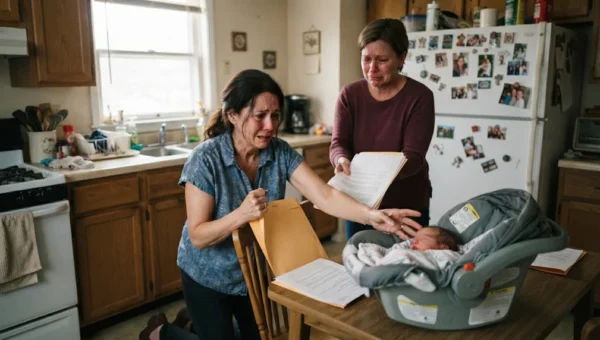
The folded wedding card was on my mother’s lap when she told my wife she wasn’t the one for me.
I was standing beside Maribel in the church hall, still wearing my rented suit, with cake icing on my thumb. My mother, Celia, had tears in her eyes and the card pinched between two fingers. “Son, she’s not right for you,” she said.
Maribel heard every word. I told Mom, “One day, you’ll love her too.” She nodded, but she didn’t look at Maribel.
I thought that was the worst part of the day. It wasn’t. Two years later, after Mom died, I found something under her bed that made me understand how long Maribel had been trying, and how long I’d let her try alone.
I’m 43 now. I fix irrigation pumps and water lines outside Bakersfield, mostly in the dry neighborhoods where every lawn has a timer and people call when the sprinklers stop. My mother came to California from Mexico when she was young. She spoke English just fine, but when she was upset, she chose each word like it might cost money. I picked up that habit. I say, “It’s okay,” when it isn’t. I say, “We’ll see,” when I mean no.
Celia raised me by herself after my father died. I was 19.
She worked in a laundry and came home smelling like soap and hot metal. When I got my first truck, she kept a little tin of mints in the glove box for me. I don’t know why I remember the mints. They were always stuck together in summer.
She loved me hard. That was part of the problem. I didn’t know how to let her love me without letting her have a say in everything.
Maribel and I met at a friend’s cookout. She was funny without trying to be, and she remembered which people didn’t eat pork. Mom liked her for about ten minutes. Then Maribel told her she’d grown up in Fresno and worked in a dental office, and Mom began asking if the job was steady, if the office gave benefits, if I’d thought about buying a house first.
I said, “Mom, we’re just having dinner.”
“I am asking because I care,” she said.
Maribel smiled and helped clear plates. I let that be the whole conversation.
It was easier than saying, “Stop talking to her like she’s applying for something.”
At the time, I told myself Celia was just nervous. She’d met other women I dated, and none had lasted, so I figured she would warm up once Maribel stayed. I didn’t see that every time Mom made Maribel feel small, I made excuses for her. I was a grown man, but when my mother frowned at me, I still felt like the kid who’d tracked mud into her clean kitchen.
At our engagement dinner, Mom brought a lemon cake. She made it herself and put it in the fridge so the frosting wouldn’t melt. It was a kind thing. Then, while Maribel was washing the plates, she told me, “You are moving too fast.”
I said, “We’ve been together three years.”
“You don’t know her family.”
“I know Maribel.”
Mom folded a dish towel into a neat square. “You know what she wants you to know.”
That made me mad. It also made me quiet. I didn’t call her out.
I took the cake home and told Maribel Mom was worried because I was her only child.
Maribel said, “I know she loves you.”
Then she asked if I could pass the pepper. I passed it. We ate the cake.
That was the pattern. Mom would say something sharp, I’d smooth it over, and Maribel would keep being polite because she loved me and didn’t want a fight. I watched it happen enough times that I started calling her patience a good sign. It wasn’t fair. It was useful to me.
At the wedding, the card on Mom’s lap had a cream cover and a little pressed flower. Maribel had picked it out for her because Mom liked flowers. I know that now. At the time, I only noticed Mom had brought it and hadn’t opened it.
When Mom said, “She’s not right for you,” I said my line about how she’d love Maribel one day. I meant it. I also meant, please don’t make this worse in front of everybody.
Maribel’s smile had been there for the pictures. It went away. She looked down at her hands and rubbed a bit of frosting off her thumb with a napkin.
Mom stood up. “I did not want to spoil your day.”
“You did,” Maribel said.
Mom looked at me. I should have answered. I didn’t. I just reached for Maribel’s hand and asked if she wanted to go outside.
She said, “No. I want to go home.”
So we left before the dancing started. I drove us to our apartment with my tie loose and both hands on the wheel. Maribel watched the road. After a few miles she said, “You could have said something.”
“I know.”
“You always know after.”
I tried to explain that Mom was upset and that she didn’t mean to hurt her. Maribel said, “She meant what she said. Maybe she’ll feel bad later, but she meant it then.”
I had no answer. At home, I put the folded wedding card on our counter because I thought Maribel might want it. She slid it into a drawer without opening it.
The next morning, Mom called. She asked if we’d eaten breakfast. I said yes, though we hadn’t. Then she asked if Maribel was mad.
I said, “She’s hurt.”
Mom went quiet. “I am her mother now too, in a way.”
“That’s not what you acted like yesterday.”
“I was scared,” she said. “You are all I have.”
I heard the sadness in it. I also heard her making her fear our job to manage. I said I’d talk to Maribel. I did not tell Mom she needed to talk to her herself.
For a while, things got better on the surface. Mom came by with bags of oranges. Maribel thanked her and put them in a bowl. Mom complimented our curtains, then asked if we planned to have children soon. Maribel said we weren’t sure. Mom said, “You should decide before it is too late.”
Maribel turned to me. I said, “Mom.”
Just that. One word. Not enough.
After Mom left, Maribel stacked the oranges in the bowl by size. She does that when she’s trying not to say something mean. I asked if she wanted to talk.
“No,” she said. “I want you to stop making me do this by myself.”
I told her I would. And I meant it until the next time it got hard.
The next time was at Mom’s house. A pipe had started leaking under her kitchen sink, and I went over to fix it. Maribel came along because she’d made a pot of chicken soup and wanted to bring Mom some. That was her way. She kept trying even when she knew it might not be returned.
Mom was sitting at the table with a pile of bills. She thanked Maribel for the soup but didn’t open it. Then she asked me if I could come by alone next time.
Maribel’s face stayed calm. “Did I do something?”
“No,” Mom said. “I just want time with my son.”
It wasn’t the first time she’d said something like that. It was the first time I saw Maribel stop trying to make it sound harmless.
I tightened the pipe wrench harder than I needed to. The metal slipped and scraped my knuckle. Mom got up for a dish towel. Maribel took one from the counter and wrapped my hand.
Mom watched us. “You don’t need to fuss over him.”
Maribel said, “I’m not fussing.”
I should have told Mom to stop. Instead I said, “It’s fine.”
Maribel let go of my hand. “That’s what you always say.”
She drove home without the soup pot. I stayed and finished the repair. I told myself Mom had been lonely, that she was getting older, that I could fix this later. All of that was true. It was also how I kept not fixing it.
The soup sat untouched on Mom’s counter for a week. She called me to ask if I wanted it. I said, “You could have thanked her.”
“I did thank her.”
“You didn’t even open it.”
“I was not hungry.”
“You could have said that without making her feel like she was in the way.”
Mom didn’t yell. That made it harder to hold my ground. She said, “I did not know she would take it like that.”
I said, “She took it exactly how you meant it.”
She hung up first. I was angry at her for about a day. Then she sent a picture of the lemon tree in her yard and asked if I could bring a ladder on Saturday. I went. I cut the dead branches. She made coffee. We didn’t talk about Maribel.
That spring, Maribel sent Mom a birthday card. I saw her write it at our kitchen table. She paused over the message and asked me what to say.
“Just say happy birthday,” I said.
“I don’t want it to sound like I don’t care.”
“Then tell her you hope she has a nice day.”
Maribel wrote that. She also added, “Thank you for raising Raul to work hard.” She sealed the card and asked me to mail it on my way to work.
I forgot. Two days later I found it in the cup holder of my truck. I mailed it then. I didn’t tell Maribel I’d forgotten because I didn’t want to hear what she’d say. I didn’t tell Mom I was sorry it came late. Small things can be cowardly too.
Mom called the next evening. “The card came.”
“Good.”
“She wrote something nice.”
“Yeah.”
There was a pause. I thought Mom might say something about Maribel. Instead she asked if I was coming by Sunday to look at the gate latch. I said I was. That was our whole talk.
When Maribel asked if Mom had liked the card, I said, “She said it was nice.”
Maribel nodded and kept folding laundry. She didn’t ask to see what Mom wrote back. There was no reply.
That summer, Mom started getting tired. She said it was the heat, then her blood pressure, then that she wasn’t sleeping well. I took her to appointments when I could. Maribel came once, carrying a paper bag with crackers and a bottle of water. Mom thanked her in the parking lot, but once we were inside, she asked the nurse if Maribel could wait outside.
Maribel looked at me. I could have said no. Instead I said, “It’s just a checkup.”
She went to sit by the vending machine. When the nurse called us in, Mom took my arm and said, “You are good to come with me.”
I heard what she meant. I heard what Maribel would hear. I went in with Mom anyway.
On the drive home, Mom said she was scared about her test results. She didn’t say she was scared of losing me. She didn’t need to. I knew that was part of it.
I also knew Maribel had spent forty minutes in a clinic lobby while I let my mother treat her like a visitor. I told myself it was one appointment. One day. One hard season. I had a whole list of small reasons, each one neat enough to hide behind.
The test results were not as bad as Mom feared, but her health didn’t improve. Over the next few months she lost weight and stopped going to church. Maribel called her twice a week. Some calls went to voicemail. When Mom did pick up, she often said she was tired.
Maribel never complained about the calls. She asked me if Mom had eaten. She asked if I could take her groceries. I said I would, and then I did. It was one of the few ways I had learned to show up.
Mom died two years after our wedding. There was no big last talk. I had gone over on a Tuesday with groceries and replaced a burnt-out porch bulb. She asked me to stay for coffee. I told her I had to get back to a job.
She put two mints in my hand from the little tin she kept by her keys. “For the truck,” she said.
I said, “I’ll come back Thursday.”
She nodded. I went home. She died in her sleep before Thursday.
For a while, I couldn’t think past the things I hadn’t said. Not even the big things. I kept thinking about the porch bulb, because it worked when I left and I had no reason to remember it. I kept thinking about the coffee I didn’t drink.
Maribel handled most of the calls after the funeral. I was no use with paperwork. She spoke to the church, found the death certificate copies, and made sure the food got put away. She had every right to refuse. She didn’t.
A week later, I went to Mom’s house to start clearing it. Maribel asked if I wanted her there.
“I can manage.”
“Are you sure?”
I said yes. She didn’t push. I wish she had.
I started with the kitchen because it was easier to sort cans than clothes. I put the good dishes in boxes, and I found two unopened soup containers pushed to the back of the freezer. One was Maribel’s chicken soup. The lid had a strip of tape with the date on it in her handwriting.
I stood there holding it longer than I needed to. Then I put it in the trash. I’m still not sure why. Maybe I was angry at Mom. Maybe I was angry at myself for letting that soup sit there. I know it was wasteful. I know Maribel would have told me to take it home.
The bedroom was last. I folded shirts, put old bills in a bag, and left the framed family pictures on the dresser. I was reaching under the bed for a pair of shoes when my knuckles hit cardboard.
I pulled out a shallow box. It was covered in dust and held together with two strips of packing tape. I thought it might be old photos or my father’s papers. Instead, there were cards inside. A lot of cards.
I recognized Maribel’s handwriting right away. Birthday cards. Christmas cards. A little thank-you card after Mom had watched our dog. A note from the day Mom got home from the clinic. Even the cream wedding card with the pressed flower was there.
Every card was opened. Every envelope was folded flat and tucked behind it. Some had a date written in Mom’s careful block letters. On one envelope, she’d written “Maribel,” then underlined it twice.
I sat on the floor. My knees hurt, but I didn’t get up. There was a small notebook at the bottom of the box. It wasn’t a diary. It was just a list of dates and short notes: “Birthday, from Maribel.” “Soup after appointment.” “Christmas card. Raul working late.” Beside some entries, Mom had written, “I should call.”
She hadn’t called.
I called Maribel from the bedroom floor. She answered on the second ring.
“I found something.”
“What?”
“Cards. The ones you sent Mom.”
She went quiet. I heard a drawer open on her end, then close. “What did she do with them?”
“She kept them.”
“Every one?”
I looked at the box. The cards filled it almost to the top. “Every one I can see.”
Maribel said she’d come over. I told her not to rush, but she was there in twenty minutes. She stood by the bedroom door and looked at the box. I could tell she wanted to touch it and didn’t know if she had the right.
I moved aside. “They’re yours.”
She picked up the wedding card first. Her thumb ran over the pressed flower. “This was the one she had at the wedding.”
“Yeah.”
“She didn’t even open it.”
I looked at the crease in the card. It had been opened and closed so many times that the fold was soft. I didn’t say that. Maribel opened it herself.
Inside, Mom had written nothing. The blank card sat there between us like the last two years. Maribel set it down and reached into the box again. She found a birthday card, then another. She read the short messages she’d written, all the careful little things. “Hope you’re feeling better.” “Thank you for having me over.” “I’m glad Raul has you.”
She stopped at that one. “I wrote that even after the soup.”
“I know.”
“I wanted it to be true.”
“I know.”
I was sorry, but I didn’t say it yet. There were too many things mixed up in me. I wanted to tell her my mother loved her. I wanted to say the cards proved it. But keeping a card is not the same as welcoming the person who sent it. I couldn’t make that small.
At the bottom of the box was a folded sheet of notebook paper. It had the same dates as the list, and it had been tucked inside the wedding card. Mom’s handwriting looked shaky at the end. I read the first line, then stopped.
Maribel said, “What is it?”
I sat back against the bed. “It’s from Mom.”
“Can I see?”
I handed it to her. She read it without moving her lips. Her eyes stopped at the last line. Then she passed it back to me.
“Read it,” she said.
My voice came out rough. I cleared my throat and tried again. The note said, “I kept every card Maribel sent me. I was afraid my son would not need me anymore, and I made that her fault. She kept being kind when I did not deserve it. I loved her before I knew how to say it.”
I read the last sentence again. “I loved her before I knew how to say it.”
Maribel covered her mouth. I reached for her hand, then stopped halfway. I had spent years expecting her to accept whatever little kindness I offered after Mom hurt her. I wasn’t going to demand another one now.
“I should’ve stood beside you,” I said. “I let you do all the work.”
“Yes,” she said. “You did.”
“I’m sorry.”
She looked at the box, not at me. “I know you are.”
There wasn’t a neat ending after that. Maribel didn’t say she forgave Mom. She didn’t say the note fixed anything. I wouldn’t have believed her if she had. She took the cards home, but she left the wedding card with me. I asked if she wanted it back.
“No,” she said. “You keep that one.”
I put it in the glove box of my truck beside the old mint tin. For a few days, I couldn’t bring myself to open it again. Then I did. The card still had the pressed flower on the front, and Mom’s note was folded inside.
I said the last line out loud, alone in my truck, with the card on my knee. “I loved her before I knew how to say it.”