PART 1
I was seven months pregnant when the doctor called me into his office alone. My husband, Brian, had dropped me off at the medical building on his lunch break and hurried back to his job at the city water department. I expected Dr. Mercer to talk about my iron levels or my scheduled ultrasound.
Instead, he closed the heavy door, sat down behind his wide desk, and looked down at my chart for a long moment before speaking.
“Mrs. Davis, the baby’s blood work is fine,” he said, keeping his voice quiet and steady. “The child is developing normally. But the blood type doesn’t match your husband.”
I sat back against the vinyl chair, resting both hands on my belly. “What do you mean?”
“Your prenatal file lists your husband as type O,” he said. “Your own records show you as type A. When a mother is type A and the father is type O, the child can only inherit type O or type A. But your maternal fetal draw shows this baby is AB positive.”
He looked at me with that guarded, neutral expression doctors use when they suspect something ugly in a marriage.
“Biologically,” he added, “a type O man cannot father an AB positive child. Unless there is another biological contributor, we need to look into genetic testing.”
I looked right back at him. “I never cheated. Not once in eleven years. Brian is the only man I have ever been with.”
Dr. Mercer sighed softly and leaned forward. “Then we need to confirm the laboratory parameters.
We need to rule out an extremely rare allele mutation or maternal chimerism before delivery.”
The maternal specialist at the regional hospital ran $8,400 in specialized genetic assays and antibody sequencing to confirm the finding. Our insurance balked at the claim, but I signed every financial guarantee form on the clipboard without blinking. I had to know the truth on paper.
Ten days later, the certified lab report arrived by courier. Every finding was confirmed. The baby was definitively AB positive. Brian’s blood sample, which he had given without complaint thinking it was standard RH factor screening, was confirmed type O.
Biologically, my husband could not be the father of my child unless my own blood genetics were completely impossible.
I drove home from the clinic with my hands shaking on the steering wheel. I pulled into the driveway, left the engine running, and called my mother on her kitchen landline.
“Mom,” I said as soon as she picked up. “The baby is AB positive. Brian is O. The specialist says the only way that can happen is if one of my parents carried type B blood. Dad’s army discharge papers say he was type O positive. What do you know about this?”
There was complete silence on the line. I could hear the rhythmic hum of her kitchen refrigerator through the receiver.
“Mom?” I asked again.
My mother’s voice came through, thin and unsteady. “Some things are better left alone, Clara.”
Then she hung up.
I put the car in gear, backed out onto the street, and drove forty-five minutes north on Route 4 to her small brick house outside Galion.
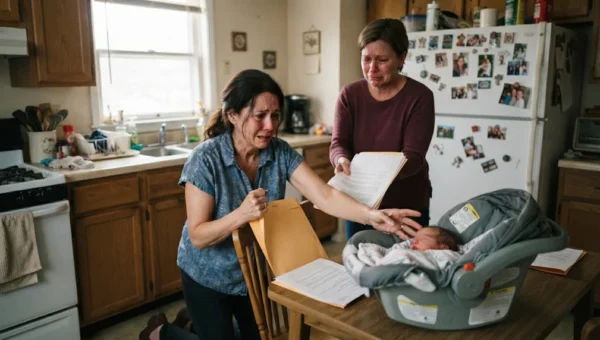
When I pushed through her unlocked screen door, she was sitting alone at the kitchen table in the gray afternoon light. Her hands were folded on the floral oilcloth, and she was crying quietly.
Without looking at me, she slid a yellow legal envelope across the table.
Inside was a state certificate of live birth, embossed with a blue county seal. It was not the pastel document tucked into the satin pocket of my baby book. It was from a municipal hospital in Marion, Ohio, a county facility I had never heard of, dated five days earlier than the birthday I had celebrated for thirty-two years.
I looked at the typed line beneath the hospital seal.
The mother’s name on the certificate was not Evelyn Davis. It was Margaret Rose Vance.
PART 2
The paper was stiff between my fingers. I pulled out a chair and sat down across from my mother, keeping my hand flat against my stomach.
“Who is Margaret Vance?” I asked.
My mother wiped her cheeks with a folded paper napkin. Her hands were spotted with age and shaking.
“She was your father’s younger sister,” Mom said, her voice barely above a whisper. “She died in 1994, Clara. You were four years old.”
I tried to reach back into my earliest memories. I remembered a woman with dark hair who lived in a small white house near the county line, someone we visited on Sunday afternoons in the summer. She always had a glass jar of lemon drops on her sideboard and let me sit on her porch swing. I had been told she was a great-aunt who passed away from pneumonia.
“Margaret had type B positive blood,” Mom said, staring at the salt shaker between us. “She was nineteen when she had you. She wasn’t married, and the man was an independent contractor from Pennsylvania who worked on the state route expansion for three months and left before she ever showed. Her own father told her that if she brought a child into that house without a husband, he would lock her out.”
“So you and Dad took me?”
“Your father and I had been trying for seven years,” Mom said, tears spilling freshly onto the table. “I had three late miscarriages. The clinic in Columbus told us my body couldn’t carry a child past twenty weeks. When Margaret went into labor alone at that county hospital in Marion, Arthur drove through the night to be with her. Margaret was terrified. She knew she couldn’t afford rent and formula on four dollars an hour at the dry cleaner, and she begged your father not to let you go into the state foster system.”
Mom reached over and touched the corner of the yellow envelope.
“Your father went to a private family attorney in Mansfield,” she said. “Margaret signed voluntary relinquishment papers, and the court issued an interlocutory decree of adoption. We brought you home six days later. We gave you the front bedroom, we had you baptized at our parish, and your father swore we would never treat you like an adoption story. You were our daughter from the second he carried you through the front door.”
“Why did you change my birthday by five days?” I asked.
“Because the legal custody transfer was signed on November twenty-seventh,” Mom whispered. “Your father wanted every school record, every insurance card, and every family Bible entry to match the day you officially became ours. He thought if there were no mismatched dates anywhere, no one in town would ever start rumors.”
“And the man from Pennsylvania?” I asked. “Did Margaret ever tell you his name?”
Mom pulled open the small drawer in the table where she kept receipts and rubber bands. She took out a tarnished metal key tag with a faded paper insert and laid it beside the Marion birth certificate.
Written in faded blue ink on the paper was a name: *Ray Miller – Crew 3, Keystone Paving.*
“Margaret kept that in her jewelry box until the day she died,” Mom said softly. “She gave it to your father right before she passed. He put it in the lockbox and told me to let it stay there. We thought we were protecting you, Clara. We never imagined a blood test thirty years later would bring it all back.”
PART 3
I drove home with the yellow envelope resting on the passenger seat.
Brian’s pickup truck was parked in the driveway when I got back. He had just walked through the front door, his navy work jacket hung on the hall peg, his work boots set neatly by the mat. He was standing at the stove, stirring a pot of canned soup for dinner.
When he heard the door shut, he turned around and smiled. Then he looked at my face, and the smile disappeared.
“Clara,” he said, walking straight over to me. “What is it? Did the clinic call back about that insurance bill?”
“The lab tests were right, Brian,” I said, my voice shaking.
Brian stopped, his brow furrowing. “What do you mean they were right?”
I laid the Marion birth certificate and the genetic sequencing profile on the kitchen counter right beside his keys.
“The baby is AB positive because I carry the type B allele from my biological mother,” I said. “My parents adopted me through private probate when I was six days old. Margaret Vance was my real mother. Arthur was my uncle, not my father. And my biological father was a road worker from Pennsylvania who had type B blood.”
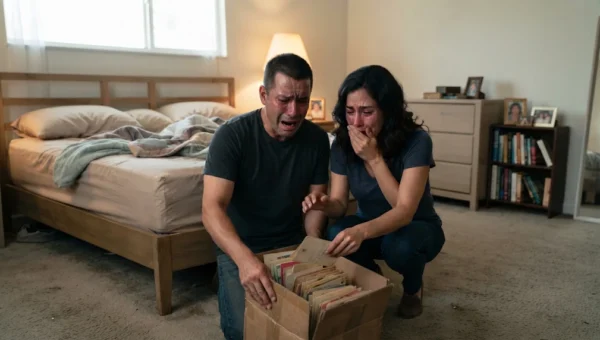
Brian stared down at the documents on the counter. He read the county seal, then looked at the genetic printout with the $8,400 test codes. He stood there in the quiet kitchen for what felt like a full minute, his chest rising and falling slowly.
Then he reached out, took my hands, and pulled me against him.
“Clara,” he whispered into my hair. “You spent two weeks carrying this by yourself because you thought I’d believe you cheated?”
“The doctor looked at me like I was a liar, Brian,” I sobbed into his shoulder. “He said you couldn’t be the father. The science said you couldn’t be the father.”
“I don’t care what that doctor looked like,” Brian said, holding me tighter. “I’ve known you since we were nineteen years old. I know who you are. We’ve been trying to have this baby for five years. If the doctors had questions, they should have asked your family history before handing you an eight-thousand-dollar panic.”
The next morning at nine, Brian took the morning off from the water department. He drove us down to Dr. Mercer’s office on High Street.
We didn’t wait for the receptionist to call my name for an exam. Brian walked up to the counter, asked for Dr. Mercer directly, and told the desk nurse that we needed five minutes in the consultation room.
Dr. Mercer came in carrying my thick paper file, his face guarded.
Before he could sit down, I placed the Marion certificate of live birth, the interlocutory adoption order, and the state genetic report flat in the middle of his desk blotter.
“The patient file needs an immediate correction,” I said, my voice steady and clear. “I am an adopted child. My biological mother carried type B blood, and my biological father carried type B blood. Brian Davis is the sole biological father of this child, and his type O status is completely compatible with my true genetics.”
Dr. Mercer picked up the Marion birth record. He read the names, checked the state seal against the dates on the lab analysis, and set the paper down slowly.
A dark flush of red crept up from his collar to his temples.
“Mrs. Davis,” he said, clearing his throat and looking at Brian, then back at me. “I apologize. When parental blood groups present an apparent incompatibility, clinical guidelines require us to investigate non-paternity before considering rare maternal anomalies.”
“Guidelines are fine, doctor,” Brian said, his voice flat and hard. “Assuming my wife broke her vows before asking if she was adopted is not. You ran eighty-four hundred dollars in specialized tests that our insurance won’t fully cover, and you sent my pregnant wife home shaking.”
Dr. Mercer looked down at the blotter. “I will personally write a medical necessity appeal to your insurance carrier today to ensure the genetic panel is covered under diagnostic protocol. And I will update your obstetrical records immediately.”
ENDING
We didn’t go looking for Ray Miller in Pennsylvania.
Whoever he was, he had left Marion in the summer of 1990, and Arthur Davis had spent thirty years being the only father I ever needed, teaching me how to drive on back gravel roads and sitting in the front row of every band concert I ever played. Finding an old road worker wouldn’t change the life I had or the home Brian and I were building.
Two weeks later, my mother drove down to our house on a quiet Sunday afternoon. She carried a small tin box that had belonged to Margaret, filled with old black-and-white family photographs and a silver locket with a dried clover inside.
She sat at our kitchen table, drank a cup of black tea, and told me about the sister who had loved me enough to let me go to a warm house with a full pantry. For the first time in thirty-two years, my mother spoke Margaret’s name without looking around the room to see who was listening.
Our daughter was born on a cold, bright morning in late January. We named her Margaret Claire Davis.
When the pediatric nurse brought the hospital discharge sheet into our recovery room for Brian and me to sign, I checked the small white box in the top right corner.
It was stamped in purple ink: *BLOOD TYPE: AB POSITIVE.*
Brian took the pen from the nurse, signed his full legal name on the line for the father, and leaned down to kiss our daughter’s cheek.
On our way home from the hospital three days later, Brian took the long way around town. He pulled the truck over by the cemetery gate on Route 4 where my father and Margaret were buried in the family plot, three rows apart.
The wind was cold, but the sun was clear on the snow. Brian stayed in the cab with the heater running, holding the baby against his coat, while I walked through the drifts to Margaret’s small granite marker.
I brushed the dry leaves away from the carved stone, laid two white winter carnations against the granite, and stood there for a minute in the quiet air.
“Thank you, Margaret,” I said softly to the cold stone. “She has your dark hair.”
Then I walked back to the warm truck, got into the passenger seat, and let my husband drive us home.