PART 1
My son was born healthy in 1998, or at least that was what the discharge papers told me.
He weighed seven pounds, four ounces. He had dark hair, ten fingers, and ten toes, and when they handed him to me wrapped in that pink and blue hospital blanket, the delivery room nurse smiled and said everything had gone smoothly.
My husband and I brought him home to our little two-bedroom house on Pine Street, thinking we were just another young couple starting a family.
By age three, the seizures started.
At first, it was just small staring spells while he sat on the rug playing with wooden blocks. His eyes would roll slightly upward, his little spoon would drop from his fingers, and for twenty seconds he was unreachable. Then came the grand mal seizures in the middle of the night, shaking his small frame until his lips turned blue while I dialed 911 with shaking hands.
Along with the seizures came the developmental delays. When other kids his age were speaking in full sentences and riding tricycles, David struggled to hold a crayon. He could barely manage three-word phrases by the time he was five.
We spent twenty-five years looking for an answer. We took him to pediatric neurologists in Columbus, genetic specialists in Cleveland, and metabolic clinics in Pittsburgh.
We tried specialized diets, anti-epileptic medications that cost six hundred dollars a bottle, physical therapy, occupational therapy, and speech training. Over the years, the out-of-pocket costs, the uncovered therapies, and the specialized equipment added up to $340,000. We remortgaged our house twice. We emptied our retirement funds. We gave up family vacations and drove ten-year-old cars with rusted rocker panels, all to keep David in therapy.
Every single specialist gave us the same blank look, tilted their head, and said the exact same sentence: “Sometimes these neurological disorders are idiopathic. There is no clear genetic or environmental explanation.”
Last year, when David turned twenty-five, the county adult disability board asked for his original neonatal records to recertify his long-term supportive housing benefits. The hospital where he was born, St. Luke’s Memorial, was a county-affiliated municipal hospital. I paid the $35 administrative fee and filed a formal public records request under the state open records law.
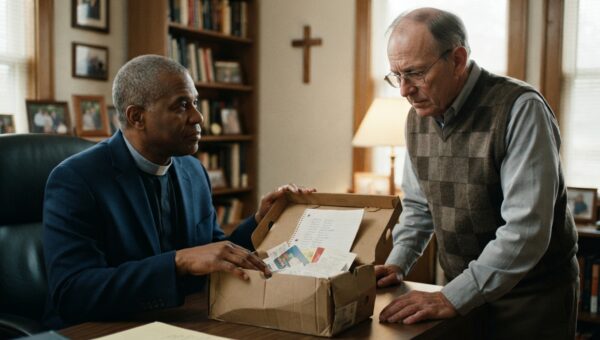
The records arrived four months later in a heavy, rectangular cardboard box.
There were 287 pages of microfiche prints, chart copies, and faded nursing flow sheets. I sat at my kitchen table on a rainy Tuesday morning with a pot of black coffee, turning the brittle, scanned pages one by one. Most of it was routine: fetal heart monitor strips, labor room temperature logs, blood pressure checks.
Then I turned to page 114.
It was an internal incident addendum, typed on yellowed carbon paper from the obstetrics floor, dated October 14, 1998, at 4:18 AM.
Tucked under a handwritten section labeled *Nursing Observations* was a note in tight cursive: “Infant experienced oxygen deprivation during delivery. 7 minutes. Cord compressed under maternal pelvic ledge during shoulder dystocia. Resuscitation bag applied. Apgar score adjusted from 2 to 7 post-stabilization. Attending physician Dr. Ronald Mercer instructed staff not to document in primary delivery record.”
I read it four times.
Seven minutes without oxygen. Seven minutes of an infant’s brain starving for air while a doctor stood over my bed, cleared the room, and ordered his nurses to falsify the state delivery log.
Twenty-five years of seizures, brain damage, and $340,000 in bills, all because a doctor covered up a seven-minute mistake.
My hands shook so hard I spilled my coffee across the counter. I called a medical malpractice attorney in the city named Mr. Callahan.
Callahan listened quietly as I read the note from page 114 over the phone. When I finished, he sighed into the receiver.
“Mrs. Davis, this is heartbreaking, and it is a blatant standard-of-care violation,” Callahan said. “But in this state, the absolute statute of repose for medical injuries runs out on a child’s nineteenth birthday, even in cases of fraud. The statute of limitations may have passed six years ago. It is almost impossible to pierce that shield after twenty-five years.”
Then he asked me to email him the complete file.
Ten minutes later, Callahan’s voice came back over the phone line, but the calm, detached legal tone was completely gone.
“Mrs. Davis,” Callahan said, his voice dropping low. “Look at page 203. There is a second note from a different nurse in the risk management audit log. Dr. Mercer did the exact same thing three months earlier to another baby.”
Callahan took a sharp breath, and then he read the name on that second incident report.
The mother of that other baby was someone I had known my entire life.
PART 2
“The patient’s name on page 203 is Brenda Albright,” Callahan said.
The phone pressed against my ear felt cold.
Brenda Albright was my older sister.
In July of 1998, twelve weeks before David was born, Brenda had delivered her daughter, Megan, at the very same hospital, with the very same physician, Dr. Ronald Mercer. Megan was born with severe spastic cerebral palsy. For twenty-five years, Brenda and I had raised our disabled children side by side in the same small town. We had carpooled to the county therapy pool every Tuesday afternoon. We had sat on my porch during long summer evenings, both of us exhausted, wondering what cruel twist of fate had struck two sisters in the same calendar year.
Our family had spent a quarter of a century believing that some terrible, unseen genetic defect ran in our bloodline.
I turned the stiff pages of the hospital record until I reached page 203.
It was an internal peer-review memorandum dated August 2, 1998, stamped CONFIDENTIAL RISK MANAGEMENT.
The report was signed by Nurse Supervisor Clara Higgins. She had written: *Review of July 9 delivery of infant Albright. Second incident of shoulder dystocia resulting in unrecorded fetal hypoxia. Dr. Mercer actively altered the delivery room Apgar summary and threatened attending nursing staff with termination if private risk management was notified. Hospital administration notified via closed executive memo.*
The hospital administration had known.
In July of 1998, they knew Ronald Mercer had botched a delivery, deprived a baby girl of oxygen, and threatened his staff to bury the truth. And instead of suspending his privileges, instead of reporting him to the state licensing board, the hospital board buried the incident report in a private filing cabinet to protect their liability insurance.
Three months later, they let that same doctor walk into my delivery room to do the exact same thing to my son.
I didn’t call Brenda. How do you tell your sister over a telephone line that the daughter she has fed through a gastric tube for twenty-five years was broken by a doctor our own family recommended?
I got in my car and drove the twelve miles out to Brenda’s farmhouse.
Brenda was out on her back patio, hanging laundry on the wire lines while Megan sat in her specialized wheelchair in the morning sun, listening to the radio. Brenda’s hair was mostly gray now, her hands worn rough from lifting a full-grown daughter in and out of bed every morning and evening.
I walked across the damp grass, carrying the thick yellow folder against my coat.
When Brenda turned around and saw my face, she dropped the clothespin in her hand.
“Ruth?” she said, wiping her palms on her apron. “What happened? Is David sick?”
“David isn’t sick, Brenda,” I said.
I set the folder down on the wooden patio table beside her laundry basket. I opened it to page 203, with page 114 right beside it.
“Read these,” I told her.
Brenda sat down on the bench. She pulled her reading glasses from her pocket and leaned over the photocopied records. I watched her eyes move across the typed lines, from Dr. Mercer’s name to the words *unrecorded fetal hypoxia*, down to the notes about her own labor on July 9th.
She read it once. Then she turned to page 114 and read the note about David.
She didn’t scream, and she didn’t cry right away. She sat completely motionless for two minutes, her fingers digging so hard into the soft pine of the picnic table that her knuckles turned white.
“They told me my pelvis was too narrow,” Brenda whispered. Her voice was cracked and hollow. “Mercer looked me in the eye the morning after Megan was born and told me that my body had failed my daughter. He told me it was my fault.”
“It was never your fault, Brenda,” I said, sitting beside her and putting my arm around her shaking shoulders. “He used forceps incorrectly, he compressed the cord, and the hospital let him do it again to David ninety days later.”
Brenda turned her head toward Megan, who was humming softly to the music from the radio, her twisted fingers resting in her lap.
“Where is Mercer now?” Brenda asked. Her voice wasn’t weak anymore. It was cold, sharp, and lethal.
“He retired seven years ago,” I said. “He lives in that brick colonial on the hill by the country club.”
“Call that lawyer, Ruth,” Brenda said, standing up from the table. “Call him right now.”
PART 3
Callahan met Brenda and me in his downtown office the next morning at eight.
He had spent the night reviewing state medical jurisprudence. He laid out three heavy legal volumes on his conference table, along with our children’s hospital records.
“The ordinary medical malpractice statute of limitations is dead,” Callahan explained, pointing to the statutes. “The defense will rely on the statute of repose, which normally cuts off all claims twenty years after the act, regardless of discovery. But there is a narrow exception under our state’s common-law fraud doctrine: fraudulent concealment with institutional conspiracy.”
He tapped page 203 with his fountain pen.
“When a physician commits malpractice, it is negligence,” Callahan said. “When a physician falsifies a state birth certificate and the hospital administration suppresses an internal peer-review memo to avoid insurance discovery, that is fraud. The statute of repose does not protect an ongoing criminal cover-up. We aren’t just suing Dr. Mercer for negligence. We are filing an institutional civil racketeering and intentional fraud petition against Mercer and the county hospital authority.”
Two days later, Callahan filed the petition in the county court of common pleas.
He didn’t file it quietly. Because the hospital was a publicly subsidized county facility, the open records basis of the filing made the complaint public record immediately.
By Friday morning, the local newspaper had the headline on the front page: *1998 Delivery Room Cover-Up Exposed in Double Infant Brain Injury Lawsuit.*
The county went into shock. The hospital’s legal defense team initially tried to file a motion to dismiss within forty-eight hours, claiming the records were confidential peer-review materials that were improperly disclosed under the public records request.
Judge Sarah Thornton denied their motion in a scathing four-page preliminary order.
“The court will not allow the statutory peer-review privilege to be utilized as a vault for the intentional concealment of medical misconduct,” Judge Thornton wrote. She ordered full evidentiary depositions from Dr. Ronald Mercer and the surviving members of the 1998 hospital risk management committee.
The deposition took place three weeks later in a conference room on the fifth floor of the county courthouse.
Dr. Ronald Mercer was seventy-six years old. He walked into the room with a silver-tipped cane, wearing a bespoke tweed suit and gold-rimmed glasses. He had spent thirty years being the most respected obstetrician in the valley, a man who had delivered half the town’s children, a man who sat on the board of the local bank.
He didn’t look at Brenda or me when he sat down across from Callahan.
Callahan didn’t warm him up with pleasantries. He placed the high-resolution scan of page 114 and page 203 on the table directly in front of Mercer.
“Dr. Mercer,” Callahan said, leaning forward. “Is that your signature on the medical clearance log for October 14, 1998?”
Mercer adjusted his glasses, looking down at the paper. “That was twenty-five years ago, counselor. I delivered thousands of infants. I cannot recall the specifics of every procedure.”
“Did you instruct Nurse Clara Higgins not to record seven minutes of fetal oxygen deprivation on David Davis’s delivery summary?” Callahan asked.
Mercer’s defense attorney immediately chimed in. “Objection. The document speaks for itself.”
“Answer the question, Doctor,” Callahan said, his voice hard as iron.
Mercer took a slow breath. He adjusted his silk tie, his hands trembling slightly on the mahogany tabletop.
“In the delivery room, decisions must be made under extreme duress,” Mercer said, his voice quiet, trying to maintain his professional authority. “Documenting temporary respiratory delays often causes undue panic for young mothers. It creates unnecessary administrative complications. If the infant stabilized to an acceptable Apgar, clinical discretion allowed for narrative adjustment.”
“Clinical discretion?” Callahan’s voice rose, echoing off the glass windows. “You had a peer-review reprimand on your desk from July 9th regarding Megan Albright. You were specifically warned by your department chief that your use of the vacuum extractor on compacted shoulders was causing severe cord compression. Isn’t it true, Doctor, that you altered these records because your personal malpractice coverage had already been canceled by your underwriter after three previous infant death claims in 1996?”
The room went dead silent.
Mercer froze. His face lost its color. He looked across the table at his attorney, his mouth opening, but no sound came out.
Callahan had found the missing underwriter records from the state insurance commissioner’s archives. Mercer hadn’t just been hiding a mistake from two mothers; he had been practicing without private liability coverage for two full years, protected only by an illegal, unwritten indemnification agreement signed by the hospital’s former chief executive.
“You knew David was hypoxic,” Callahan said, pointing his finger at the old doctor. “You knew Megan was hypoxic. You walked out of those delivery rooms, looked two sisters in the face, and told them their children were born broken because of their own bodies, just so you could keep your pension and your golf club membership.”
Mercer didn’t answer. He slumped back into his leather armchair, looking down at his polished shoes, completely destroyed by his own thirty-year-old paper trail.
ENDING
The hospital authority didn’t let the case go to a public jury trial.
Faced with the insurance fraud disclosures and the deposition testimony from Nurse Clara Higgins, who was eighty-two and living in Florida, the hospital’s municipal risk pool agreed to a formal, structured global settlement.
The county hospital board and Mercer’s estate agreed to pay a total of $14,200,000 to be divided equally into two comprehensive special needs trusts for David and Megan.
The settlement wasn’t about revenge. It was about security.
With that settlement, Brenda and I were able to pay off every single medical debt we had carried for twenty-five years. We purchased a fully accessible single-story home on three acres just outside of town, with specialized hydrotherapy rooms, widened doorways, and twenty-four-hour licensed home healthcare support.
For the first time in twenty-five years, Brenda didn’t have to ruin her back lifting Megan into the shower. For the first time in my adult life, I didn’t lie awake at three in the morning wondering what would happen to David when my husband and I were too old or dead to care for him.
His care is funded for the rest of his natural life.
Dr. Ronald Mercer’s name was formally stripped from the hospital’s obstetrics wing, and the state medical board issued a posthumous revocation of his emeritus credentials, entering the full fraud findings into the permanent national practitioner registry.
Two weeks ago, on a warm Sunday afternoon, Brenda and I sat on the back deck of our new house, drinking iced tea while David and Megan sat together under the shade of a large red maple tree.
Megan had her headphones on, smiling at the breeze, while David sat beside her with his photo album, pointing to pictures of his therapy dogs.
They will never be able to speak the words we fought to hear. They will never know why their bodies couldn’t run or why their childhoods were filled with ambulances and emergency rooms. But the shadow that hung over our family for twenty-five years is completely gone.
We were never broken. Our blood was never cursed.
I looked down at the table, where the yellow folder lay closed under my tea glass, resting quietly in the sun.
I picked it up, carried it inside to the corner desk, and closed the drawer for good.