PART 1
My husband, Richard, forgot our twenty-seventh anniversary on a Wednesday in September, but he remembered to send two dozen long-stem white roses to his executive secretary, Megan.
The florist van pulled up to our curb at eight in the morning while Richard was still in the shower. I signed the electronic pad on the porch, assuming the arrangement was for me.
But when I slid the little envelope out from the plastic fork nestled in the greenery, the card was addressed to Megan at his engineering firm downtown.
The front had a printed message congratulating her on five years with the company.
I had bought that exact box of blank floral enclosure cards at the stationery shop three weeks earlier because Richard always complained about florist markups. I recognized the gold border. But when I turned the stiff paper over, someone had written a second line on the back in purple ballpoint ink:
“Thank you for keeping my world running. Tonight at seven.”
The handwriting was not Richard’s. Richard wrote in tiny, cramped architect block capitals that looked like blueprint notes. This script was rounded, loose, and slanted to the left.
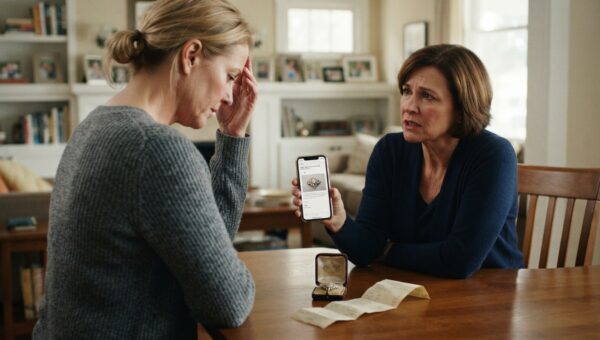
When Richard came down the hall buttoning his cuffs, I held the vase out to him.
“The driver almost left these here,” I said, watching his eyes. “And who wrote on the back of the card?”
Richard didn’t blink. He reached out, took the vase by the glass neck, and set it on the kitchen island.
“The girl at the counter must have mixed up the enclosures,” he said, checking his watch. “I dictated a note over the phone while I was driving yesterday, and the clerk probably scribbled something from another order on the back. It’s Megan’s five-year milestone, Laura. The partners agreed we should send something formal from the firm.”
“Today is the eighteenth, Richard,” I said.
He paused with his hand on his briefcase handle, his eyebrows pulling together for half a second.
“Right,” he said, giving me a quick peck on the cheek that barely grazed my skin. “Wednesday. Don’t wait up late for dinner. The highway widening project estimates are due to the county commissioners in the morning.”
He took the roses and walked out to his car.
I stood by the window and let him believe I accepted that answer. I had been married to Richard since I was twenty-six.
Over twenty-seven years, you learn that asking four questions in a row only gives a man time to smooth out his excuses. If you want the truth, you keep your mouth shut, keep the coffee brewed, and watch where the loose ends drop.
The following week, on a Tuesday morning while Richard was at a breakfast meeting with county developers, I pulled out the deep kitchen drawer beside the stove to clean out breadcrumbs from the wooden organizer.
The drawer wouldn’t slide all the way out. It stuck on the bottom runner with a dull scrape.
I got down on my knees on the linoleum, reached my hand underneath the cabinet frame to free the track, and my fingers brushed against a thick strip of heavy gray duct tape.
I pulled. The tape came away with a sharp tearing sound.
Stuck flat to the underside of the drawer bottom was a cheap black prepaid smartphone, switched on, its battery at eighty-two percent.
There was no security passcode on the home screen. There were no apps, no photos, and only one saved contact in the address book, labeled simply as M.
I opened the messaging thread.
The latest text had arrived at six-forty that morning, right as Richard was tying his necktie in the bathroom mirror:
“When she signs the papers, the escrow account at First National will clear in forty-eight hours. Don’t let her lawyer look at the trust amendment.”
PART 2
I knelt on the kitchen linoleum with the small black phone resting in the palm of my hand.
The words on the screen stayed sharp and steady: “When she signs the papers, the escrow account at First National will clear in forty-eight hours. Don’t let her lawyer look at the trust amendment.”
I scrolled up through the text thread.
The messages went back four months, starting in early June. There were no pet names or romantic pictures. It was pure business, cold and calculated, written in the same hurried, efficient shorthand Megan used on the office memos Richard brought home in his briefcase.
“Survey crew finished the parcel split,” Megan had texted on July 14.
Richard’s reply from the burner phone: “Make sure the deed lists the holding LLC, not the joint marital trust. Laura thinks it’s zoned agricultural.”
Another from Megan on August 29: “The title company wants her wet signature on the quitclaim before Friday. Tell her it’s for the property tax reassessment.”
I felt the blood drain straight down to my feet.
The property they were talking about was forty-eight acres of timber and rolling pasture out in Franklin County. My father had bought that land in 1974 with his army severance pay. When he passed seven years ago, he left the deed directly to me as sole heir, along with the old stone farmhouse where my sister and I had spent our childhood summers.
Two weeks ago, Richard had set a thick blue folder on the kitchen table while I was cutting green beans for dinner. He had told me the county was reassessing rural acreage, and that if we transferred the farm into a family asset protection trust, our annual property taxes would drop by forty percent. He had flagged five signature tabs with yellow sticky notes, asking me to sign them before Friday so his firm’s legal runner could file them with the county clerk.
I hadn’t signed them yet. I had left the folder on my sewing desk in the spare bedroom because the ink on the notary acknowledgment looked fresh and I wanted to read the fine print when my eyes weren’t tired from work.
Richard thought I was just dragging my feet out of carelessness.
I took out my regular phone, took clear photos of every single text message on the burner screen, capturing the timestamps, the phone number, and the message about the First National escrow account. Then I took a fresh piece of duct tape from the utility shelf, taped the burner phone back under the drawer in the exact spot where I had found it, and pushed the drawer shut.
At nine o’clock, I took the blue folder from my sewing desk, put on my coat, and drove downtown to the county courthouse.
I didn’t call Richard’s firm. I went straight to the office of Arthur Gable, an estate and title attorney who had handled my father’s probate seven years ago. Arthur was seventy-one, with white hair and a cluttered office that smelled of old legal volumes and pipe tobacco.
He put on his bifocals and spent twenty minutes reading through the pages Richard had brought home.
When Arthur looked up, his jaw was set hard.
“Laura,” Arthur said, tapping the fourth page of the packet with a yellow pencil. “This isn’t a family asset protection trust. This is a deed of conveyance and an irrevocable assignment of beneficial interest.”
“What does that mean in plain English, Arthur?” I asked.
“It means if you sign this page, you transfer full title of your father’s forty-eight acres to an entity called Riverbend Development Partners LLC,” Arthur said. “And Riverbend Development Partners is owned entirely by Richard Miller and Megan Vance.”
He turned the page toward me.
“The state highway authority is finalizing the corridor for the new commercial bypass,” Arthur continued. “The county approved the route three weeks ago in an executive session. That bypass cuts right through the eastern thirty acres of your father’s farm. The state has already allocated $840,000 for the eminent domain land acquisition. If you sign this quitclaim, that check doesn’t come to you. It goes directly to the LLC.”
PART 3
I sat in Arthur’s leather chair, looking at my father’s land mapped out in black and white surveyor lines across the legal parchment.
Eight hundred and forty thousand dollars.
Richard hadn’t bought roses for his secretary to celebrate an anniversary. He was celebrating a buyout. Megan wasn’t just an assistant typing invoices; she was his corporate partner, helping him funnel a state highway windfall away from our marriage before filing for divorce.
“What do you want to do, Laura?” Arthur asked quietly. “I can file an emergency cloud on the title this afternoon to block any transfer attempts.”
“Not yet,” I said. My voice was completely calm. “Does Richard know the title company checked the deed status today?”
“No,” Arthur said. “Title searches are public inquiry. No notice goes to the applicant until a formal defect is recorded.”
“Keep the folder here, Arthur,” I told him. “And draw up a complete revocation of Richard’s spousal power of attorney over my father’s estate. I will be back at four to sign it.”
I spent the next three hours at our bank.
Because our primary checking and savings accounts were held jointly with right of survivorship, I had full legal authority to move funds. I pulled our joint balance statements for the last twelve months.
Tucked into the electronic records was a series of six monthly transfers, exactly $2,500 each, moving from our joint money market into a commercial checking account at First National labeled “Riverbend Holding.” Richard had been using our household savings to pay the engineering and environmental assessment fees for the private development parcel.
I didn’t empty our savings. I withdrew exactly half of the remaining cash, fifteen thousand dollars, and deposited it into a new account in my name alone at the state credit union across the street.
Then I went back to Arthur’s office, signed the power of attorney revocation, and had him draft a formal notice of separate maintenance and an emergency lis pendens on the Franklin County parcel.
At six o’clock that evening, I was in the kitchen roasting a chicken when Richard came through the back door.
He looked pleased with himself. He hung his suit jacket on the coat hook, loosened his burgundy tie, and walked over to the kitchen counter where I was setting out the plates.
“Smells good, Laura,” he said, reaching into the refrigerator for a bottle of sparkling water. “Did you get a chance to look over that county tax paperwork? The runner from the title office is coming by tomorrow morning at eight to pick up the packet.”
“I looked at it, Richard,” I said, setting the salt and pepper shakers in the center of the table.
“Good,” he said, leaning against the counter. “Just sign on the yellow tabs tonight so we don’t have to scramble before work. It saves us six thousand dollars in property taxes this year.”
I walked over to the drawer beside the stove.
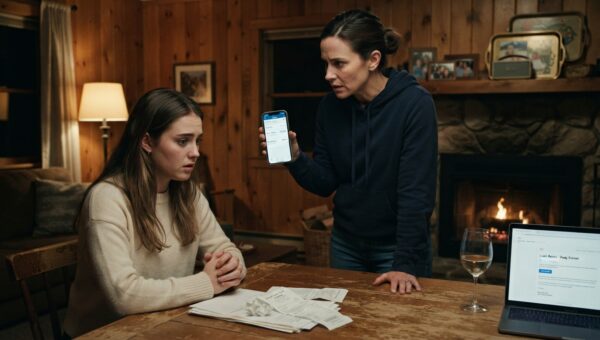
I reached underneath, peeled the gray duct tape away with a loud rip, and set the little black burner phone right on the granite island between his glass and the cutting board.
Beside the phone, I laid the certified title search Arthur had printed, with the name Riverbend Development Partners LLC highlighted in bright yellow ink.
Richard froze.
His hand stayed resting on the top of the water bottle. His eyes moved from the black plastic casing of the burner phone to the yellow highlight on the title paper.
For five seconds, the only sound in the house was the timer ticking softly on the stove.
“What is this?” he asked, though his voice had lost all of its practiced confidence.
“Megan texted you at six-forty this morning,” I said, looking right into his face. “She told you the escrow account at First National would clear in forty-eight hours once I signed the quitclaim, and warned you not to let my lawyer see the trust amendment.”
Richard’s mouth opened slightly. The color began to creep up his neck, a blotchy, dull red that reached his temples.
“Laura,” he stammered, his fingers tightening around the glass bottle. “You’re misunderstanding the structure. Riverbend is a blind holding trust. It’s designed to shield the family from liability during the highway construction. Megan is just the corporate administrator. Her name is on the registry for administrative filing convenience.”
“Megan owns forty-nine percent of the operating shares, Richard,” I told him, tapping the corporate printout Arthur had pulled from the secretary of state’s database. “And you used fifteen thousand dollars of our grocery and mortgage savings to pay the soil engineers.”
“It was an investment for our retirement!” he said, his voice rising, trying to regain the upper hand. “You don’t understand how commercial zoning works! The state is offering eight hundred and forty thousand dollars for that strip of woods! That money would have set us up for the rest of our lives!”
“It was set up for you and Megan,” I said. “My father left that land to me, Richard. Not to an engineering firm, and certainly not to your secretary.”
“You can’t prove that,” he snapped, his eyes narrowing as he stepped toward the island. “You went through my things. You stole a private company telephone from this house.”
“That telephone was taped to my kitchen cabinets,” I replied. “And Arthur Gable has already recorded a lis pendens on the county deed. The state highway acquisition officer was notified at two o’clock today that the title is in dispute. There will be no escrow payout to Riverbend tomorrow. There will be no payout next week. And you have until nine o’clock tonight to pack your clothes into your car.”
ENDING
Richard didn’t yell after that. The fight went out of him like air escaping a punctured tire.
He knew the legal ground had vanished beneath his boots. In our state, attempting to fraudulently induce a spouse to sign away separate inherited real property into a hidden commercial entity carries severe civil and criminal penalties, and Arthur Gable had made sure the county prosecutor’s civil division received a copy of the inquiry.
Richard packed three suitcases, his golf clubs, and his computer from the den. He tried to speak to me once while he was carrying his shoes out to his sedan, asking if we could sit down with a mediator to discuss a joint development agreement.
I didn’t answer him. I stood on the front porch with my arms crossed, watching him load the trunk in the dark.
He backed down the driveway at eight-forty-five, his headlights sweeping across the lawn, and turned toward the bypass.
The formal divorce was filed the following week.
Because the evidence of attempted asset concealment was overwhelming, Richard’s attorney advised him to settle without going before a judge. Under the final decree signed four months later, Richard surrendered all claims to my father’s Franklin County land, repaid the fifteen thousand dollars taken from our joint savings, and was ordered to cover my legal expenses.
Megan Vance resigned from the engineering firm three weeks after the title dispute hit the county records. The partners at the firm forced Richard to buy out her administrative shares to avoid a public ethics review with the state licensing board, costing him nearly sixty thousand dollars out of his private partnership capital.
From what my neighbor told me, Richard moved into a rented two-bedroom apartment near the airport and has spent the last year working seventy-hour weeks trying to rebuild his standing with the county contractors.
I kept the stone farmhouse.
When the state highway department finally completed the eminent domain process in the spring, the $840,000 acquisition check was issued directly to Laura Albright, sole owner.
I used a portion of the funds to put a new metal standing-seam roof on my father’s old house, repaired the field fencing, and invested the remainder into safe municipal bonds that pay enough interest to cover my living expenses for the rest of my life.
Yesterday afternoon was bright and clear.
I drove my wagon out to the farm. The October air was cool, carrying the sweet scent of fallen leaves and dry pasture grass.
I walked out to the edge of the east meadow, where the surveyor stakes marked the state corridor far down near the bottom trees. The rest of the forty-eight acres lay quiet and open under the afternoon sun, the stone walls my father had mended with his own hands standing solid along the property line.
I sat on the wooden fence rail with a cup of warm cider, watching two red-tailed hawks circle high over the timber.
My father always told me that good land doesn’t belong to the people who try to scheme it away on paper; it belongs to the people who know what it cost to clear the rocks.
I took a slow sip of my cider, looked out across the grass, and let the quiet sink in. The deed was in my safe deposit box, the bills were paid in full, and not a single foot of that ground would ever be signed away again.