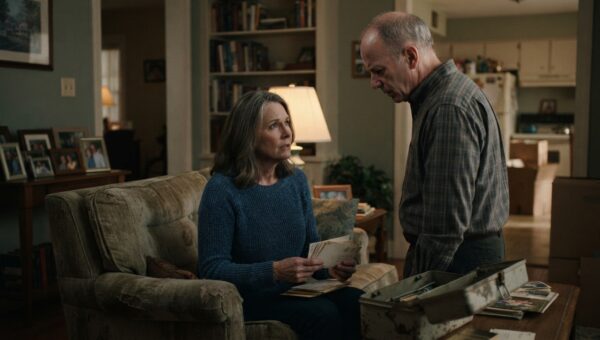
Forty years. That is how long Arthur and I had been sharing the same coffee pot, the same worn patch of hallway carpet, and the quiet rhythm of mornings that did not require many words.
On our fortieth anniversary, the sun came up over the ridge like it always did, cold and pale through the kitchen glass, and Arthur handed me a plain grocery store card with a grease smudge near the corner.
He did not look me in the eye when he laid it on the oilcloth table.
“I had been too busy to plan anything,” he said, his voice flat and dry as winter grass.
I smiled because disappointment had become easier than arguing. Forty years will teach you how to swallow things until your throat feels lined with sand. I told him it was fine, that we didn’t need a fuss, and I watched him pull his canvas jacket on over his flannel shirt and walk out to the truck to check the fence line.
That evening, after the sun had dropped behind the pines and the house had gone completely still except for the hum of the old refrigerator, I picked the card up to throw it in the trash. That was when I saw the date stamped near the barcode. It was wrong by one day, but more than that, the ink was faded in a way modern printers just do not do anymore.
I don’t even know why I bothered, honestly. I think part of me was just tired of pretending everything fit together neatly. I dialed the number for Miller’s Grocery down on Fourth Street, figuring the kid behind the counter would look at me like I was losing my mind.
The clerk, a young fellow named Toby whose voice still cracked a little, put me on hold for a minute before he came back. He checked the old paper receipt rolls they still kept archived in the back room for tax purposes. He told me that specific card stock had been bought twelve years earlier, right down to the month, along with a roll of cheap brown gift paper and a small cardboard box.
Twelve years.
I sat there at the kitchen table with the phone in my hand, listening to the dial tone start its steady, mechanical beep, and my brain just stopped working for a few seconds.
Twelve years ago, our life had felt ordinary. Arthur was working the timber yard, I was helping out at the parish hall, and our youngest had just finished college. Nothing had been on fire back then. Or so I thought.
I dropped my hand down to steady myself against the edge of the table, and my fingers brushed against something cold and hard taped to the underside of the wood.
It was an old brass key, held up by yellowed strips of masking tape, right in the exact spot where our kids used to hide their plastic army men when they were little. I pulled it loose, the tape peeling away with a dry ripping sound. I knew that key didn’t belong to the house. I knew it before I even stood up.
By nine o’clock that night, I was driving my old sedan down the empty county road toward the regional train station three towns over.
The dash lights flickered every time I hit a pothole, casting yellow shadows across the steering wheel. My hands were shaking so hard I could barely keep the gear shift steady, but my mind was terrifyingly clear.
The station was dark except for the amber security bulb hanging over the side entrance. Locker 114 was down at the very end of the brick corridor, tucked away in the shadows where the damp smell of old concrete and diesel exhaust hung heavy in the air. The brass key slid into the rusted lock with a heavy, satisfying click.
Inside the metal box sat a single navy blue suitcase. It was sized precisely for me, packed with my wool winter coat, three flannel shirts I thought I had lost during the move five years ago, and a pair of sturdy walking boots. Resting right on top of the folded clothes was a small white envelope with my name written in Arthur’s cramped, deliberate handwriting.
I pulled the note out under the yellow light. It began with a sentence that made my stomach drop right down to my boots.
“If you are reading this before Friday, do not let him leave alone.”
I stood there in that drafty corridor for a long time, listening to the distant rumble of a freight train rolling through the valley. Twelve years. Twelve years ago, Arthur had packed this bag, hidden the key under the kitchen table, and then walked back into our house, deciding to stay and swallow whatever poison was coming for us. And now, the clock had started ticking again. Friday was tomorrow.
I drove back home with the suitcase riding on the passenger seat, its hard shell clicking softly against the console every time I took a turn too sharp. The house was pitch black when I pulled into the gravel drive. Arthur was asleep upstairs, or pretending to be, his breathing slow and heavy through the ceiling boards.
I didn’t go up to the bedroom. Instead, I walked straight into his small study off the kitchen, turning on only the green-shaded desk lamp. The room smelled of pipe tobacco and old paper, the scent of a man who kept his thoughts locked behind his teeth.
I didn’t have to look long. In the bottom drawer of his walnut desk, pushed behind a stack of old tractor manuals, was a thin manila folder. Inside were the letters and the bank printouts. They weren’t from a bank in our state. They were from a collection agency in Richmond, tied to his estranged younger brother, Eli, a man who hadn’t set foot in our town since the nineties but apparently still knew how to sink a hook into our lives. Eli had run up a mountain of illegal gambling debts using a forged signature on a family land title, and the men he owed were coming to collect. The payoff demand was set for Friday morning at the county line. Arthur had liquidated our remaining savings account, every last dollar of our retirement cushion, to pay them off and keep Eli’s name out of the federal courts, and he had planned to walk out the front door alone tomorrow to take the full legal and physical brunt of the fallout.
He was going to trade his freedom for a ghost, and he hadn’t said a single word to me about it.
I sat in his leather desk chair until the green lamp began to hum in the pre-dawn stillness. My coffee went cold beside my elbow. I watched the red numbers on the digital clock crawl from 3:14 to 5:45, each minute feeling like a heavy stone dropped into a well.
When the floorboards upstairs finally creaked at 6:00 AM, I didn’t move. I heard Arthur’s heavy footsteps coming down the stairs, followed by the sound of him pulling his heavy canvas coat from the hook by the back door. He had his travel bag already packed by the coat rack, sitting right beside his boots.
He walked into the kitchen, looking older than forty years of marriage had any right to make a man look. His shoulders were bowed, and his face had that gray, hollow look of someone who had already said goodbye to the world in his own head.
He stopped dead in his tracks when he saw me sitting at the kitchen table with the open suitcase between us and the manila folder spread out across the oilcloth.
For a long time, neither of us breathed. The kitchen clock ticked against the wall, loud and harsh, measuring out the seconds we had left before the lie fell apart completely.
Arthur looked down at the suitcase, then up at my face, and the last bit of color drained right out of his cheeks.
“You found it,” he whispered. His voice was barely a rasp, the sound of a man whose armor had finally been beaten flat.
“Twelve years,” I said, and my own voice sounded strange to my ears, hard and level as a stone wall. “You packed a bag twelve years ago and you kept it waiting in a train station locker while you ate breakfast with me every single morning.”
Arthur reached out and gripped the edge of the kitchen table, his knuckles turning white. “I couldn’t let them touch you, Martha. Eli is my blood, but you didn’t sign up for his ruin.”
“We signed up for forty years, Arthur,” I said, standing up so the chair scraped loudly against the linoleum. “That means you don’t get to decide when you carry the whole world by yourself.”
He opened his mouth to argue, to give me one of his quiet, stubborn excuses about protecting me, but I didn’t give him the room. I reached across the table and tapped the edge of the note from locker 114.
“If you are reading this before Friday,” I read aloud, my voice steady now, cutting right through the quiet of the room, “do not let him leave alone.”
Arthur looked at me, really looked at me, for the first time in twelve years. The wall he had built around himself, brick by heavy brick, started to crack right down the middle. I saw the terror in his eyes, but I also saw the profound, exhausted relief of a man who finally put down a weight he had been carrying too long.
He didn’t say another word. He just let out a long, shuddering breath that sounded like a sigh of wind through dry cornstalks, and he walked over to the table.
We didn’t call the police right then, and we didn’t call a lawyer from the kitchen. We packed his travel bag back into the closet, right beside my winter coat, and we called our local attorney to set up an appointment for nine o’clock. We were going to face the debt together, open the books, and let the chips fall where they legally belonged, without him playing martyr in the dark.
By noon, the house was quiet again, but it was a different kind of quiet. The empty, battered suitcase was tucked away in the hallway closet, its contents finally unpacked and returned to their proper drawers.
The sun broke through the heavy gray clouds just as the afternoon shadows started to stretch across the yard. Arthur and I walked out the back screen door without a word and sat down side-by-side on the old wooden porch swing. He reached out, his rough, calloused fingers finding mine, and we just sat there holding hands while the wind rustled through the dry pine branches above us.