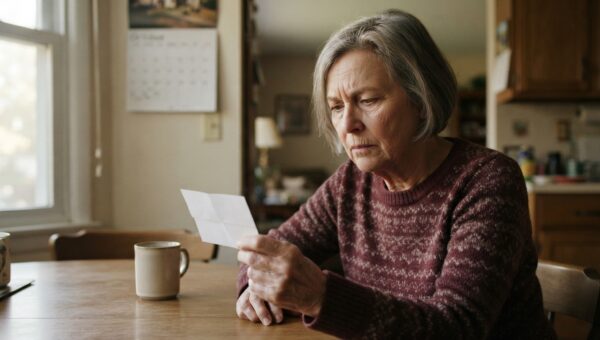
The fluorescent lights in St. Jude’s fourth-floor corridor had that annoying, high-pitched hum that always gave me a headache after about ten minutes. I was standing right outside room 412, holding a small plastic cup of lukewarm water the nurse had handed me, waiting for Arthur to finish talking to his doctor. Arthur is my father, though I have rarely called him Dad since I was old enough to realize that parents are supposed to show up when you need them.
He had been admitted three days earlier with some kind of stubborn lung infection that wouldn’t clear up, and when he finally called me, his voice thin and raspy through the phone speaker, he didn’t ask how I was doing. He just told me that before I was allowed to step foot in his room, I needed to swing by the diagnostic clinic down the block and complete a routine family health screening.
“Just get the blood draw, Clara,” he had told me, coughing halfway through the sentence. “It’s a precaution for visitors on this wing. They need a baseline.”
I didn’t think much of it at the time. Hospitals have all kinds of strange rules since the new regulations came down, and Arthur had always been obsessive about medical protocols anyway. He worked forty years as a procurement manager for the county water authority, a job that required him to treat every minor rule like a federal mandate.
So I drove down to the clinic on Oak Street, sat in the plastic chair under the humming vent, and let the tech find a vein in my left arm without asking questions. I had other things on my mind, mostly the quarterly inventory report I still had to finish for the bookstore downtown, and I just wanted to get the visit over with so I could go home.
Three hours later, my phone buzzed while I was unloading a shipment of paperbacks in the back room.
The caller ID said St. Jude’s Diagnostic Lab. I figured it was just billing asking for my insurance card number again, since my provider always manages to mess up the group code on the first try. Instead, a young woman named Brenda with a slightly nervous edge to her voice asked if I was Clara Vance.
“Yes,” I said, pausing with a stack of historical biographies in my arms. “Is something wrong with the paperwork?”
“Well, that’s actually why I’m calling,” Brenda said, her keyboard clicking softly in the background. “Your sample came through under your name, Miss Vance, but the primary file associated with the genetic markers you were tested against… it’s flagged under a completely different household name.
An address on Mill Street. And when I cross-referenced the insurance policy number, it turned out your Social Security number was linked to a pediatric and adolescent care claim history going back nearly twenty years.”
I set the books down on the metal sorting table. “I don’t live on Mill Street. I’ve lived on Hudson Street for twelve years, and before that I was in my mother’s house on Maple.”
“I know,” Brenda said, and her voice dropped an octave, the way people do when they’re about to tell you bad news they shouldn’t be sharing. “That’s why I pulled the physical file. The name on the patient intake form for the corresponding profile is Maya Hayes. And the billing code indicates this isn’t a visitor screening at all. It’s a familial DNA verification panel.”
I stared at the poster of local author events taped to the wall above the desk. The words didn’t mean anything for a second. “A what?”
“A family match test,” she repeated gently. “Someone ordered a direct profile comparison between your blood sample and an existing minor’s file stored in our legacy network under your father’s primary policy. Miss Vance… whoever set this up used your name on the requisition form to run the test without your knowledge.”
I didn’t answer right away. I told Brenda I would handle it, hung up the phone, and stood there in the quiet stockroom while the radiator hissed against the chill of an early October afternoon. The bookstore was empty except for Mrs. Gable ringing up a calendar near the front register, the little brass bell above the door chiming every time someone walked past. I felt cold all of a sudden, not the kind of cold that comes from a drafty window, but the heavy, sinking feeling you get when you realize a floor you’ve walked on your whole life was never actually solid.
Arthur had lied to me. Not about a small thing, not about where he left his car keys or whether he took his blood pressure pills, but about why I was really at that clinic.
I didn’t go back to Hudson Street. I got straight into my sedan and drove back to St. Jude’s, my hands gripping the steering wheel so tight my knuckles ached. When I pushed open the door to room 412, Arthur was propped up against two stiff pillows, staring out the window at the parking lot. He looked smaller than he had during my last visit six months ago, his gray hair uncombed, his hospital gown hanging loosely over his collarbones.
He didn’t look surprised when I walked in. That was the first thing that told me he knew I’d figured it out.
“You didn’t go back to work,” he said, his voice dry as sandpaper.
I pulled the folded printout Brenda had emailed to my phone straight out of my coat pocket and laid it across the tray table, right on top of his untouched cup of Jell-O.
“Care to explain why my name is on a file for someone named Maya Hayes?” I asked. My voice didn’t shake. I was surprised by how steady it sounded, like someone reading a shipping manifest.
Arthur looked down at the paper. He didn’t touch it. He just slowly turned his head back toward the window, watching a grey sedan pull into a visitor space below.
“You were never meant to see that file,” he said softly.
“No,” I said, stepping closer to the bed until the metal frame separated us. ” Brenda at the lab wasn’t supposed to call me either, I imagine. But she did. So now you’re going to tell me who Maya Hayes is, and why you’ve been running genetic matches against my blood using an insurance policy I haven’t been covered under since I turned twenty-six.”
Arthur closed his eyes for a long moment, his chest rising and falling beneath the thin blue cotton. The silence in the room wasn’t quiet at all; it was filled with the rhythmic hiss of the oxygen machine in the corner and the muffled sound of a cart rolling down the linoleum hallway outside.
“She’s your sister,” he said.
The words didn’t hit me like a blow. They hit me like a cold bucket of water thrown in the dark. I stood there, looking at the man who had raised me alone in that drafty house on Maple Street, the man who had always been so precise, so orderly, so fiercely protective of his privacy.
“My sister,” I repeated, the words tasting like metal on my tongue. “My mother didn’t have another child. My mother left town the summer I was born, Arthur. You told me that every time I asked. You said she couldn’t handle being a mother and just walked out the door one July morning.”
Arthur finally turned his head back to look at me, and for the first time in my life, I saw something in his eyes that wasn’t stubbornness or control. It looked like fear.
“Your mother didn’t leave because she didn’t want a child,” he said, his voice barely louder than the hum of the machine. “She left because she found out I already had one.”
The room seemed to tilt slightly, the gray linoleum floor drifting away for a split second before snapping back into place. I remembered the stories he used to tell about that summer, how the heat had broken the pavement on Main Street, how he had come home from his shift at the water authority to find an empty nursery and a note on the kitchen counter that said she couldn’t live a lie anymore. He had played the abandoned father for thirty-four years. He had worn that grief like a badge of honor, letting me grow up feeling like half a person, always wondering what was wrong with me that my own mother couldn’t stay.
“Maya was born four months before you,” Arthur whispered, staring at his call button like it was a lifeline. “Her mother and I… it was before I met your mother. Then things got complicated. When your mother got pregnant with you, I tried to end it. I thought I could keep the lines separate. I thought if I paid the bills, if I kept them in a small house over on Mill Street, nobody would ever have to know.”
“You used my insurance,” I said, my voice dropping to a whisper. “All these years, you kept a secondary policy active under my Social Security number to cover their medical bills.”
“She needed treatments, Clara,” he said, his voice rising with a flash of that old, defensive authority that used to make me back down when I was ten years old. “Maya has a kidney condition. It’s hereditary. The doctors caught it when she was a teenager. My county insurance wouldn’t cover a second household directly without a lot of questions from the auditors, so I used the family pool. I had to keep her alive.”
“And the test today?” I asked, feeling the coldness settle deep into my bones. “You needed a marrow or tissue match because your lungs are failing, didn’t you? You didn’t want a family visit. You wanted to see if I was compatible enough to save the daughter you actually cared about, using my own body without my consent.”
Arthur didn’t deny it. He just let his chin drop toward his chest, the silence stretching between us until the oxygen machine clicked twice.
“She’s your sister, Clara,” he repeated, as if saying it enough times would magically rearrange the last three decades of lies into something decent. “She doesn’t even know about you. She thinks I was just an old family friend who helped pay her tuition and hospital bills. I wanted to fix it before… well. Before this infection got the better of me.”
“You don’t get to fix thirty-four years of lies with a forged lab requisition,” I said.
I didn’t yell. I didn’t cry. I picked up the printed sheet from the tray table, folded it twice, and slipped it back into my coat pocket.
“The hospital administration is going to audit those insurance claims tomorrow morning,” I told him, looking down at the man who had engineered my entire life as a backup plan for a secret he was too cowardly to confess. “And I’m going to make sure the records are corrected. You can tell your doctors whatever you want, Arthur. But you won’t use my name to do it.”
I turned toward the door, my hand on the cold brass handle.
“Clara,” he called out, his voice cracking for the first time. “Did your mother ever tell you why she left town that summer?”
I stopped, my fingers resting on the metal, but I didn’t turn back around.
“She didn’t have to,” I said. “I finally know.”
I walked out of room 412, past the nurses’ station where Brenda was typing away at her computer, and pushed through the heavy glass doors into the cool October air. The sun was dipping below the roofline of the brick medical center, casting long, sharp shadows across the asphalt. My car was parked three rows down, the silver paint dull under the streetlights that were just starting to flicker on against the dusk.
It took me four days to sort through the administrative nightmare Arthur had left behind. With the help of a patient advocate at the billing office, I stripped my Social Security number off the Mill Street accounts, restoring the proper legal boundaries to my own identity and forcing the hospital to address Maya’s care through legitimate channels. I didn’t hate her. As I sat at my kitchen table looking over the redacted billing codes, I realized she was just another victim of the quiet, methodical deception Arthur had practiced for half a century. She was twenty-four years old, working part-time at a veterinary clinic on the south side of town, completely unaware that the man she called a family friend was her father, or that her older half-sister had just spent a week untangling the web of insurance fraud that kept her alive.
I found her address from the paperwork Brenda had given me. It was a small, faded duplex with a blue front door and a single pot of chrysanthemums sitting on the concrete porch step.
I didn’t knock. I didn’t want to show up on her doorstep like a ghost from a past she didn’t know she had, upending her life the way Arthur had upended mine. Instead, I sat in my sedan across the street for twenty minutes, watching her carry a bag of groceries up the steps, her red winter coat bright against the gray siding. She moved with a slight hitch in her left stride, a small physical detail I recognized instantly because I had the exact same way of walking when my knees acted up in the damp weather.
We share that much, at least. A limp, a blood type, and a father who thought he could rewrite human lives like inventory sheets.
When I got back home to Hudson Street, the evening paper was wedged in the screen door, and the house was cold because I had forgotten to turn the thermostat up before leaving. I set my keys on the small wooden table by the back door, right where I always drop them.
Then I noticed the unsealed manila envelope sitting on the kitchen counter.
It had been slid through the mail slot while I was out. Inside wasn’t a bill or a medical report. It was a thin, leather-bound notebook with faded blue ink on the cover, written in my mother’s neat, sloping handwriting, a journal from the summer of 1990, left behind in the attic of the old house on Maple Street before Arthur cleared it out last spring and forgot to throw it in the trash.
I poured myself a cup of black coffee, pulled out a wooden chair, and sat down in the quiet kitchen light. I opened the cover to the first page, where she had written the date in pencil just beneath the margin: *July 14. He thinks I don’t know about the house on Mill Street.*
I didn’t look up until the coffee went cold in the mug, reading every line in the fading light, finally understanding the distance between who my father pretended to be and who he actually was. The house was completely silent around me, but for the first time in my life, the silence didn’t feel like something waiting to break. It just felt like the truth, sitting right there on the table, waiting to be read.